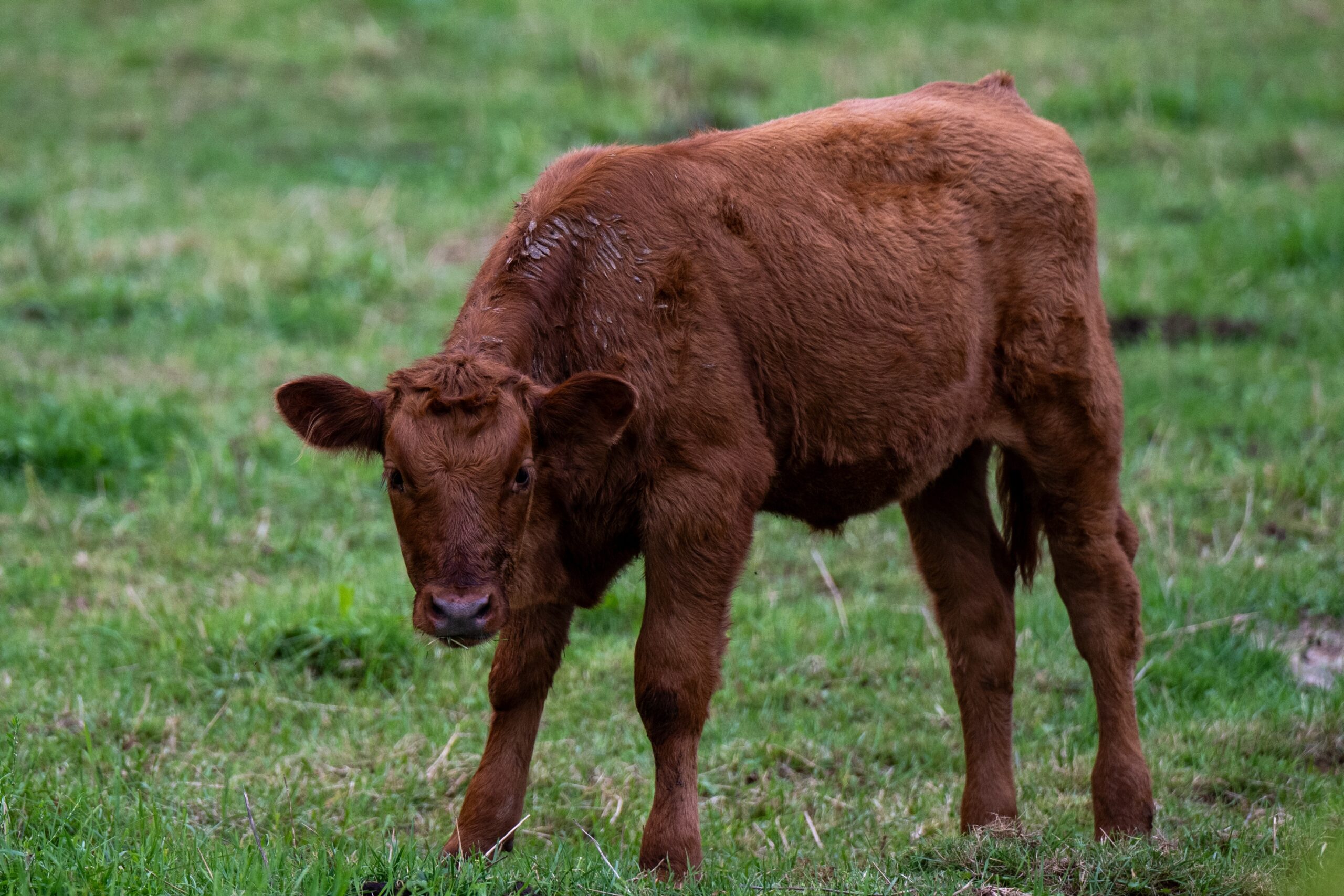
A red heifer born last month in the hills of the Galilee, sired by imported American semen and born to a black-coated mother, has reignited a coordinated national campaign among Israeli rabbis, breeders, and educators to restore the lost laws of ritual purity to the Jewish people. The campaign arrives at a moment when public appetite for Temple-related preparation appears to be surging: a recent survey found 55 percent of Israeli Jews now support rebuilding the Holy Temple on the Temple Mount, and a report published this week put the number of men enrolled in Temple service training at 150,000, out of a planned 200,000. “This is not a private event or private issue,” declared Yehuda Ben Tzvi, head of programming at the Mikdash Educational Center, in an interview with Joseph Good of Hatikva Ministries. The calf, he announced, is only one piece of a six-point national strategy the organization has spent the past year building, one Ben Tzvi insists must become “a national historical event” rather than the work of a small circle of activists.
The campaign’s appeal to ordinary Israelis is no longer confined to grassroots circles. On Sunday, Israel365 News published an editorial by Yosef Eitan reporting that the government has quietly called for training 200,000 men in the procedures of Temple service, with 150,000 already enrolled. The Israeli government itself has not formally endorsed the broader Temple movement, but the figures Eitan cited suggest the Israeli public increasingly has. Last week, Israel365 News reported on a new survey commissioned by the Temple Mount Heritage Foundation and conducted by the Direct Polls Institute, which found that support among Israeli Jews for rebuilding the Beit HaMikdash (Holy Temple) on Har HaBayit (the Temple Mount) now stands at 55 percent.
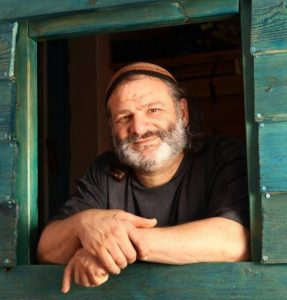
Ben Tzvi, who lives in Jerusalem overlooking the Temple Mount and descends from a family of Leviim (Levites), opened the conversation by describing his life’s work. “I spend my nights and days reminding myself, the Jewish people, and the rest of the world to love Jerusalem, never forget Jerusalem,” he said, before turning to what he called “an epic historic two years” for the Jewish people. “It’s not all about arms and strength and the military effort,” Ben Tzvi said, “but it’s also about faith, about the inner strength, remembering who we are, why we are here, what is the destiny of the Jewish people.”
“Tip to Toe 100 Percent Pure”
The centerpiece of the interview is the new calf, discovered by a team member of the National Red Heifer Institute who works at a breeding farm using semen imported from the United States. “Fascinatingly enough,” Ben Tzvi said, “a beautiful red heifer was born around a month ago, and she was, funnily enough, discovered by one of our team members from the National Red Heifer Institute.” He emphasized the unlikely genetics involved. “A red heifer born from a black Angus, but she was tip to toe 100 percent pure.” The calf has been named Tamima, meaning whole or unblemished. “We named her Tamima in a prayer that she will remain Tamim, whole, both in body and in redness of her coat,” Ben Tzvi said.
The law of the red heifer, parah adumah in Hebrew, comes directly from the book of Numbers: “This is the statute of the law which the Lord has commanded, saying, Speak to the children of Israel, that they bring you a red heifer without spot, in which is no blemish, and on which never came a yoke” (Numbers 19:2).
Ben Tzvi explained why an animal that sounds common is, in practice, nearly impossible to produce. “A red heifer is not so rare,” he said. “It’s actually something which is found throughout, for example, Canada, hundreds of thousands of red Angus are bred throughout in huge pastures.” The disqualifying factor is the ear tag. “By law, you must place an ear tag upon birth upon the newborn calf, which practically makes 99 percent of cattle, which you reach over a week’s age, not worthy for the ritual, because they have a blemish, a hole in their ear.” When the Galilee calf was found already tagged, Ben Tzvi acted immediately. “I said to Shahi, immediately get those tags out of there,” he recalled. “The next day, eight years of age,” referring to days old, “she already didn’t have any tags, and we are now waiting to see if the blemish will heal 100 percent.”
The second obstacle is color retention. “He has to keep it 100 percent red coat until it’s two years of age,” Ben Tzvi said, “plus most red Angus grow white hairs” within a year and a half. “We spent months researching the subject.” Even five red Angus cattle brought to Shiloh years earlier failed the test. “They’ve also grown white hairs in their tails.” Rabbi Azariah Ariel, head of the Halacha Institute, has proposed a laser-based solution. “He brought forward a proposition to use a laser to burn the stems of the white hairs,” Ben Tzvi said, “in order we will definitely be sure that they will not grow white or black hairs instead of the red.”
Good identified Rabbi Ariel’s lineage on air. “His father has been the leading sage on the Holy Temple since 1987,” Good said, “and actually, he was one of the paratroopers in 1967 when the Temple Mount went back to the people.”
“Even More Rare Than the Red Heifer”
The second of the six components, Ben Tzvi said, is harder to secure than the heifer itself: a ritually pure kohen (priest). “Any kohen today, at least the people in the synagogue, is considered a kohen,” he said, “but a pure kohen is nearly unheard of, because he has to be born outside the hospital.” Contact with death, even indirect, disqualifies. “Any closeness to a dead body, whether by touch, like a graveyard, or with a tomb, or in a vicinity in a hospital where somebody passed away, that would turn the entire body within the hospital impure.”
A small number of families have raised sons under these conditions from birth. “They have had their son born at home,” Ben Tzvi said, “and throughout his life have made the effort that he would never step, not in a hospital, definitely not in a graveyard, and over every trip they would ask and consult of an expert, is this area considered an impure zone, or is it clear.”
He described how easily the effort can collapse. “One family had four sons who, when they’re teenagers, one day somebody passed away in the building, and the whole family were considered impure,” Ben Tzvi said. “We had nothing we could do.”
Despite the risk, the institute now has a candidate. “Thank God, there is a pure Cohen who we definitely keep in secret,” Ben Tzvi said. He recounted a recent close call. “Just a while ago, our kohen, who, again, is 100 percent pure, went to visit a family in the hospital. He didn’t enter the hospital himself, but he drove into the car park to allow his wife to enter.” The team scrambled to determine whether the parking lot counted as part of the impure zone. “We went through severely to understand, was there a dead body in the vicinity or not? And thank God, the hospital was free of any impurity at the time, but it could have so easily been otherwise.”
A Balcony Over the Mount of Olives
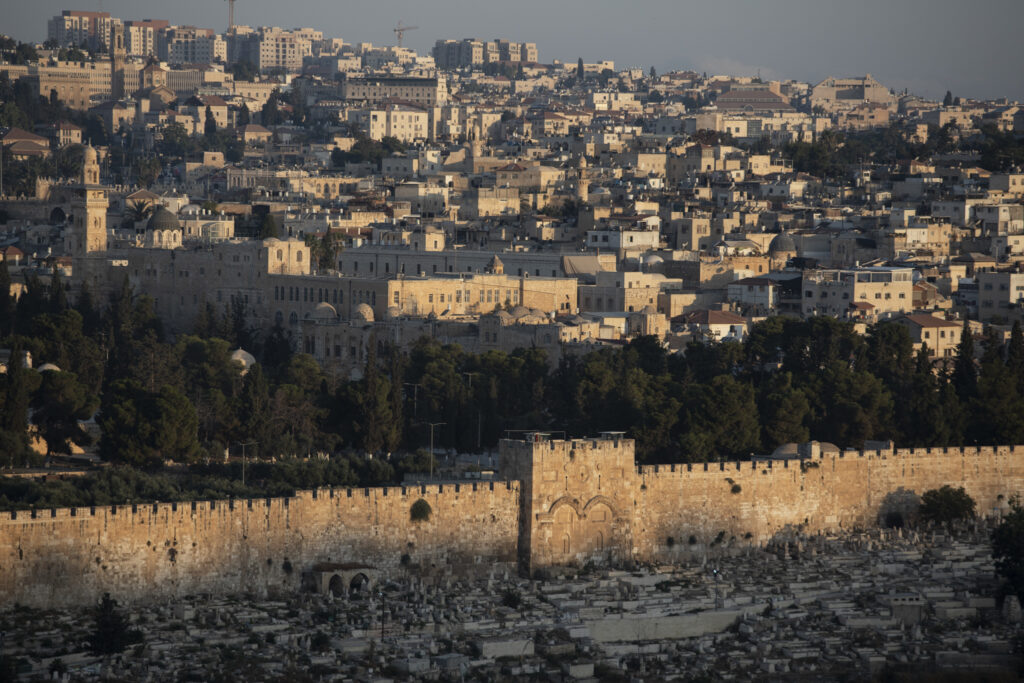
The third required component is the precise spot where the heifer must be burned, a location requiring direct line of sight to the site of the Temple itself. “The Cohen stands facing this point, where his eye can see clearly the place of the temple,” Ben Tzvi said, “and there he sprinkles seven times in the blood of the heifer, and only there can the ritual be done.” That requirement points to the Mount of Olives, the only ground east of the Temple Mount high enough for the sightline. The historical site, Ben Tzvi said, now sits beneath a church partway down the mount, a location he doubts will be made available. As an alternative, he raised a recent proposal. “Why don’t we build a balcony on the eastern side of Temple Mount?” he said, describing it as a platform that could host the ritual without requiring entry onto the holy site itself.
“It’s a National Institute. It’s a National Effort.”
Ben Tzvi was blunt about why three working components are not sufficient. “This is not enough,” he said. “It’s a national institute. It’s a national effort, which needs three more components.”
The fourth is halachic backing built on national consensus. The institute has assembled twenty rabbis devoted to resolving questions left unanswered for two thousand years. “They are taking ten or more important selected dilemmas, which we need to reach conclusions to give practical guidance to the program, and they are step by step reaching conclusions by democratic resolution,” Ben Tzvi said. In their first month and a half, the panel reached conclusions on three subjects, one of which directly addressed whether a reconstituted Sanhedrin is required before the ritual can proceed. “Although until the Sanhedrin are reestablished in Israel, it is not obligatory to have their presence recreating the red heifer ritual,” Ben Tzvi said, “but a great effort must be done to make it a national event. We are not representing ourselves, we are representing the entire sides of the Jewish people of the nation.”
The fifth component is public awareness, built through media, an expanding educational park at Mini Israel between Tel Aviv and Jerusalem, and direct outreach. “Anybody interested in making more videos or interviews is welcome to make contact,” Ben Tzvi said. He also warned against a widely circulated story from the previous July describing an alleged red heifer rehearsal. “It was 100 percent far from being anything up to standard,” he said. “It was far away from Jerusalem, nowhere close. The Cohen wasn’t 100 percent pure at the time. He drove in a car from the spring to the actual point. It finished long after dusk.” He praised Good directly for his role in countering such misinformation. “You are definitely a trustworthy source, which I very much appreciate.”
The sixth component is funding, and on this point, Ben Tzvi was emphatic that the campaign will not accept money from non-Jews at this stage. “We are not asking for funding from any non-Jewish pocket,” he said, “because we believe that first and foremost the t=Temple and our covenant with God stems from the relationship between the Jewish people and God.” He described the project in concentric terms, beginning with the Jewish people and expanding outward. “Once its temple is built, the circles can resound. Once we’ve made the inner circle, it can stand to the outer circle, all creating God’s presence within the Jewish people, bringing blessing to the nations… around the world.”
“Why Does Anybody Care So Much About a Red Heifer?”
Toward the close of the interview, Ben Tzvi addressed the deeper purpose behind the campaign. “It’s all about the relationship and the closeness between us and God,” he said. “How are we able as human beings to have His presence dwell within us?” He framed the return to the land of Israel as setting the stage for this next step. “Once the Jewish people have moved from after 2,000 years of exile to a new step in the life and the story of the Jewish people, creating a homeland and a nation here in Israel, it makes a great change where we can aspire to create a nation [in] which God dwells in our midst.”
He described the Temple’s structure in intimate terms. “The Temple is drafted just like a home. We have the lantern, we have a table. The Holy of Holies is twice named in the Bible, the bedroom, the intimate close connection between God and the Jewish people.” At the same time, he stressed its universal reach. “The courtyards around the temple in the Temple Mount can definitely encompass all humanity, Muslim, Christian, Hindu, any God-fearing person asking to stand for his maker and praying to God.”
Ben Tzvi closed with a direct call to action. “Please purify your hearts, be righteous, care for the people around you,” he said, “and please God, as humanity, we will have the merit of having God dwell within us and of the full redemption.” He ended the interview looking ahead to the calf’s second birthday. “Please God, we are to from here in Jerusalem declare the victory of life, recreating purity here in Jerusalem.”