
The government has quietly called for training 200,000 men in the procedures of Temple service. 150,000 have already enrolled. This comes as Israel continues daily operations against Hamas terrorists and internal debates over priorities on the Temple Mount. Sixteen years after the exiles returned from Babylon, the work on the House of GOD had stalled while the people paneled their own homes. At that moment, the prophet Haggai delivered a direct message from Hashem.
The Question of Readiness
How does a nation resume the service when the priesthood remains naive in execution, and the people must first master every detail from the daily offering to the procedures assigned by lot? The answer lies in the pattern given through the prophets and the assurance that accompanies obedient preparation.
How Hashem Commands the Tamid
The daily tamid offering required more than priests performing rites in isolation. Hashem commanded that every Jew participate as the actual offerer through the ma’amad, the men of the station. Twenty-four divisions rotated representatives from each district. A minimum of ten adult males from each district stood in the Court of Israel and declared the offering aloud.
The Tosefta Ta’anit records their words. We are the emissaries of Israel. This offering is from us and from all Israel. The kohen responded Blessed is Hashem. He accepts you.
This was no symbolic gesture. The Bible states the obligation clearly. This is the offering by fire which you shall offer to the Lord, two lambs of the first year without blemish, day by day for a continual burnt offering. The one lamb you shall offer in the morning and the other lamb you shall offer at dusk (Numbers 28:3-4).
The language you shall offer addresses the entire nation, not the kohanim and Levites alone. Hashem placed the duty squarely on the people of Israel. The ma’amad fulfilled that command. Hundreds stood on ordinary days. More filled the courts on festivals. Rotation ensured that, over time, every community and nearly every individual would touch the national gift to Hashem.
The tamid was a korban tzibur, a public offering carried by the people themselves. The priests facilitated according to their watches, but the offering belonged to every Jew from Dan to Beersheba. This is how Hashem wants the tamid brought. Not by proxy alone but through direct national representation. Every Israelite stood as an emissary. Every family sent its representative. Every district declared that this is from us. The duty is not outsourced. It is owned by the whole house of Israel. This model stirs the desire to participate once more. The people themselves declare the gift. The people themselves stand accountable. The acceptance comes when the offering rises from the entire nation.
The Scale of Current Preparation
The current training push mirrors this model on a national scale. Just as every eighteen-year-old serves in the Israel Defense Forces, the Kohanim must send their sons into systematic preparation for the avodah. The Sages describe how the lottery assigned tasks each morning. One kohen could draw the incense one day and slaughter the next. Every member of the priestly division needed mastery of the entire courtyard protocol.
Silent execution inside the Azarah left no room for instruction or correction. The High Priest rehearsed his Yom Kippur service repeatedly during the week of separation. Current re-enactments show competence in parts but fail to integrate seamlessly. These are not minor flaws. In the days of the functioning Temple, such errors invalidated the offering or carried grave consequences.
The altar itself, once kindled in proper avodah acquires permanent sanctity. It does not descend. It must rest on the bedrock of Mount Moriah, according to the tavnit, without temporary props or relocation. The Sages and Rambam insist on exact adherence. Any deviation treats the holy as common and risks the judgment that fell on Nadav and Abihu or Uzzah.
The Prophets Demand Precision
The prophets spoke directly to these requirements. Ezekiel received the vision of the future House and was told to show it to the house of Israel so they would measure the pattern and be ashamed of their iniquities. The command to study the measurements and gates precedes construction. Widespread knowledge across the nation fulfills that step.
Isaiah promised that foreigners would build the walls while kings minister in favor, yet the inner courts remain the domain of precise Israelite service. Zechariah addressed the high priest Joshua. Thus says the Lord of hosts if you will walk in My ways and keep My charge, then you shall rule My house and have charge of My courts. The condition remains walking in the ways and keeping the charge without shortcuts or improvisation.
Malachi closed the line of prophets with the promise that once the sons of Levi are purified, the offering of Judah and Jerusalem will be pleasing to the Lord as in the days of old and as in former years. Purification comes through correction of practice, not through continued tolerance of error.
Leadership and Collective Duty
Leadership bears primary responsibility. Silence when opportunities for the Passover offering arise shares in the guilt described in Leviticus. If a person hears the voice of an oath and is a witness whether he has seen or known of the matter, if he does not speak out, he shall bear his iniquity. The people cannot fulfill the perpetual statute of the korban Pesach without access and without trained kohanim ready to act.
Private announcements of training represent progress, yet the public must demand that the study translate into functional readiness rather than endless rehearsal.
Holy and Common Must Remain Distinct
The distinction between holy and common remains nonnegotiable. The Western Wall plaza lies in the ancient Court of the Gentiles below the level of the Temple platform. Calling it Ezrat Yisrael or treating it as the inner court erodes the boundaries the Bible demands. Leviticus commands to distinguish between the holy and the common. The true Ezrat Yisrael stood within the Azarah, adjacent to the altar, and was open only to pure Israelites.
Preparation includes restoring those distinctions as shown in the tavnit given to Moses and Ezekiel. Partial simulations on incorrect locations or with disqualified animals fail the standard applied to the red heifer in Mishnah Parah. Exact location on the Mount of Olives facing the Temple porch, proper slaughter by a kohen, and communal ownership without external claims preserve the integrity required for purification of ashes.
The Assurance in the Work
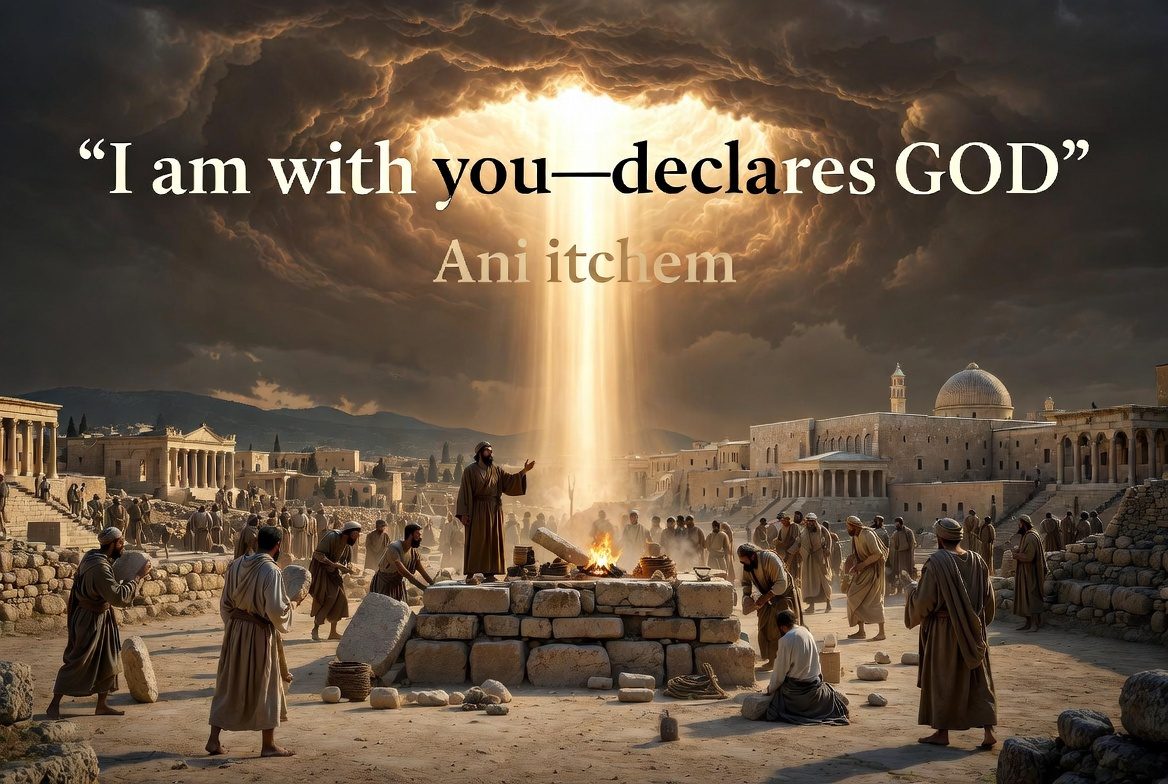
The exiles in Haggai’s day faced drought, poor harvests, and opposition after laying the foundations. They had begun the work, yet turned to their own houses. The prophet delivered the word on the first day of the sixth month. The response came quickly. Zerubbabel, Joshua, and the remnant obeyed. They feared the Lord and set to work twenty-three days later. The assurance came immediately. I am with you, declares GOD.
The same presence accompanies the work of preparation today. The prophets did not promise ease or instant completion. They demanded exactness and collective commitment. The ma’amad taught that the tamid belonged to all Israel. The training now underway must produce the same result. Every Jew learns the procedures. Every Kohen masters the service. Leadership enables rather than obstructs. When the altar ascends on the proper foundation with flawless execution, it stands forever. The offering then rises as acceptable as in former years.
The Path Forward
The prophets spoke with one voice in this sequence. Study the pattern. Purify the practice. Distinguish the holy. Resume the offerings. The word given to Haggai holds. I am with you, declares GOD. The nation that internalizes every detail of the avodah and acts with precision will see the House restored and the service accepted. The time for mere discussion has passed. The work of preparation must advance to completion.