



In the shadow of ongoing war in the north, something rare emerged from a dairy farm tucked into the hills of the Galilee: a calf that was, against every genetic expectation, entirely red. No black hairs. No white hairs. Just the burnished copper coat that has made the parah adumah, the red heifer, one of the most sought-after animals in the history of the Jewish people.
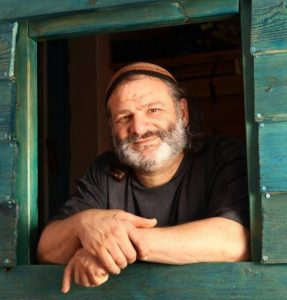
Shai Givon, a specialist in artificial insemination at the company Piryon, discovered the calf. He had bred the dairy cow with semen from a Red Angus bull nine months earlier. This time, Givon wasn’t working alone. He is now part of the National Institute for Red Heifer Research, a body established to bring together halachic scholars, cattle specialists, and researchers under one roof as a national-scale project focused on the biblical commandment. Yehuda Ben Tzvi of the Mikdash Educational Center, one of the institute’s founding members, described the moment Givon called him with the news.
The genetics behind Temima’s coloring deepen the sense of the improbable. The mother was a dairy cow bred for black-and-white Holstein coloring. In standard cattle genetics, the black coat gene is dominant. When a black or dark-coated dairy cow is crossed with a Red Angus bull, the offspring will almost always express the dominant dark coloring of the mother’s breed. A fully red calf emerging from such a crossing is a genetic outlier, possible in theory, but vanishingly rare in practice. Givon himself, a professional who performs this procedure routinely across farms throughout the north, had never seen it happen. “I impregnated the parents with black Angus,” he told Ben Tzvi, “and the fact that it came out red is astonishing.”
He also knew, from hard experience, how easily potential can be destroyed. Fifteen years ago, a red heifer was born in his herd and was disqualified after black hairs were found along the edges of its body, its ears, and its tail.
“He said to me: ‘I have fascinating news, but also unfortunate news. We found a red heifer born in the Galil unexpectedly. I myself inseminated the parents with black Angus, so the fact that she came out red is astonishing,'” Ben Tzvi recalled. “It comes down to genetics, which we’ve also been researching. I’ll use the word miraculous. It’s nature, but it’s not expected to happen so perfectly.”
What followed the birth, however, introduced a complication that goes to the heart of why producing a qualified red heifer in the modern world is so difficult. A farm worker, unaware of the calf’s potential, placed an identification tag in her ear, a routine act on any commercial farm. In the world of the parah adumah, it was anything but routine. The tag caused a deformity. Givon recognized the problem and had the tag removed eight days later.
“The one who found her is Shai, who is part of our team,” Ben Tzvi said to Givon. “Ben Tzvi instructed Givon to remove the tag. “Miraculously, she was born in a religious kibbutz with a religious farm manager, so it was pretty easy to have the tag removed, and now she’s under proper care.”
The moom, the blemish, is the defining disqualifier in the laws of the red heifer. As this writer noted in The Return of the Red Heifers: Paving the Road to Redemption: “Industrial farming methods can inadvertently create disqualifying conditions, and the need for constant supervision from birth makes the search even more complex. Authorities require ear tags and branding, both of which constitute blemishes that disqualify calves from the ceremony. The combination of perfect coloring, unblemished physical condition, and a complete absence of use makes finding a suitable red heifer one of the rarest occurrences in Jewish ritual life.”
The ear tag placed on this calf is precisely the kind of collision between modern agricultural law and ancient ritual requirement that has made the red heifer program one of the most technically complex endeavors in contemporary Jewish religious life. What the state mandates, the halacha may forbid.
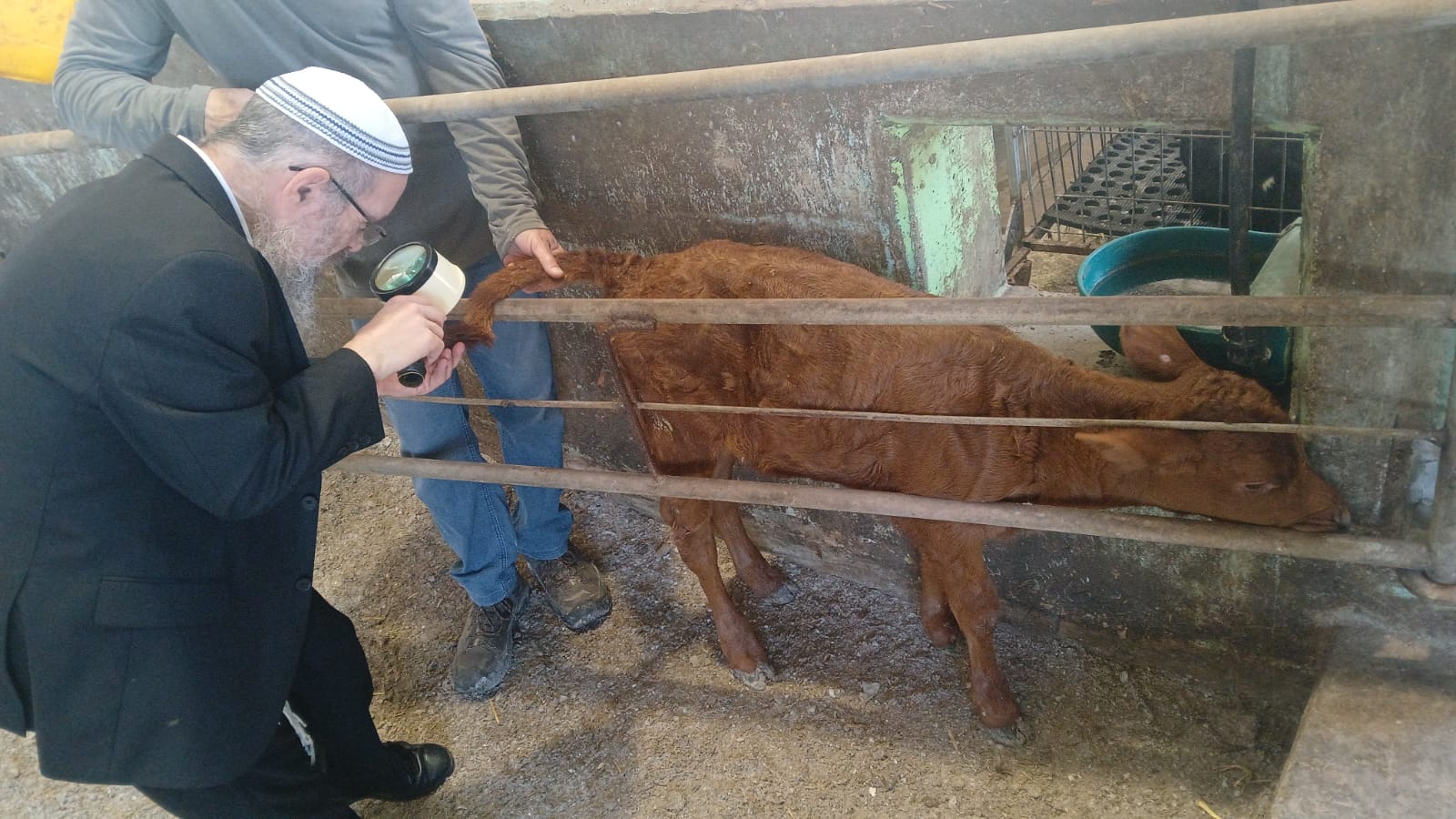
Last week, Rabbi Azaria Ariel, head of the institute’s beit midrash and a scholar who has spent more than fifteen years researching the laws of the red heifer, formerly as director of the Temple Institute’s Red Heifer Project, conducted a comprehensive examination of the calf. He found her coat pure in its redness and was encouraged by the healing rate of the affected ear.
“This past week I went with Rabbi Azaria Ariel, who is our central halachic authority,” Ben Tzvi said. “She really did turn out to be red in all her hairs. As for the wound from the tag, we can see it is healing very positively. A special cream was applied to help it heal, and the wound is recovering rapidly. Please God, it will heal properly.”
Following the examination, the institute named her Temima, meaning wholeness, purity, completeness, and is an expression of prayer as much as description.
The halachic question now is whether Temima can live up to her name.
Rabbi Ariel has expressed the view that electrolysis could be used to remove disqualifying hairs that grow due to melanin deficiency, provided the heifer was born fully red, and the hairs remain few and scattered. The genetics of this particular calf work in her favor: her parents carry a tendency toward black coloring, which, paradoxically, reduces the likelihood of white hairs appearing in a calf whose coat is already red.
The question now before the institute’s beit midrash, its study hall of approximately twenty Torah scholars, is whether the ear’s recovery from the deformity is sufficient to restore the heifer’s status, or whether the moom created by the tag constitutes a permanent disqualification. Ben Tzvi explained the scope of the halachic undertaking the institute has assembled to resolve such questions.
“We have ten major issues which we are resolving,” he said. “We began the syllabus just a month ago, and thank God we’ve already reached agreement on two subjects.”
The first concerns the Kohen Tahor, the pure Priest, who will perform the ceremony. He is not a theoretical figure, but a real man already identified by the institute. “He’s a practical person who has kept himself his entire life from severe tumah: born at home, never entered a graveyard, never entered an area considered tamei from a dead body, and trained very carefully for the Red Heifer ceremony,” Ben Tzvi said. “He’s a fascinating person.” The beit midrash ruled that this Kohen must receive the blood of the heifer in his own hand, not in a vessel, before sprinkling it toward the Temple site.
The second ruling addressed one of the most commonly raised questions about the entire enterprise: whether the ceremony requires a reconstituted Sanhedrin. “The conclusion reached was that since the Sanhedrin has not yet been restored in Israel, it is not obligatory,” Ben Tzvi said, “though great effort must be made to make this a national event, not a private enterprise. It must be a national story with the broad interest of the Jewish people. We are therefore doing everything we can to arouse interest, awareness, and connection to this extraordinary mitzvah.”
The beit midrash will now turn to an equally exacting question: the precise halachic definition of when a wound has sufficiently healed to restore a heifer’s status, which is a discussion that Daf Yomi students encountered only last week in their daily study cycle.
The broader context in which Temima was born is not incidental. The National Institute was established in direct response to the increasing proximity of these preparations to real possibility. Among its founding team, alongside Rabbi Ariel and Ben Tzvi himself. The institute sees its mission as nothing less than national transformation.
“We are doing everything we can to elevate the Jewish people to another stage toward full redemption,” Ben Tzvi said.
This is not the first time the preparations have reached an advanced stage. In September 2022, five red heifers were flown from Texas to Ben Gurion International Airport by the Temple Institute and Boneh Israel. In July 2025, a practice burning was conducted at an undisclosed location in Samaria, using a heifer that had been ruled disqualified due to non-red hairs, to rehearse the precise procedures specified in Jewish law. The actual ceremony may only be performed at a specific location on the Mount of Olives in Jerusalem.
The commandment itself is recorded in Numbers 19:2: “This is the statute of the Torah which the Lord has commanded, saying: Speak unto the children of Israel, that they bring you a red heifer, faultless, wherein is no blemish, and upon which never came a yoke.”
From the time of Moses, who personally prepared the first heifer, until the destruction of the Second Temple, only nine red heifers were prepared in all of Jewish history, yet this was sufficient to maintain the ritual purity of the entire nation for nearly two thousand years. The Rambam, Rabbi Moshe ben Maimon, wrote in his commentary on the commandment that “the tenth red heifer will be accomplished by the king, the Messiah; may he be revealed speedily, Amen, May it be God’s will.”
The institute’s own statement framed Temima’s birth in the language of national transformation. During the forty years of desert wandering, the red heifer ceremony marked the transition from the generation that left Egypt to the generation that would enter the land. That generation had to bury its past, literally, and emerge purified, ready for their historical destiny under the leadership of Joshua. The institute sees an echo of that moment in the present: a nation that has spent months absorbing the losses of war, now watching as the instruments of purification take shape in the hills of the Galilee.
“We are the Red Heifer National Institute, which brings together experts who have been working on the Red Heifer issue over the past decade,” Ben Tzvi said. “We’ve come together as a unit with the goal of turning the whole issue into a national event, restoring purity to the Jewish people.”
The conversation turned to whether the land of Israel itself has halachic significance for the red heifer. Ben Tzvi’s colleague clarified that the concern applies to the Kohen performing the ritual, not to the animal. “Living animals are always pure until they’re dead,” he explained. “A heifer can never become tamei while it’s alive; she could even walk through a graveyard on the way to the ceremony, and it would have no bearing on her status.”
The location of the ceremony on the Mount of Olives is another open question before the beit midrash, and Ben Tzvi was careful not to press into sensitive territory. The most historically precise site, the spot believed to be where the ritual was performed two thousand years ago, is today occupied by a Christian church, and the chances of securing access to those premises are, in his words, “very, very nearly impossible.” The institute has therefore focused its attention on the halachic parameters that define an acceptable alternative.
“We seem to think that any place pointing directly east of the Golden Dome is the correct place, so long as it is higher than the Golden Dome, even if it is within a few tens of yards north or south,” he said. “We have found a specific area which falls within those limits, and we still think it is a very strong candidate. We are waiting for the beit midrash to reach its final conclusions, but things are moving forward, thank God, more than I would have expected.”
Temima herself is three weeks old, born just as the Jewish calendar entered Parshat Chukat, the Torah portion that contains the commandment of the red heifer. Ben Tzvi did not treat the timing as a coincidence.
“We are small people with an almighty God,” he said, “and my feeling with this subject is that He is pushing us further and greater than I would have gone with my own small hands.”
At the current rate of development, a qualified window for a ceremony could be possible in approximately two years. Ben Tzvi was measured about what lies ahead. “The practical preparations — we do our best. But we’ve realized, as a national Red Heifer Institute, that you need more than just the red heifer, the pure Kohen, and the specific space for the burning. You need national halachic backing, national awareness and interest in the subject, and the financial capacity for a national event. If those come together in two years’ time, we will be able to tell the Jewish people: we are ready.”
He paused, then added: “Slowly, I believe God is moving the whole story to where He wants it to go. We do our best to prepare ourselves and be acquainted with His will, for the prosperity and blessing of the Jewish people and the entire world.”
Temima still faces the long road to qualification. She must reach two years of age without developing a single white hair, without carrying a yoke, and, the question now foremost in the beit midrash, without a moom that cannot be healed. The tag is gone. The ear is healing. Twenty scholars are studying. And in a dairy farm in northern Israel, a red calf carries a name that is also a prayer.
