




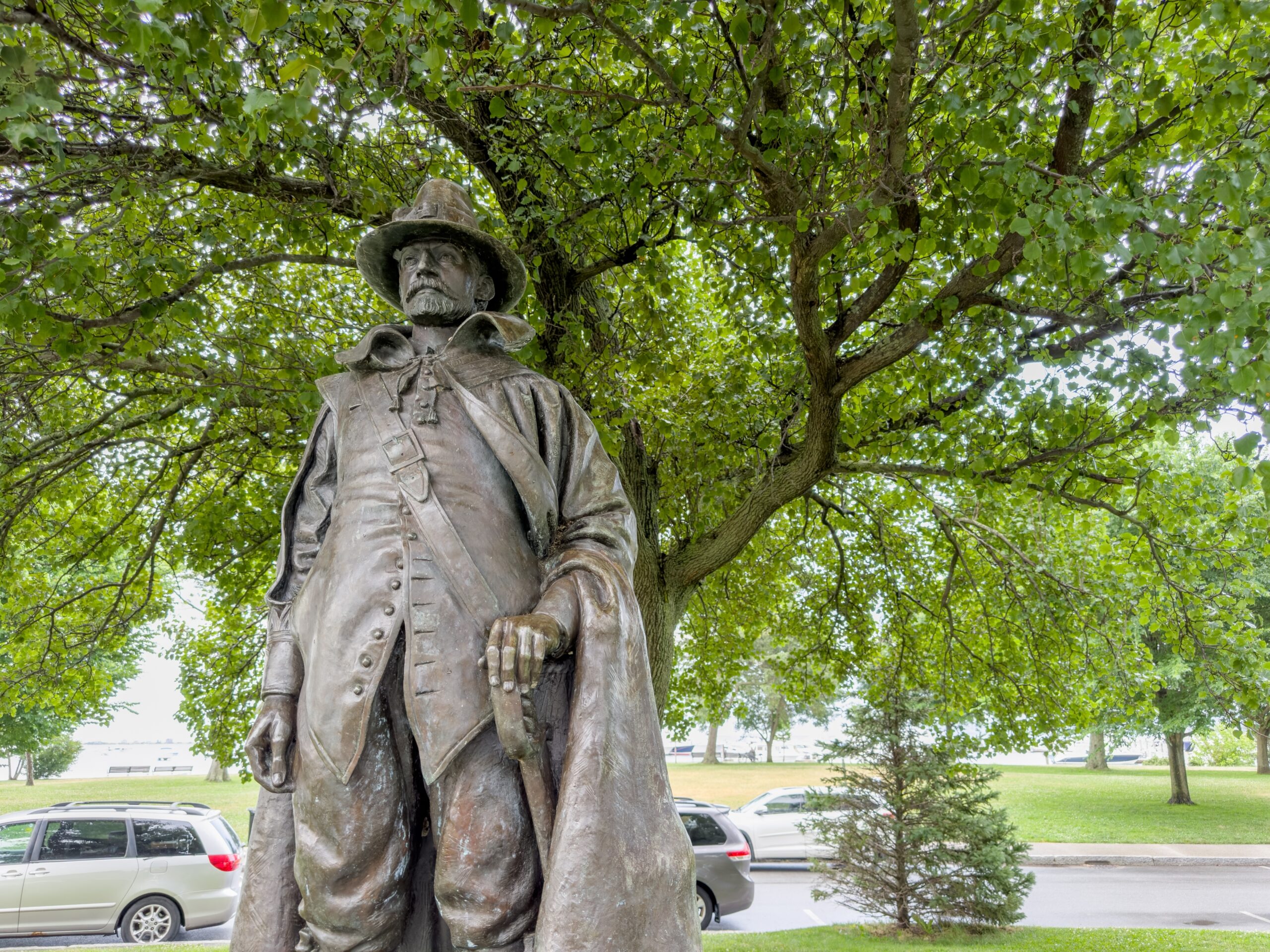
A governor goes back to school
Near the end of his life, William Bradford, the governor of Plymouth Colony and the man who recorded the story of the first Thanksgiving, sat down to learn Hebrew. He was well past sixty, a man who survived a brutal ocean crossing, buried friends, and watched half his community die in their first New England winter (Of Plymouth Plantation).
On the opening pages of his own handwritten history, Of Plymouth Plantation, he copied out Hebrew words and verses beside their English meanings in a careful, unpracticed hand. He explained why in a short note: though he was now old, he still longed to see with his own eyes something of the holy tongue in which God first spoke to the patriarchs (William Bradford, Of Plymouth Plantation, manuscript front pages).
The question at your table
This Thursday, tens of millions of Americans sit down to the holiday Bradford’s people made famous. Most will say a few words of thanks before the turkey, and almost none of them will think about where that habit came from.
Bradford knew. He read his English Bible for decades, and it was not enough for him. Something in those ancient pages pulled an exhausted old man toward a new alphabet, at an age when most people stop learning anything at all.
So what did he expect to find in the Hebrew that he could not find in the English?
The offering that outlasts all the others
In the Temple in Jerusalem, a person who survived danger brought a special sacrifice called the todah, the Thanksgiving offering. The Sages named four people who owe God that kind of thanks: someone who crosses the sea, someone who crosses the desert, someone who recovers from serious illness, and someone who walks out of prison (Talmud, Berakhot 54b). Now hold that list up against the Mayflower. Bradford’s people crossed an ocean and buried their sick, and years earlier, some of them sat in an English jail for trying to leave (Of Plymouth Plantation). They lived three of the four lines on the todah list.
The Bible even gives the offering its own song. Psalm 100 opens with the words mizmor l’todah, “a psalm for the thanksgiving offering,” and then tells us how to walk into God’s house: “Enter His gates with thanksgiving, His courts with praise; give thanks to Him and bless His name” (Psalm 100:4).
The English hides a double meaning. Todah comes from a root that means both “to thank” and “to admit.” In Hebrew, saying thank you is a confession. It means acknowledging that you did not get here on your own strength, that your harvest, your health, and your safe arrival came from somewhere above you.
The Sages took that idea one step further. They taught that in the time to come, every other offering will cease, but the Thanksgiving offering will never end (Vayikra Rabbah 9:7). Sin offerings answer a broken world, but gratitude keeps its place even in a perfected one.
From year’s beginning to year’s end
There is one verse in the Bible that tells us how God spends His time. Describing the Land of Israel, Moses says: “It is a land which the LORD your God looks after, on which the LORD your God always keeps His eye, from year’s beginning to year’s end” (Deuteronomy 11:12).
That verse inspired Rabbi Tuly Weisz to create the Israel Bible. If God keeps His eyes on Israel every day of the year, the people who love His Word can do the same, reading Scripture with the Land, the People, and the God of Israel at the center.
The Jewish people have practiced a version of this for thousands of years. Every week, synagogues across the world read the same portion of the Five Books of Moses, finishing the cycle each year and starting again from Genesis. A Jew in Jerusalem and a Jew in Johannesburg read the same words on the same Sabbath, so no one reads alone.
Bradford had to learn a new alphabet to get close to that kind of reading, and today you can start without one.
A year in the Bible, at our lowest price
For Black Friday, we are offering our Israel Bible bundle at its lowest price of the year: $159.99, down from the $259.99 for the set alone.
Here is what you get. The complete Israel Bible in 20 lightweight softcover volumes, every book from Genesis to Chronicles, with the Hebrew text beside a clear English translation, full-color photos and maps of the places you read about, and commentary that puts Israel at the center. Each book stands on its own, so you carry only the one you’re reading.
The bundle also includes the 52-Week Journey Through the Israel Bible, which puts you on the same weekly reading cycle the Jewish people have followed for generations, and a full year of Bible Plus, our library of video courses from Bible teachers in Israel.
It makes a remarkable gift for the Bible reader in your family, and an even better gift to yourself if 2027 is the year you finally read the Bible the way Bradford wanted to.
Get the Israel Bible bundle for $159.99 by clicking here
What Bradford was looking for
Bradford never became a Hebrew scholar. His notes in the front of that manuscript are the work of a beginner. But he understood something most people at a Thanksgiving table miss: people first spoke the words of thanks we say every November in Hebrew, in the Temple in Jerusalem, after crossing seas and deserts and living to tell about it.
When you say todah, you admit that every good thing on your table came from God. When you open the Bible to the words He first spoke, in the Land He watches from year’s beginning to year’s end, you go looking for Him the way Bradford did.
He started past sixty, copying Hebrew letters by hand. This Thanksgiving, with all 20 volumes of the Israel Bible along with 52-Week Journey Through the Israel Bible and Bible Plus courses on sale for Black Friday, you have every advantage he lacked, and a whole year ahead to use them.
Get the bundle here.
