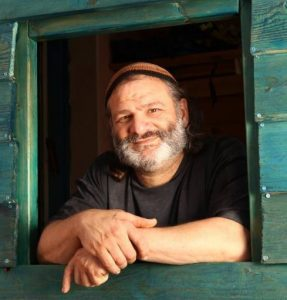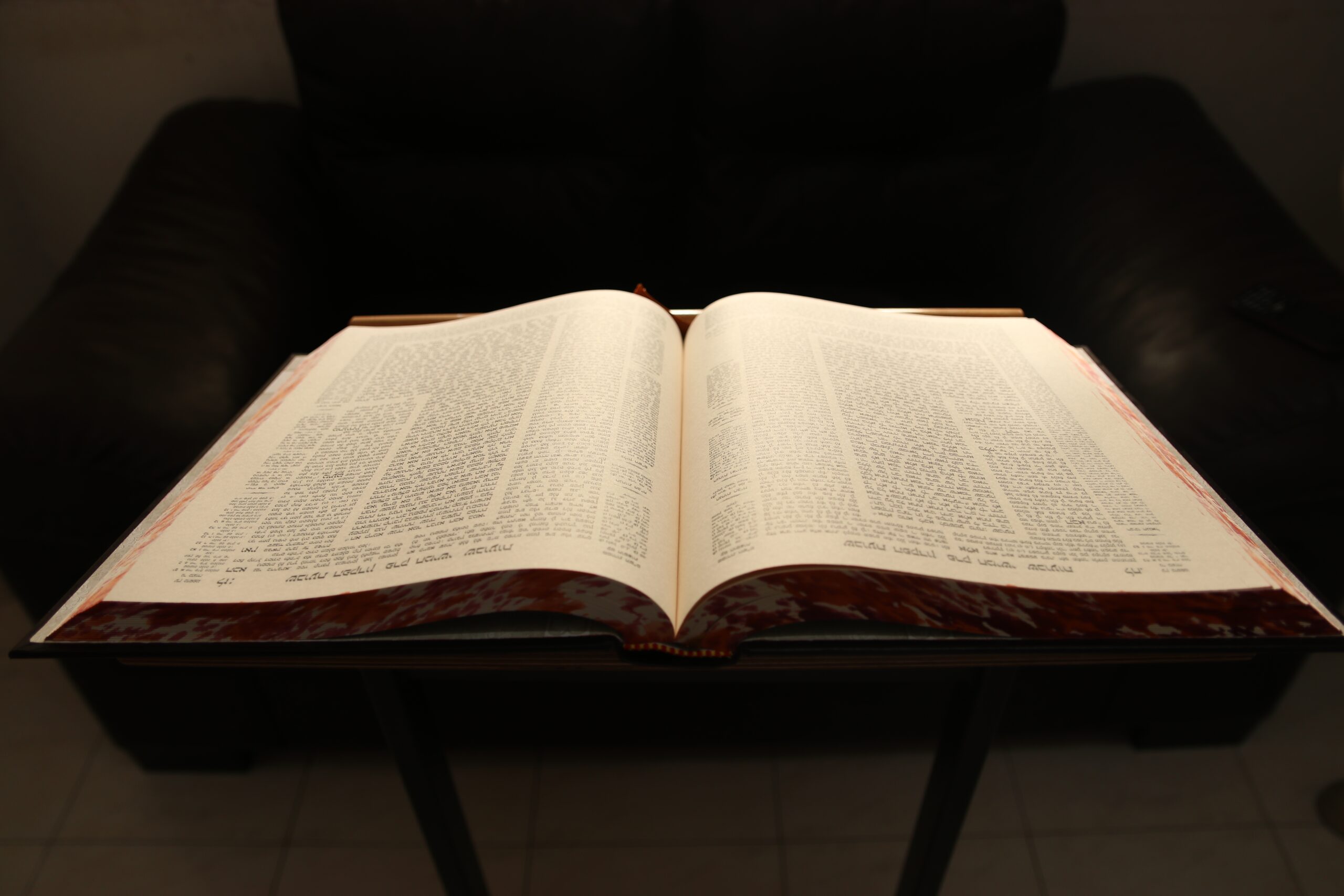
The Talmud, which many Christians were taught to fear as a man-made perversion of God’s word, teaches that a non-Jew who studies God’s commandments is like the High Priest of Israel. Rabbi Elie Mischel explains why the book they fear holds the missing details of the Bible they love.
An Orthodox Jewish woman once offered to teach a room full of Christians about the Bible. One woman in the room agreed to join on one condition: no Talmud. Asked what was so bad about the Talmud, the Christian woman answered that it was “full of demonic evil witchcraft and immorality.”
Rabbi Elie Mischel, director of education at Israel365, told the story at the opening of a new teaching on the Israel Bible YouTube channel. He said that versions of that charge fill the channel’s comment sections every day.
“People write to me and they say, ‘You Jews, you don’t actually follow the Bible. You follow the rabbis. You follow the Talmud, a book that’s written by men,'” Rabbi Mischel said. “For a lot of good, sincere, Bible-loving Christians, the Talmud is not just a book they happen to disagree with. It’s something dark and sinister, a perversion of God’s word. Now, of course, they’ve never actually looked at a Talmud.”
“We Jews built our entire way of life on that Talmud,” he said. He warned his viewers that the answer might make some of them uncomfortable. “I personally think that being uncomfortable is the price of truth.”
His answer is a direct challenge to Christian critics. The Talmud holds the explanation of the very Bible they love, and the Talmud itself honors non-Jews who study God’s word. The book many Christians were taught to fear contains the details of the commandments they are trying to keep.
Headlines without the story
Rabbi Mischel began with a challenge: open the books of Exodus, Leviticus, and Deuteronomy and try to keep the commandments using the written text alone.
The Sabbath comes first. “Six days shalt thou labour, and do all thy work; but the seventh day is a sabbath unto the LORD thy God, in it thou shalt not do any manner of work” (Exodus 20:9-10). Violating the Sabbath carries the death penalty in the Bible, yet the text never defines melacha (work).
“Are you allowed to cook a meal? Are you allowed to carry your keys down the street? Are you allowed to switch on a light?” Rabbi Mischel asked. “The Bible never once defines the single most important word in the sentence. You would think that’s pretty important to know.”
The Sages answered that question by linking the Sabbath to the building of the Tabernacle, which the Bible places side by side with the Sabbath command. The Mishnah (Shabbat 7:2) lists 39 categories of forbidden work, each drawn from the labor of building the Mishkan (Tabernacle).
The festival of Sukkot revolves around a command to take “the fruit of goodly trees” (Leviticus 23:40). “Is it an apple tree? An orange? A fig?” Rabbi Mischel asked. “God never specifies which fruit we’re supposed to take.” Jews have taken the etrog (citron) for thousands of years based on the oral tradition.
The Bible commands a thread of techelet (blue) on the corners of every garment (Numbers 15:38). “What shade of blue? How do you make it? What is it made from? How many threads should we put on the corner of our garments? How long should those threads be?” he said. “The Bible doesn’t tell you anything.”
The sharpest example is kosher slaughter. Moses tells Israel that when they want meat, “thou shalt kill of thy herd and of thy flock, which the LORD hath given thee, as I have commanded thee” (Deuteronomy 12:21).
“Open the five books of Moses and search for the laws of how to slaughter an animal. They’re not there,” Rabbi Mischel said. “God tells us in the Bible to refer to instructions that are not in the Bible. Where are those instructions?”
“God gave us commandments, but in the Bible, he only gave us the chapter titles, the big picture,” he said. “He gave the headlines, but then he left out the rest of the story.”
Forty days on the mountain
The Jewish answer, Rabbi Mischel explained, is that God gave the Bible at Sinai in two parts: the Torah Shebichtav (Written Torah), the five books of Moses, and the Torah Shebe’al Peh (Oral Torah), the explanation passed from mouth to ear.
He pointed to the length of Moses’ stay on Sinai. The Bible says Moses “was in the mount forty days and forty nights” (Exodus 24:18).
“You could read the entire five books of Moses out loud in a day or two,” Rabbi Mischel said. “So, what was God doing with Moses up on that mountain for 40 days and 40 nights? We believe that God was teaching Moses everything that the written words leave out. God was giving Moses the details.”
The verse that calls Moses up the mountain describes more than one gift:
And the LORD said unto Moses: ‘Come up to Me into the mount, and be there; and I will give thee the tables of stone, and the law and the commandment, which I have written, that thou mayest teach them.’ (Exodus 24:12)
“God is giving Moses two things, the teaching and the commandment,” Rabbi Mischel said. “There’s a written word and a living instruction, an oral Torah, an oral Bible that goes alongside of the written one.” The Talmud (Berachot 5a) reads each phrase of that verse as a separate layer of revelation, from the Ten Commandments to the Prophets to the Talmud itself.
God also built a system of authority into the Bible to settle the hard questions of every generation. Cases too difficult for local courts were to be brought to the priests and the judge of the day:
According to the law which they shall teach thee, and according to the judgment which they shall tell thee, thou shalt do; thou shalt not turn aside from the sentence which they shall declare unto thee, to the right hand, nor to the left. (Deuteronomy 17:11)
“God did not just hand us a book, the written Bible, and walk away. He set up a living system, judges in every generation who have the authority to rule on what his words actually mean,” Rabbi Mischel said. “So when some people sneer that the rabbis gave themselves the right to interpret the Bible, they have it backwards. God gave them that right, and it’s written in the Bible.”
A Chain that could not be stolen
The Mishnah opens with that chain of transmission: “Moses received the Torah from Sinai and transmitted it to Joshua, Joshua to the elders, the elders to the prophets, and the prophets transmitted it to the Men of the Great Assembly” (Avot 1:1). For more than a thousand years, from Moses until after the destruction of the Second Temple, the tradition passed from teacher to student without being written down.
“A book can be taken by anyone,” Rabbi Mischel said. “Once the explanation is written on a page, a stranger who has no teacher or no tradition can pick it up and can twist it to mean whatever he wants it to mean. But a living and breathing teacher cannot be stolen.”
He gave a deeper reason as well. God left gaps in the written text on purpose, to draw Israel into the work of understanding it. He cited Moses’ declaration that the Bible “is not in heaven” (Deuteronomy 30:12). The Talmud (Bava Metzia 59b) applies that verse to a dispute in which the Sages overruled a heavenly voice, declaring that the Bible, once given at Sinai, was placed in the hands of human judges.
“God did not put the Bible in heaven. He put the Bible in our hands, in human hands, on purpose, so we could dig into it, argue over it, and help bring it to life,” Rabbi Mischel said. “By doing so, he makes us his partners.”
The Oral Torah has two layers, he explained. The first is the explanation Moses received at Sinai: which fruit to take on Sukkot, how to slaughter an animal, what counts as work on the Sabbath. The second is the application of those principles to new questions in every generation, such as electricity and cars on the Sabbath. He compared it to the U.S. Supreme Court applying the Constitution of 1787 to airplanes and the internet. “The judges are not writing a new constitution,” he said. “They’re doing exactly what the Constitution set them up to do.”
The tradition was finally written down to save it. In 70 CE, Rome destroyed the Temple. Hundreds of thousands of Jews were slaughtered, great teachers were murdered, and students were cut off from their teachers. Around 200 CE, Rabbi Judah the Prince compiled the core of the oral tradition into the Mishnah. Over the following centuries, the debates of the Sages on the Mishnah were recorded as the Talmud.
“The Talmud is not a new religion that men wrote to replace the Bible,” Rabbi Mischel said. “It is the oral Torah that was rescued from destruction and written down because we had to write it down. If the rabbis had not written it down, it would have been lost forever.”
Everyone has an oral tradition
Rabbi Mischel then turned to the critics in his comment section. “Whether you like it or not, whether you admit it or not, you are also following an oral tradition,” he said. “Everybody who takes the Bible seriously and tries to live out the Bible has an oral tradition.”
He pointed to the growing number of Christians who want to keep the Sabbath and the biblical holidays. “God bless them. That’s wonderful,” he said. “But what happens when they open up the Bible and try to figure out how to keep the Sabbath? They run into the exact same problem. What is work? Can I cook on the Sabbath? Can I build a model plane in the garage with my son? The Bible doesn’t say. So they decide for themselves.”
“The minute you decide what work means, you’re creating your own oral tradition,” he said. “The only difference is that your oral tradition maybe started last year or 10 years ago in your living room. And the Talmud is an oral tradition that goes back thousands of years. So the question is not the Bible or tradition, because there’s no such thing as a Bible that’s workable without a tradition. The real question is which tradition you trust.”
The charge that the Sages invented their own religion collapses on contact with the text, he said. “Have you ever actually opened the Talmud? It is page after page of the sages arguing about the meaning of a verse. Sometimes about a single word in a verse,” Rabbi Mischel said. “The sages believed in God and the Bible with all their hearts. And they were terrified of getting God’s word wrong. These were men who were desperately trying to fulfill God’s word.”
The “evil Talmud” welcomes non-Jewish students
Rabbi Mischel was clear that Christians are not obligated in the commandments of the Talmud. “God made a very specific covenant with the people of Israel with commandments that only we are obligated in,” he said. “But that doesn’t mean that the Talmud has nothing to say to you. It’s just the opposite.”
The Talmud does speak directly to them. In Sanhedrin 59a, Rabbi Meir asks where the Bible teaches that a non-Jew who studies God’s word is precious. He answers from Leviticus:
Ye shall therefore keep My statutes, and Mine ordinances, which if a man do, he shall live by them: I am the LORD. (Leviticus 18:5)
“The Bible there does not say if a priest does these commandments, or a Levite, or even an Israelite,” Rabbi Mischel said. “It says if a person fulfills my commandments, any person.” From this, Rabbi Meir concluded that a non-Jew who studies God’s law is like the Kohen Gadol (High Priest). The Talmud applies the teaching to the seven Noahide laws, the universal commandments given to all mankind, which this week drew delegates from more than 20 countries to the first International Congress of Noahides in Jerusalem.
“So the very same Talmud that so many people were told is full of demonic evil says that a non-Jew who studies God’s word is equal to the holiest man in all of Israel,” Rabbi Mischel said.
He closed with Moses’ prediction of how the nations would one day see Israel’s laws:
Observe therefore and do them; for this is your wisdom and your understanding in the sight of the peoples, that, when they hear all these statutes, shall say: ‘Surely this great nation is a wise and understanding people.’ (Deuteronomy 4:6)
“The nations will hear about the statutes, the details of how Israel keeps God’s commands, and they will see wisdom in them,” Rabbi Mischel said. “Not demonic evil, but wisdom.”
Open the book
The woman who refused to sit in a class that taught Talmud was guarding herself against a book she had never opened. Inside it, she would have found the 39 labors of the Sabbath drawn from the building of the Tabernacle, the etrog a Sukkah requires, the laws that spare an animal pain at slaughter, and a ruling that a Gentile who studies God’s commandments stands like the High Priest.
Christians who love the Bible have read the commandments of Moses for centuries with the explanation missing. The details Moses received in 40 days on Sinai, carried through exile and massacre and finally written down to save them, are open to anyone willing to learn. Every Christian who keeps the Sabbath, celebrates Sukkot, or wants to understand the thread of blue on the corner of a garment is already asking the questions the Sages spent centuries answering.
“It’s the explanation God gave Moses on Mount Sinai during those 40 days and 40 nights on the mountain, kept alive and applied by the Jewish people for thousands of years and written down so it would never be lost,” Rabbi Mischel said. “The Talmud is not a wall between the Jewish people and the Bible. It’s how we live the Bible.”
Moses promised that the nations would one day hear Israel’s statutes and call them wisdom. The Christians who stop condemning the Talmud and start learning it are the ones who will fulfill his words.
Watch Rabbi Mischel’s full teaching here. For more teachings from the original Hebrew, explore Bible Plus, Israel365’s online Bible study platform.