
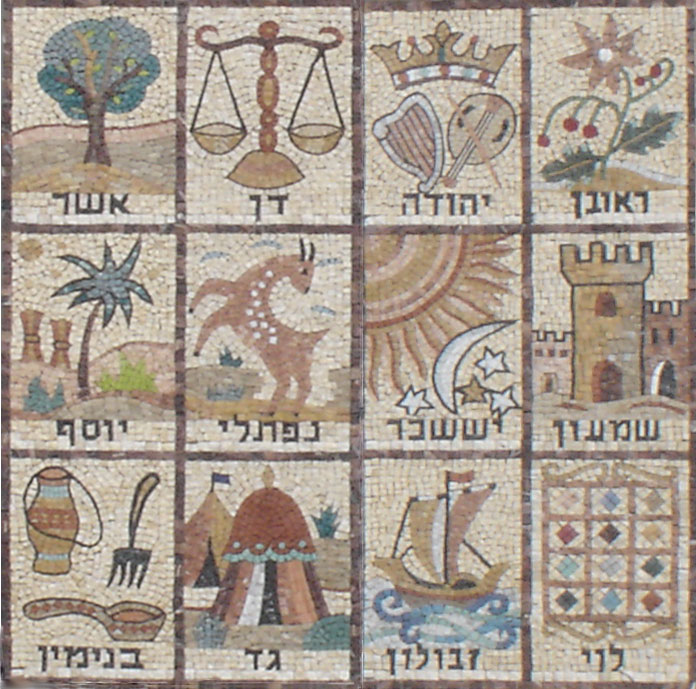
Rabbi Elie Mischel says Christians who believe they are the lost tribes of Israel repeat the church’s oldest error in a new form. God will gather the tribes Himself, and the nations already hold a holy role of their own.
Across America and Britain, thousands of Christians who love the Bible and stand with Israel have come to a startling conclusion about themselves: they are Israel. Members of the Two House, Ephraimite and British Israelite movements believe they descend from the ten tribes carried off by Assyria 2,700 years ago, and that their love of the Hebrew Bible is the stirring of ancient Israelite blood. Rabbi Elie Mischel, Director of Education at Israel365, says he meets them constantly and admires their passion. He also says their belief is replacement theology in a new costume.
“I understand the appeal. I really do,” Rabbi Mischel said in a new lesson on the Israel Bible Channel. “I think it comes from a sincere love of Israel, of the Bible, and a longing to be part of this incredible story of redemption. And that longing is very beautiful. But I have to be honest. It is a form of replacement theology.”
The lesson is the first episode of the channel’s new viewer Q&A series, which answers questions straight from the Bible and Jewish tradition. He opened with one of the most-asked questions in the channel’s comments: whatever happened to the ten lost tribes of Israel? Where did they go? Are they still out there? And will they ever come back?
Why would Christians who reject the church’s ancient claim to have replaced Israel end up making the very same claim in a different form?
The kingdom that vanished
After the reign of King Solomon, the nation of Israel split in two. The southern kingdom of Judah included the tribes of Judah and Benjamin, along with many Levites. The larger northern kingdom of Israel held the other ten tribes. In 722 BCE, the Assyrian Empire conquered the north and exiled its people to the region of today’s northern Iraq, Kurdistan, Syria, and Iran (2 Kings 17:6). Judah later went into Babylonian exile as well, and after 70 years, Cyrus allowed the Jews to return and rebuild Jerusalem.
“But the ten northern tribes had no such return,” Rabbi Mischel said. “There is no grand homecoming in the Bible for those ten tribes. They were scattered among the nations. And as the generations passed, they seemed to simply vanish from history.”
Never entirely lost
Rabbi Mischel pointed to biblical evidence that the ten tribes were never completely lost. Generations after the Assyrian exile, God sent Jeremiah to call the northern exiles home: “Return, faithless Israel, declares the LORD. I will not look on you in anger, for I am faithful” (Jeremiah 3:12). When King Josiah held his great Passover in Jerusalem, it was celebrated by “all Judah and Israel who were present” (2 Chronicles 35:18). The Sages teach (Megillah 14b) that Jeremiah personally brought back a portion of the ten tribes.
“It means that we Jews today actually carry within us members of every single one of the twelve tribes mixed into the nation,” he said. “What we lost was the bulk of those ten tribes as distinct, identifiable, separate groups. We do have them among us. We just don’t know who they are.”
A few communities kept their identity alive for 2,700 years. The Jews of Ethiopia were identified in the 16th century by Rabbi David ibn Zimra, known as the Radbaz, as descendants of the tribe of Dan. The Bnei Menashe of northeastern India preserved a tradition of descent from the tribe of Manasseh, and in 2005 Israel’s Sephardi Chief Rabbi Shlomo Amar formally recognized them as descendants of Israel. Right now, Israel is bringing them home. Roughly 4,000 have already made aliyah, and last November the government approved a plan led by Prime Minister Benjamin Netanyahu and Aliyah and Integration Minister Ofir Sofer to bring about 1,200 more by the end of 2026 and another 4,600 by 2030.

“They did not wake up one morning with a feeling that they belong to one of the ten lost tribes,” Rabbi Mischel said. “These are communities with thousands of years of real history, real traditions, real memory passed down from parent to child across the generations.”
Jewish law calls such evidence a chazakah, an established presumption. Even so, both communities underwent conversion on arrival in Israel as a precaution. “That’s how seriously the Jewish people take this question of who truly belongs to the nation,” he said.
The oldest error
Replacement theology, known to scholars as supersessionism, holds that God divorced Israel and transferred His covenants to the church. In its classic Catholic/Christian form, God grew weary of Israel’s disobedience and its rejection of Jesus, revoked His promises to the Jewish people, and replaced them with a new people.
The doctrine took shape in the second century CE as the young church, increasingly Gentile, competed with the synagogue over the inheritance of the Hebrew Bible. Around 160 CE, the Christian apologist Justin Martyr told a Jew in his Dialogue with Trypho that Christians are “the true spiritual Israel,” and that the prophecies are contained in “your Scriptures, or rather not yours, but ours.” When Christianity gained the power of Rome, the doctrine gained the power of law. After the Council of Nicaea in 325 CE, Emperor Constantine circulated a letter branding the Jews murderers of the Lord. Augustine, Martin Luther, whose 1543 tract On the Jews and Their Lies was later celebrated by the Nazis, and most of the Reformers carried the idea forward. For nearly two millennia it fueled expulsions, blood libels and massacres.
The Holocaust forced a reckoning. In 1965, the Catholic Church’s Nostra Aetate declared that the Jews must not be presented as rejected or accursed by God. In the evangelical world, a theology distinguishing Israel from the church became the backbone of Christian Zionism.
Israel365 has long tracked the Christian effort to uproot the doctrine. In a 2018 report for Breaking Israel News, Rivkah Adler spoke with Christian leaders working to undo its damage. Rabbi Tuly Weisz, founder of Israel365, told her that Christian rejection of replacement theology is a “prerequisite for all of the other stages of geula (redemption).” Tommy Waller, founder of HaYovel, which brings Christian volunteers to work Jewish farms in Judea and Samaria, said the doctrine had stripped Jerusalem and Israel out of the Christian reading of the Bible.
That effort now faces a headwind. A survey by Infinity Concepts and Grey Matter Research, reported by Israel365 News, found that while 49 percent of American evangelicals affirm that the Jewish people remain God’s chosen nation, only 29 percent of those under 35 agree. Among evangelicals who regularly hear their pastors teach that the Jews remain chosen, 71 percent hold that belief. Among those who never hear it, the number collapses to 12 percent.
The Hebrew Bible states plainly that the covenant is permanent:
“If these ordinances depart from before Me, saith the LORD, then the seed of Israel also shall cease from being a nation before Me for ever.” (Jeremiah 31:35; Jeremiah 31:36 in most English Bibles)
Moses saw it coming
Rabbi Pesach Wolicki, executive director of Israel365 Action, has pointed out an irony buried in Deuteronomy. In a 2023 commentary for Israel365 News, he noted that Moses foresaw foreigners who would look at the exiled Jews and the desolate land, who would know “every curse that is written in this book,” and who would conclude that Israel had forsaken the covenant and been uprooted “as it is this day.”
Before Christianity carried the Hebrew Bible across the world, no such Bible-reading nations existed. “Christian theologians who promoted Replacement Theology looked at the seemingly endless exile of the Jews and the desolation of the land and came to the exact conclusion foretold by Moses in these verses,” Rabbi Wolicki wrote. “Ironically, by espousing their erroneous doctrine, these theologians were fulfilling this prophecy without even realizing it!”
Moses immediately warned against that conclusion:
“The secret things belong unto the LORD our God; but the things that are revealed belong unto us and to our children for ever, that we may do all the words of this law.” (Deuteronomy 29:28; Deuteronomy 29:29 in most English Bibles)
The very next chapter promises that God will gather Israel “from all the nations” and bring them back to “the land which thy fathers possessed” (Deuteronomy 30:3-5), the promise millions of Jews in a sovereign Israel are living today. “Read the Bible,” Rabbi Wolicki wrote. “The covenant is forever.”
The covenant God cut alone
Tricia Miller, director of CAMERA’s Partnership of Christians and Jews, has argued that replacement theology collapses at the very first covenant. Writing for Israel365 News after Tucker Carlson called Christian Zionism “Christian heresy,” she pointed to Genesis 15. In the ancient covenant ritual, each party walked between the halves of slaughtered animals, binding himself to their fate if he broke his word. Abram never walked. God cast a deep sleep on him and passed through alone:
“And it came to pass, that, when the sun went down, and there was thick darkness, behold a smoking furnace, and a flaming torch that passed between these pieces.” (Genesis 15:17)
“This means that the keeping of the covenant is only dependent on God,” Miller wrote. “It is not dependent on anything Abram or his descendants do or don’t do.” A covenant God alone guarantees cannot be lost by the Jewish people, and it cannot be acquired by anyone who decides he belongs inside it.
Replacement theology wearing a new coat
Rabbi Mischel argued that the lost-tribes movements reach the church fathers’ destination by a different road.
“Classic replacement theology said that the church replaced Israel,” he explained. “But here we have a newer version of replacement theology. It doesn’t say that we replaced Israel. It says something that sounds different, but really it ends up in the same place. These people are saying, we are Israel. We are the real Ephraim. We are the lost tribes. But the result is identical. Israel’s identity, Israel’s inheritance, Israel’s promises are transferred away from the actual living people of Israel and onto somebody else.”
For a generation of young evangelicals already drifting from Israel’s chosenness, a teaching that tells them they are Israel offers the same old error in its most flattering form.
From British Israelism to bloodshed
The oldest of these movements, British Israelism, traces to John Wilson’s 1840 lectures, Our Israelitish Origin, which claimed the Anglo-Saxon peoples descend from the ten tribes. His disciple Edward Hine taught that England was Ephraim and America was Manasseh, and in the 20th century Herbert W. Armstrong spread the idea to millions through his Worldwide Church of God.
Wilson and Hine were friendly toward Jews. Their American heirs were not. British Israelism became the seedbed of the Christian Identity movement, whose founder, Howard Rand, declared that Jews are not descendants of Judah at all. Its adherents embraced the Khazar theory, and some taught that Jews descend from Cain. The ideology that began by claiming to be Israel ended by denying that the Jews are Israel.
The same claim has cost Jewish lives. In December 2019, gunmen attacked a kosher grocery store in Jersey City, New Jersey, drawing attention to extremist factions of the Black Hebrew Israelites movement. Oren Segal of the Anti-Defamation League explained that those followers see Blacks, Hispanics, and Native Americans as the true twelve tribes. “They view blacks as the true Israelites and not the impostor Jews,” Segal said. As Israel365 News reported, they deny that the Jews are partners in God’s covenant with Abraham, “an everlasting covenant, to be a God unto thee and to thy seed after thee” (Genesis 17:7). Once a group decides it holds Israel’s identity, the living Jewish people become impostors in the way.
The Two House movement
The Two House or Ephraimite movement, popularized by Batya Ruth Wootten’s book Who Is Israel?, is far gentler. It teaches that many Gentile Christians are hidden members of the northern tribes, and reads Jacob’s blessing of Ephraim, “his seed shall become a multitude of nations” (Genesis 48:19), as proof that Ephraim became the Gentiles. Rashi, the great 11th-century commentator, explains that the phrase refers to Joshua, a descendant of Ephraim, whose fame would fill the whole world when he made the sun stand still at Gibeon.
Mainstream Christian Zionists have rejected the teaching. Malcolm Hedding, former executive director of the International Christian Embassy Jerusalem, called it “The Ephraimite Fable,” writing that its teachers present the ten tribes as “lost but now rediscovered in the Church.” Some Ephraimites reject replacement as well. Pete Rambo of Ani Yosef told Israel365 News, “I stand against anyone who claims to replace or do away with Judah or Ephraim.” John Conrad of B’Ney Yosef North America added, “We apologize for the bad behavior of our family. We have 2000 years of bad behavior to overcome.”
“Ethnic tribe stealing”
One Christian author, writing a forthcoming book on the Christian relationship with Israel, recalls first hearing the lost-tribes claim in the 1980s from Herbert W. Armstrong’s broadcasts, and later from a coworker at a sheriff’s office who “thought modern Jews to be imposters and anything but God’s ‘chosen people.'”
He calls the claim the worst form of replacement theology he knows. “This form of Replacement Theology, above the others, strikes me as being born out of basic covetous envy,” he writes. “They want what was promised to the Jews in addition to what was promised to Christians. They also want that little Land of Israel to call their own.”
“It is ethnic tribe stealing,” he writes. “It is no better than showing up on Elon Musk’s doorstep and claiming to be his long-lost son or daughter without any evidence. It is an absolute violation of the tenth commandment, coveting what belongs to your neighbor.”
That commandment reads:
“Thou shalt not covet thy neighbour’s house; thou shalt not covet thy neighbour’s wife, nor his man-servant, nor his maid-servant, nor his ox, nor his ass, nor any thing that is thy neighbour’s.” (Exodus 20:14; Exodus 20:17 in most English Bibles)
A farm boy by upbringing, he compares the Christian relationship with Israel to a Gravenstein branch grafted onto a Red Delicious apple tree. “The purpose of a graft is not to replace what was there,” he writes, “but for the apple to become dependent on the life-giving tree that was there while continuing to be the variety of apple God originally made it to be.”
A nation, not a feeling
“The people of Israel are a real nation. We are not a feeling,” Rabbi Mischel said. “From Abraham on down, God built a very specific family that became a very specific nation, and He keeps meticulous track of that nation. My family, we are Levites. My father is a Levite, and his father is a Levite, and it goes all the way back up to the original Levi, the son of Jacob.”
“You cannot join the tribe of Asher because you feel spiritually connected to Asher,” he added, “any more than you can become Japanese because you love Japan and you love sushi.”
Joining Israel is possible through conversion, “a very serious, formal, and demanding process.” The vast majority of the northern exiles assimilated into the nations, as the prophet Hosea warned when he said they had “begotten strange children” (Hosea 5:7).
God has not lost track
Rabbi Mischel stressed that the tribes remain precious to God, and the prophets promise their return:
“And it shall come to pass in that day, that a great horn shall be blown; and they shall come that were lost in the land of Assyria, and they that were dispersed in the land of Egypt; and they shall worship the LORD in the holy mountain at Jerusalem.” (Isaiah 27:13)
He drew attention to the Hebrew word for “those who were lost,” ha’ovdim, from the same root as aveidah, the term Jewish law uses for a lost object. “A lost object by definition is not an abandoned object,” he said. “When an object is lost, it means that the owner is still looking for it. And that is how God sees the ten lost tribes.”
Ezekiel’s vision of the dry bones describes redemption in two stages. The first, the Jewish people rising from the Holocaust to rebuild their nation in the land, is happening now. The second, when God joins the stick of Judah with the stick of Ephraim, comes with the messianic king. Maimonides rules (Laws of Kings 12:3) that the Messiah will establish each Israelite’s tribe through the holy spirit resting upon him.
“We are not going to figure out who the ten tribes are through DNA tests,” Rabbi Mischel said. “And we’re not going to determine who they are based on how strongly somebody feels that they belong to the ten tribes. It will be done through prophecy. God knows precisely who every one of them is. But finding them and identifying them is His job. It’s not our job.”
The lattice around the Temple
The question of who belongs to Israel determines who may stand where on the Temple Mount. The Second Temple was surrounded by the soreg, a latticed stone barrier beyond which non-Jews could not pass. The Mishnah (Middot 2:3) records that the Greek kings broke through it in thirteen places to defile the Temple, and the Hasmoneans repaired the breaches after the Hanukkah victory. Archaeologists have found the Greek warning that hung on it: “No foreigner is to go beyond the balustrade and the plaza of the temple zone. Whoever is caught doing so will have himself to blame for his death which will follow.”
Ezekiel, in his vision of the future Temple, states the law in God’s own words:
“Thus saith the Lord GOD: No alien, uncircumcised in heart and uncircumcised in flesh, shall enter into My sanctuary, of any alien that is among the children of Israel.” (Ezekiel 44:9)
A Christian who sincerely believes he is Ephraim will believe he may pass the soreg. When the Third Temple stands, a non-Jew posing as an Israelite and walking past that barrier would profane the very sanctuary he loves, doing out of devotion what the Greek kings did out of contempt.
Purified to pass the lattice
The danger has already moved from theory to teaching. In a January editorial for Israel365 News, this reporter described the trend of Christians claiming to be Ephraim, and the ways it now reaches toward the Temple itself.
One Christian teacher who is gaining a large following insists that Christians, as Israel, must be purified by the ashes of the red heifer. The red heifer, described in Numbers 19, provides the purification required before entering the Temple. Its ashes are the key that opens the way past the soreg. A teaching that claims those ashes for Christians as Israelites prepares non-Jews to cross the one boundary the Bible forbids them to cross.

Other claims run in the same direction. A German Christian cult leader has proclaimed himself king of Ephraim, teaching that the Messiah will come from Ephraim rather than Judah, which made him, conveniently, the prime candidate. A Christian acquaintance who keeps Shabbat announced to this reporter that he does so as a member of the tribe of Ephraim, and refused conversion on the grounds that it would make him part of Judah. In his view, the Jews have no authority over Ephraim. Some Christians have embraced a “Melchizedek priesthood” that discards the hereditary lineage of Aaron’s descendants, the kohanim, whose identity every Jewish community guards and inscribes on their gravestones.
These self-proclaimed Ephraimites insist they will enter the Third Temple as full members of the nation of Israel. That would profane the Temple, turning it into the very temple of the antichrist that Christians themselves warn against.
A holier calling for the nations
The Bible gives the nations a glorious place on the Temple Mount on their own side of the lattice. King Solomon, dedicating the First Temple, prayed for the foreigner “that is not of Thy people Israel” who would come from afar to pray toward God’s house (1 Kings 8:41-43). Isaiah promises that God’s house “shall be called a house of prayer for all peoples” (Isaiah 56:7). The soreg keeps Israel’s sanctuary holy, so that the nations have a holy house to come to.
Rabbi Mischel pointed to Isaiah 49:22, where God declares that the nations “shall bring your sons in their bosom, and your daughters shall be carried upon their shoulders.”
“It’s happening as we speak,” he said. “So many incredible Christians fulfill this prophecy. They help poor Jews who are living in Ukraine and Russia and places like this all over the world. They help them come home. That is a holy calling. That’s not a consolation prize.” The International Christian Embassy Jerusalem has sponsored flights for nearly half of all Bnei Menashe immigrants since 2012.
Tommy Waller offers another model. In 2017, as Israel365 News reported, he released a video calling on Christians to reject replacement theology completely. “Any agreement with replacement theology is disagreement with God, who identifies himself as the God of Abraham, Isaac, and Jacob, the God of Israel,” Waller said, and he asked Jews for forgiveness for the crimes of his forefathers. HaYovel’s volunteers harvest the vineyards of Samaria, fulfilling Jeremiah’s promise to “plant vineyards upon the mountains of Samaria” (Jeremiah 31:4), and Safed Chief Rabbi Shmuel Eliyahu called them “partners in the great redemption.” Waller never claimed to be Ephraim. He came to the land as a Christian and stood beside its people as a Christian.
“When a member of the nations abandons this holy role of the nations and pretends that he’s an Israelite, it means that he or she is abandoning their beautiful God-given role,” Rabbi Mischel said. “And that’s a tragedy.”
He quoted the Kotzker Rebbe, the 19th-century Hasidic master: “If I am I because you are you, and you are you because I am I, then I am not I, and you are not you. But if I am I because I am I, and you are you because you are you, then I am I and you are you.”
“Israel is Israel. The nations are the nations,” Rabbi Mischel said. “And it’s only because we are all true to ourselves that we can join together in love and friendship and bring the redemption together.”
Justin Martyr told a Jew 1,900 years ago that the Bible belonged to the church. A modern Christian who tells a Jew he is the real Ephraim says it more warmly, but the claim is the same: what God promised Israel now belongs to someone else. The prophets reserved a different place for the nations: holding the hem of a Jew’s garment, carrying Israel’s children home on their shoulders, harvesting the vineyards of Samaria, and walking up to Jerusalem alongside Israel as themselves, to pray in a house built for all peoples on their own side of the lattice. That place is waiting, and no one else can fill it.
For more insights from the original Hebrew, join Bible Plus, Israel365’s premier online Bible study platform. Bible Plus is just $60 per year! That’s as low as $5 a month!
Shop our Bible sets for incredible Bible study at the Israel365 Store.
Follow us on Instagram for daily videos, and follow our Facebook page.