
Americans are watching their own midterms, but Israel’s election comes first, on October 27, and it is the closest and least predictable in memory. Some 400,000 English-speaking Israelis, many of them Americans, are worth roughly four Knesset seats and have never voted as a bloc. On October 4, ten parties come to Jerusalem to ask for their vote.
On October 27, five weeks before Americans vote in the midterms, Israelis will decide whether Benjamin Netanyahu stays in power. Nobody knows the answer. Not the parties, not the pollsters, and not Netanyahu.
Three Israeli television networks polled the race in the past week. They came back with three radically different results.
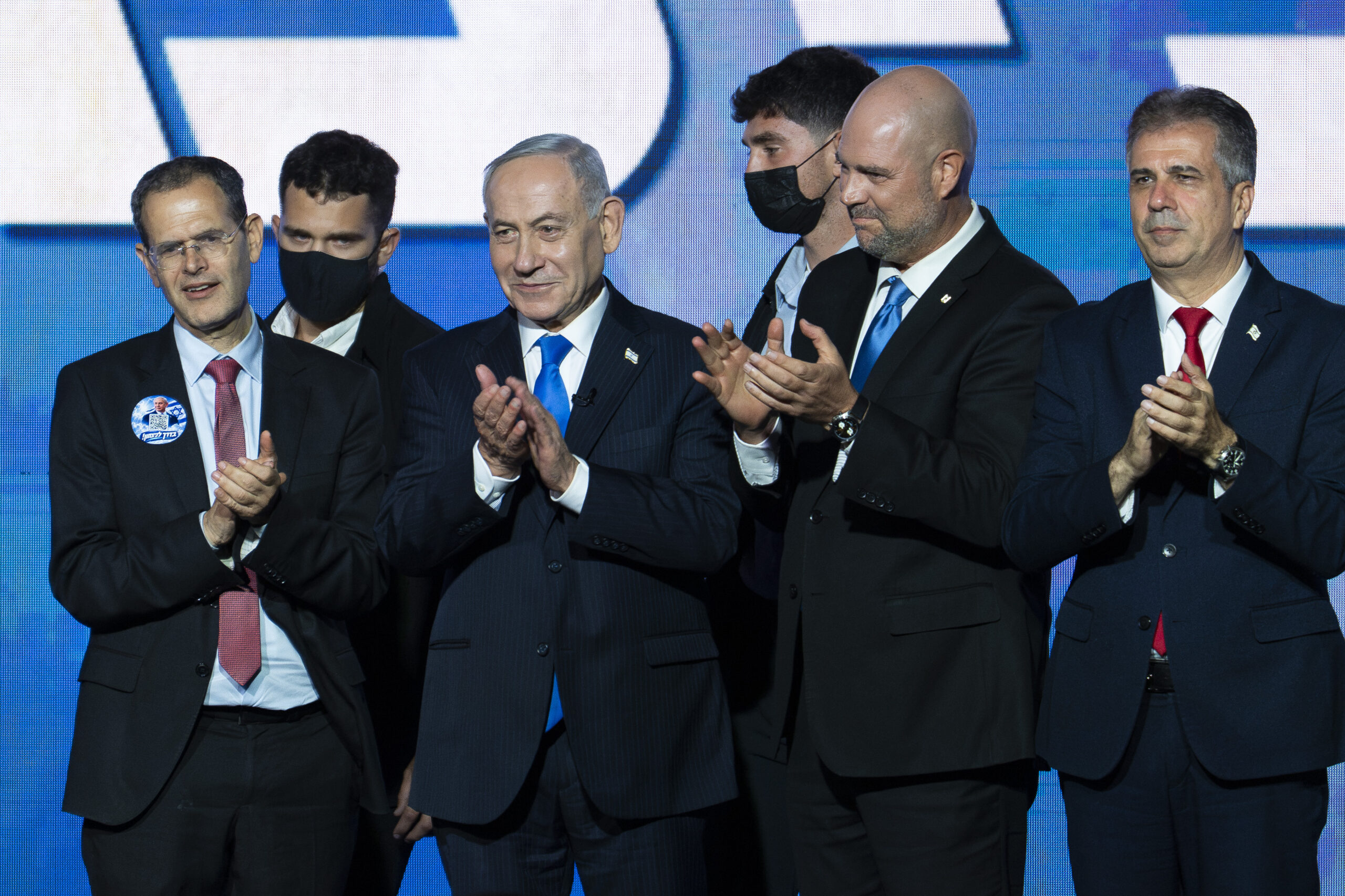
The right-wing Channel 14 predicts a Netanyahu victory. Its September 17 poll gives his Likud party 30 seats in the 120-seat Knesset and his right-wing bloc a governing majority of 64.
The left-wing Channel 13, polling the same day, says Likud has collapsed to 18 seats, the lowest number in the party’s history. Even so, it puts Netanyahu’s right-wing bloc narrowly ahead, 54 to 52, with the Arab parties holding the remaining 14 seats. Channel 12, another left-wing channel, gives the opposition 54 seats and Netanyahu’s coalition 50. With this result, neither side comes close to the 61 seats needed to form a government.
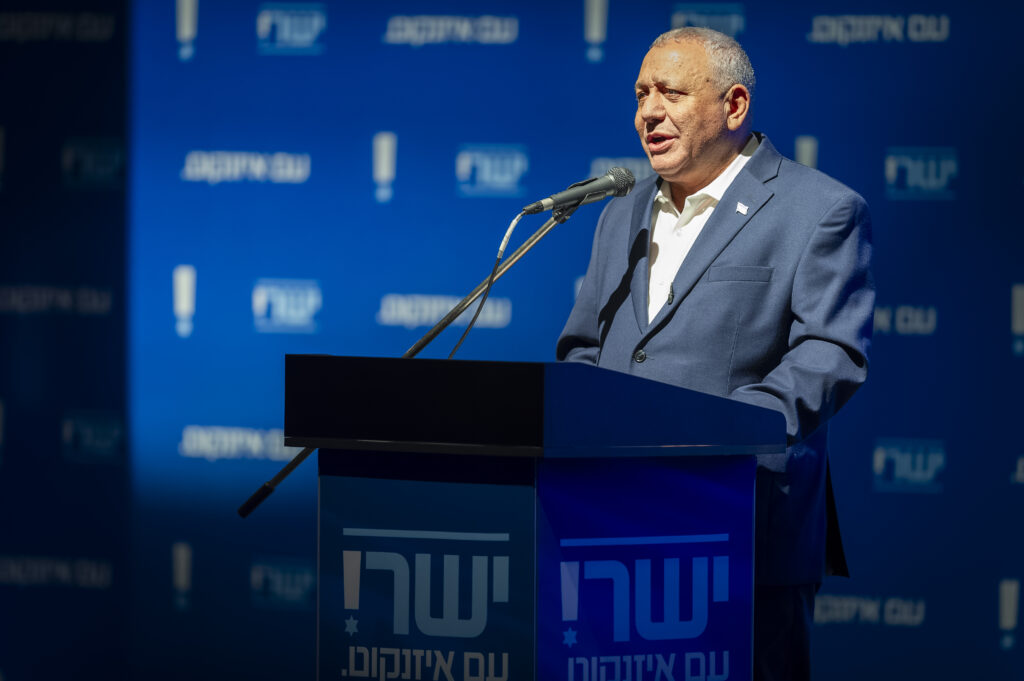
The three networks do agree on one thing. A party that did not exist a year ago is now running neck and neck with Likud for first place. Yashar, founded by former IDF chief of staff Gadi Eisenkot, polls at 21 to 23 seats in all three surveys, and Reuters’ average of every poll through September 14 puts it slightly ahead of Likud. That average also confirms the deadlock: no bloc has a clear path to 61.
Why the polls can’t agree
How can three professional pollsters, surveying the same small country in the same week, produce results this far apart? Methodology explains some of it. The networks use different polling firms, different sampling methods, and different assumptions about who will actually turn out, and those choices alone can move a party several seats.
The bigger reason is a rule most Americans have never heard of. To enter the Knesset at all, a party needs at least 3.25 percent of the national vote. If a party falls short of the threshold by even one vote, every vote cast for that party is thrown away. Four or five parties are hovering right at that line, and each one that crosses it, or falls under it, moves several seats from one bloc to the other without a single voter changing sides.
Two examples from this week’s polls show how much that matters. In Channel 13’s poll, the merged list of Bezalel Smotrich and Moshe Feiglin clears the threshold with 8 seats, and Netanyahu’s bloc pulls ahead. In Channel 12’s poll, the Reservists, a new party founded by Yoaz Hendel out of the movement against the Haredi draft exemption, squeak in with 4 seats. Hendel has not said which bloc he would join, so those 4 seats are the difference between a deadlock and a government.
Three weeks ago the picture was reversed. Channel 12’s August 31 poll had Ofer Winter’s Amcha Yisrael in and Smotrich out. A week later, Maariv had Winter out and the Reservists in. Smotrich’s merger with Feiglin on September 1 appears to have steadied his list at 6 to 8 seats, while the Reservists have gone from just under the line to just over it in a week. Winter’s position is the least settled of any party on the ballot.
There is a second reason this election is so hard to call: Israeli voters are less attached to their parties than they have ever been. Five of the lists on the ballot were founded or reconstituted in the past year: Beyachad, Yashar, Amcha Yisrael, The Reservists, and The Haredi Public. The Israel Democracy Institute found that only 26 percent of Israelis say a party closely represents their views, and 34 percent say no party does. A record share of Israelis are voting as free agents, in the year free agents decide everything.
Which is why, less than two weeks from now, ten parties are sending representatives to Jerusalem to face a group of voters that has never been asked for its vote in its own language.
Ten parties, one stage, in English
On Sunday, October 4, Israel365 News will host the Knesset Elections Town Hall at the Menachem Begin Heritage Center in Jerusalem. Representatives from ten parties will make their case in English, on one stage. Then each will answer questions from moderator Rabbi Pesach Wolicki on the issues Anglo voters care about most: the draft, security, the cost of living, judicial reform, religion and state, and Judea and Samaria.
The speakers, listed alphabetically by party, are Fleur Hassan-Nahoum (Amcha Yisrael), Mati Gill (Beyachad), Moran Zer Katzenstein (The Democrats), Minister Amichai Chikli (Likud), Yishai Fleisher (Otzma Yehudit), Dr. Einat Wilf (The Reservists and the Economic Party), MK Ohad Tal (Religious Zionism), Lianne Pollak-David (Yashar), former MK Dan Illouz (Yisrael Beiteinu), and Moshe Feiglin (Zehut).
Israel365 News invited parties with a realistic chance of entering the next Knesset. Lists polling well below the threshold were not included. Even so, two of the ten, Amcha Yisrael and The Reservists, may not make it: in some polls they pass the threshold and in others they fall short. And the stage runs from Itamar Ben-Gvir’s Otzma Yehudit on the right to Yair Golan’s Democrats on the left, as wide a spread as any Israeli stage this campaign.
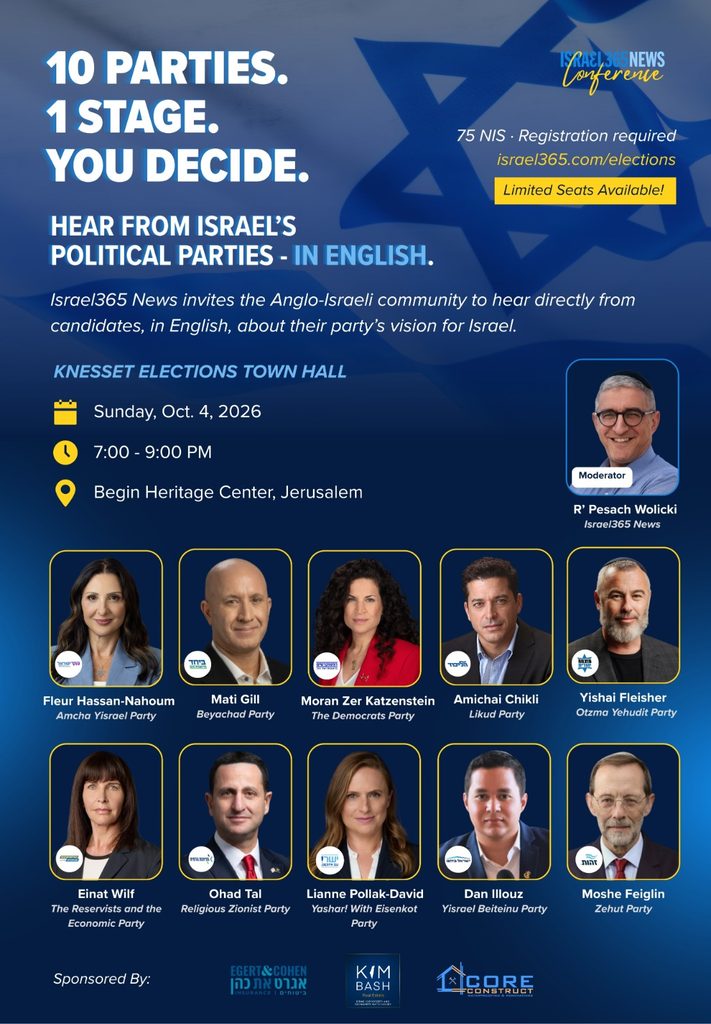
Doors open at 6:00 PM and the program runs from 7:00 to 9:00 PM. Entrance is 75 NIS and registration is required in advance at https://israel365.com/elections/. Israel365 News does not endorse any party, candidate, or list.
Nobody knows exactly how many English speakers live in Israel, because the government keeps no such category. The broadest estimate, which counts immigrants along with their children and grandchildren, puts the figure at roughly 400,000. A narrower 2019 estimate counted about 170,000 eligible Anglo voters, or 2.9 percent of the electorate. That is worth roughly four Knesset seats.
In most elections, four seats would be a footnote. In this one, four seats is more than Amcha Yisrael and The Reservists are polling combined. It is roughly the gap between the two blocs in Channel 13’s poll. And it is a vote no party has managed to lock up.
Why nobody asked before
Russian-speaking immigrants built a party, Yisrael Beiteinu. Haredi (ultra-Orthodox) voters built Shas and United Torah Judaism and the institutions that deliver their votes on election day. Anglos built nothing like that, because their politics always mattered more than their accent. The American in Efrat, the Briton in Tel Aviv, the South African in Ra’anana and the American Haredi in Jerusalem all speak English at home, but nothing about that shared language tells you how any of them will vote.
The one survey ever devoted to this population, the 2020 Anglo Vision poll, found 49 percent identifying with the Right, 25 percent with the Center, and 22 percent with the Left.
Parties have noticed the community before. Blue and White ran an English-language campaign in 2019. But no party ever had to answer to Anglo voters, because Anglo voters never showed up as a group.
The first election Anglos could decide
For twenty-five years, Israel’s parties treated English-speaking voters the way any party treats votes it cannot win or lose: politely, and from a distance. Nobody had to earn the Anglo vote because nobody could be punished for ignoring it. It was spread too thin across too many parties to reward anyone or hurt anyone.
This year the arithmetic has changed. In 2022, the 3.25 percent threshold came to roughly 155,000 votes. Amcha Yisrael and The Reservists are each polling within a hair of that line. The gap between 3.1 percent, where a party disappears, and 3.3 percent, where it enters the Knesset with four seats, is about 10,000 votes nationwide. Beit Shemesh alone has 62,000 English speakers. Efrat has nearly 13,000. A shift of a few thousand Anglo votes in one or two towns can decide whether a party exists, and with it, which bloc reaches 61.
The issues have changed too. The biggest fight in this election is over the army. Israel drafts nearly every Jewish 18-year-old, but for decades ultra-Orthodox men have been exempt so they can study full-time. After two years of war, with reservists called up again and again, that exemption has become the question every party has to answer.
Anglo families are not watching this from the sidelines. English-speaking immigrants and their children serve in the IDF at rates equal to or higher than the national Jewish average, a product of the Zionist conviction that brought them to Israel in the first place and of the religious-Zionist communities many of them live in. Their sons and daughters are the ones being called up, and many of them live in the same neighborhoods as the ultra-Orthodox Jews who are not serving in the army. No group of voters in Israel has more at stake in how the draft question is answered.
The parties have noticed. That is why ten of them, from right to left, accepted an invitation to stand on one stage in Jerusalem and make their case in English. They are not doing it as a courtesy. They are doing it because the polls cannot tell them whether they will be in the next Knesset, and a few thousand votes might.
On October 4, they come to Jerusalem to ask for those votes, and to answer for them.
Register now: https://israel365.com/elections/