


Hundreds of Jews stood on the Temple Mount before dawn on the second day of Rosh Hashanah this year, and by the time they left, something had happened there that Rabbi Josh Wander believes had not happened in thousands of years: the shofar sounded on the Mount together with the silver Temple trumpets. Wander was there for both days of the holiday, and described what he saw in an interview with Rabbi Aharon Sokol on the podcast Parsha Inspired, an account independently corroborated by police statements and other eyewitnesses.
A Shabbat exception, revived
Any year Rosh Hashanah falls on Shabbat is, in Wander’s words, “going to be a very eventful year.” This year, the first day of the holiday landed on Shabbat, and Wander had “the pleasure again of blowing shofar on Shabbat Rosh Hashanah in the Old City of Jerusalem.” He was quick to explain why that is unusual. “For already many, many years, it has been the practice to refrain from blowing shofar on the first day of Rosh Hashanah when it falls on Shabbat,” he said. “But there are exceptions to that rule.” He pointed to the Rif, who blew shofar in his community in Morocco, and to more recent precedent in Jerusalem: “We have more modern examples in Jerusalem, Akiva Yosef Schlesinger and others, who blew shofar in Jerusalem when there was a beit din present.”
Wander was careful to explain the underlying halacha. “It’s a mitzvah in the Torah to blow shofar on Rosh Hashanah,” he said. “The Sages came and excluded this mitzvah temporarily, because no rabbi in the world can take away a mitzvah from the Torah or add one to it.” The reason for the exclusion, he explained, was concern over carrying: “The Sages were concerned we’re not allowed to carry in public on Shabbat, and if we blew shofar, someone might carry it out into the public afterward and break Shabbat. So it’s understood that if there’s a beit din present, people will be careful not to break Shabbat laws and will do it properly.”
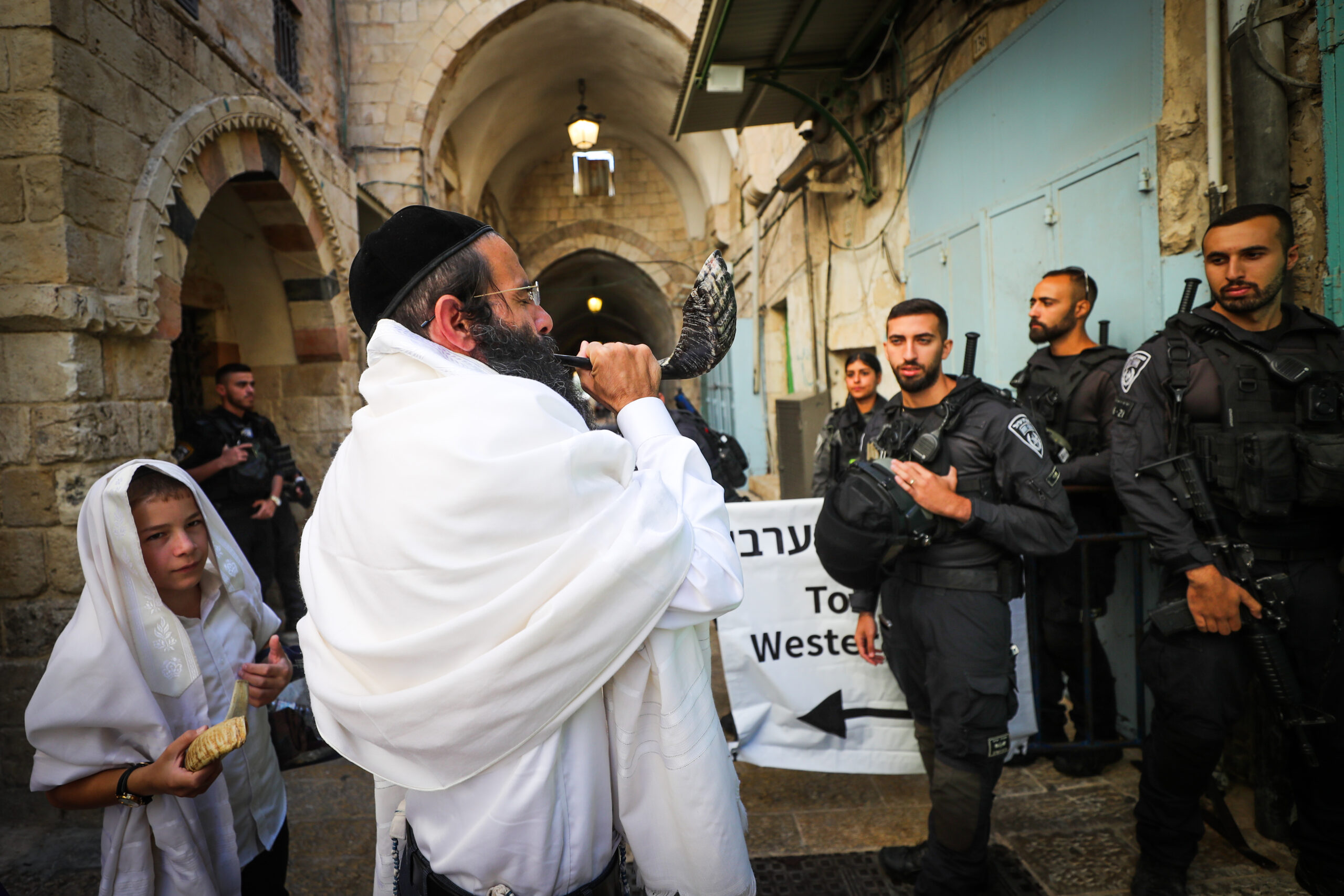
This year’s minyan, held at the Temple Institute under Rabbi Yisrael Ariel and convened as a formal beit din for the occasion, drew a crowd Wander had never seen before. “The room was packed. I’ve never seen anything like it,” he said. “We had hundreds of people in the room as shofar was blown on Misgav Ladach Street in Jerusalem’s Old City.” He drew a direct line to Schlesinger’s own failed attempt roughly a century and a half earlier to unite Jerusalem’s communities around the same practice. “Even though he couldn’t get all the rabbis on board, the rabbis came and stood outside as he blew, because they said, ‘Even if we don’t agree that we should be blowing shofar on Shabbat right now, we can still fulfill the mitzvah by listening to his blowing.'” The same thing happened this year, Wander said: “Many people, even if they weren’t praying with us, came to hear the shofar on Shabbat. It was very special, very moving.”
The ascent
The second day, a Sunday, brought Wander and hundreds of others to the Temple Mount itself. “There was a line of people right after sunrise, waiting to go up to the Temple Mount — hundreds of Jews,” he said. Before ascending, the group blew shofar at the entrance “with a brachah, just to make sure that if we weren’t able to hear it later, we’d have already fulfilled the mitzvah of hearing the shofar.”
What followed, Wander said, had never happened before. “The police allowed us up in groups of thirty. What was unusual this year is that, usually, they send up smaller groups and rush them off the Mount, bringing up the next group as each one leaves. This time, they just kept adding groups; thirty, then another thirty, and another, and another.” He estimated at least 120 people at the first minyan of the morning, with other counts running as high as 200, and roughly 600 total ascending over the course of the day. The group prayed with “pre-printed, pre-approved machzorim” and, for the first time in years, with their own tallitot. “We had Jews, maybe for the first time in many, many years, going up to the Temple Mount and praying freely, in large groups, with their prayer books and their prayer shawls,” he said. The service itself ran nearly four hours. “I don’t think we’ve ever had such a large group praying for that long on the Temple Mount,” Wander said.
Then came the shofar. “When it came time to blow the shofar, a number of people who had managed to sneak shofars up to the Temple Mount started blowing,” Wander said. “That in itself has happened the past two years, [and is] not as significant as what happened next.” This time, worshippers also smuggled up the silver Temple trumpets meant to accompany the shofar. “According to halacha, you’re supposed to have one shofar and two silver trumpets, blowing on either side of it,” he explained. “It’s brought down in the Mishnah that on Rosh Hashanah, the shofar and the trumpets all start blowing together, and at some point the trumpets stop while the shofar continues, because the shofar is the mitzvah of the day.”
What made this year unprecedented, in Wander’s account, was not the smuggling itself but the response. “In previous years, even if someone managed to sneak up a shofar and blow it, they’d immediately be tackled by police and removed from the Mount,” he said. “This year was different; the police were kind to us. Even though they briefly detained the people who brought up the shofar and the trumpets, they let us complete each round first.” Three full rounds of shofar and trumpets sounded together during the service, Wander said, each one allowed to finish before anyone was detained. “We managed, I think, for the first time in thousands of years, to blow shofar together with the silver trumpets on the Temple Mount.”
The group had a contingency in place in case the ascent failed. “We also had a backup plan right behind the Eastern Wall, where we were standing and praying at what’s called Sha’ar HaRachamim, the Golden Gate, the Mercy Gate,” Wander said. “People were waiting there too, with shofars, in case we didn’t succeed in blowing on the Mount itself. So we had all our bases covered.”
Weeks before the holiday, Rabbi Ariel’s beit din of three, acting on behalf of the nascent Sanhedrin, issued a formal psak halacha renewing the practice for this Rosh Hashanah specifically. The ruling rests on the Mishnah, which records that when the Temple stood, the shofar was blown on Shabbat throughout Jerusalem, and even beyond it, wherever a beit din was seated. After the Temple’s destruction, Rabban Yochanan ben Zakkai limited the practice to wherever a beit din convened, and Maimonides later codified that limitation in the Mishneh Torah, explaining that the underlying concern was carrying the shofar through public ground, a concern the Sages waived only in the presence of a functioning court whose authority could prevent error. Once the Sanhedrin itself ceased to sit, no place retained the exemption, and the practice lapsed everywhere. Rabbi Ariel’s beit din holds that its own convening satisfies exactly the condition the Mishnah and Rambam describe, reviving the original halacha rather than departing from it, a position the mainstream Orthodox rabbinate does not accept, since it does not recognize the modern Sanhedrin as holding the classical body’s authority.
Independent confirmation, and a political demand behind it
Wander’s account closely aligns with what JNS independently reported that same week. An Israel Police statement confirmed that those who sounded shofars on the Mount “were removed from the site,” with “administrative proceedings” opened against them. Yishai Fleisher, international spokesman for the Jewish community of Hebron, told JNS he counted 300 to 400 worshippers that morning and described a prayer service that also ran nearly four hours, calling it a “liberated prayer experience.” HaKol Hayehudi reported ten worshippers detained in total: eight for sounding the shofar and trumpets, and two more for prostrating in places not permitted.
Days before the holiday, Knesset Constitution, Law and Justice Committee Chairman Simcha Rothman sent an urgent letter to Prime Minister Benjamin Netanyahu and National Security Minister Itamar Ben-Gvir, demanding that Jews be permitted to blow the shofar and pray on the Temple Mount on Rosh Hashanah. “The inability to blow the shofar on the Temple Mount on this day constitutes a significant infringement on the public’s ability to fulfill this commandment at the site most sacred to it,” Rothman wrote. Communications Minister Shlomo Karai made the same demand publicly days earlier, at a conference on Temple Mount access moderated by activist Assaf Fried. “We are not asking anyone for a favor,” Karai told the crowd. “We are demanding our historic right.”
What comes next
Wander is already looking toward Sukkot, when the same halachic logic could extend to bringing the lulav and etrog onto the Temple Mount. “Pretty much everybody agrees that if we have access to the Temple Mount on Shabbat, it is a commandment from the Torah to shake the lulav and etrog there on Shabbat,” he said. A separate case on regular Shabbat access to the Mount was headed to Israel’s Supreme Court within days of the interview, though Wander kept his expectations modest. “Regardless of how they rule, I’m not expecting anything too spectacular from that,” he said. “But we hope to have the lulav and etrog shaken on the Temple Mount this year, along with other good things. This is just the beginning of a lot of exciting things to come.”
Reflecting on the new Hebrew year, 5787, Wander closed with a blessing he says he repeats three times a day: that God “should open our eyes to see the redemption unfolding before us.” He added: “We pray not only that the redemption should happen, but that we should be aware that it’s happening. There are so many things going on right now, simultaneously, across the country, that people are unaware of. I think that if most Jews, and most people in the world, were aware of all the incredible Temple-related and redemption-related projects going on right now, simultaneously, it would become obvious to them that we’re living in an unprecedented, historic time.”
