

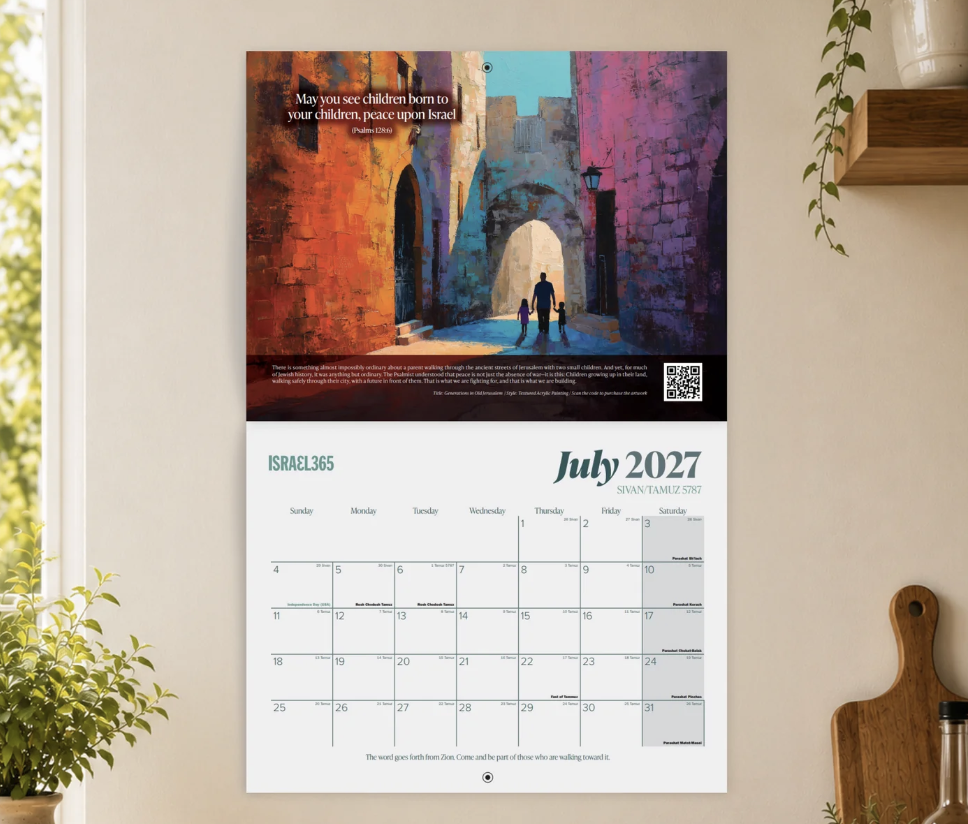
Ask someone what’s hanging in their living room, and they can tell you. Ask about the kitchen, and you’ll usually get a calendar, glanced at a dozen times a day, checked for appointments and birthdays and the date of the next dentist visit, and never once looked at as anything but a grid of numbers.
The 2027 Israel365 Calendar, covering September 2026 through December 2027, is designed to fight the idea that a calendar is a waste of space on a wall.
Past editions used photographs. This one uses sixteen months of painting: watercolor, impasto oil, palette knife work depicting the alleys of the Old City, the soldiers stationed at Israel’s borders, and the hills of Samaria replanted with vineyards, fulfilling Jeremiah’s promise that vines would be planted again on the mountains of Samaria (Jeremiah 31:5).
The more interesting choice is what sits alongside each image. Every month pairs its painting with a verse from the Hebrew Bible and a reflection drawn from Jewish tradition, the accumulated commentary of rabbis and Sages spanning three thousand years.
Take Deborah. The book of Judges places her beneath a palm tree, and most readers pass over the detail as scenery. The Sages did not. They taught that a palm has a single heart at its center, and they connected that to the unity of Israel, which was the work Deborah was doing among the tribes.
That kind of reading lives in Hebrew commentary and rarely makes it into English. It does something to a verse you thought you knew. You’ve read it a hundred times, and suddenly there’s a detail in it you never saw.
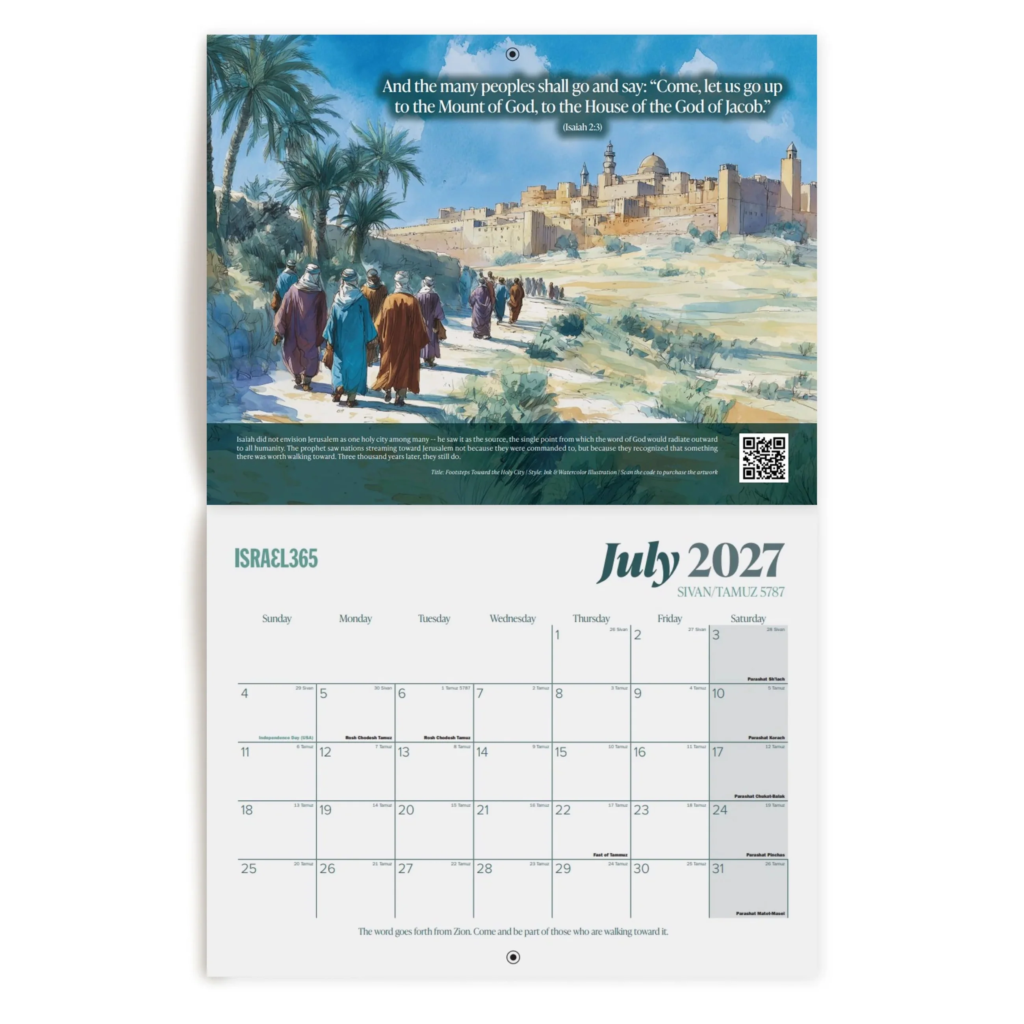
The calendar also carries Hebrew-Gregorian dual dating and a Jewish Holiday Guide, so Shabbat, the weekly day of rest running from Friday evening to Saturday evening, and the festivals land where they should.
There is a timing detail worth noticing. The calendar begins in September, and so does the Jewish year. Rosh Hashana, the Jewish New Year, falls in early autumn, which means a calendar bought now does not sit unused until January. It starts working immediately, tracking the civil year already in progress and the biblical year about to begin.
A painting on a wall gets admired once and then disappears into the background. A calendar doesn’t, because it has a job. Someone needs to know what day it is, so they look, and they keep looking, all year.
Which means sixteen times over sixteen months, an ordinary glance at a date lands on a painting of the Land of Israel and a piece of biblical wisdom most readers have never come across. The looking was going to happen anyway. The only question was what would be there when it did.
The 2027 Israel365 Calendar is available at the Israel365 Store. Click here to get yours.