

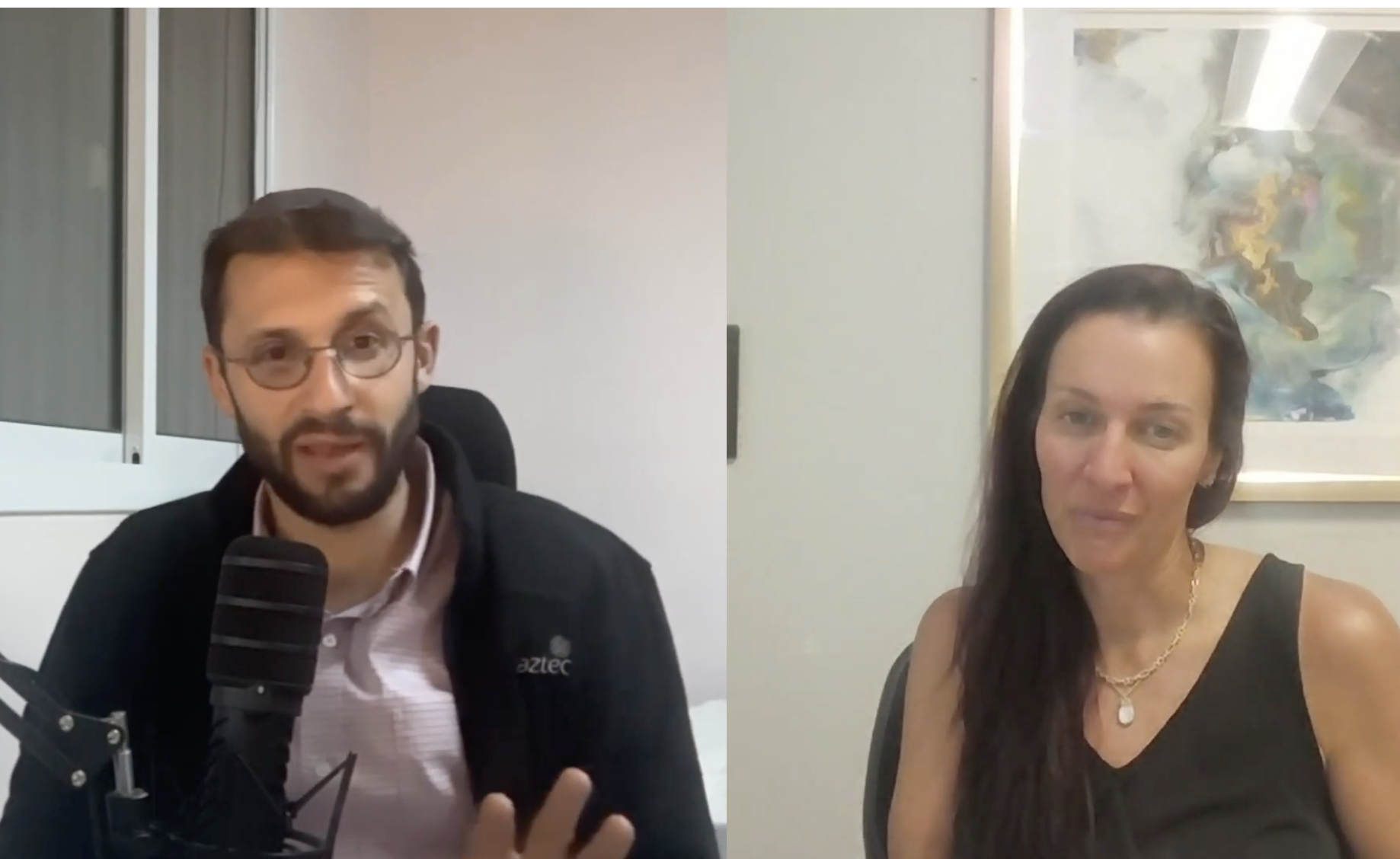
Skye Davis spent years trying to build something with her name on it. A Division I volleyball player, she went into the fitness industry because she wanted to stand out, then bought her own meal-prep company in Dallas because she wanted to be her own boss. She had told herself two things she would never do: sit behind a desk, and work in downtown Dallas. She ended up doing both.
Then the business she owned quietly folded.
“I failed,” she says, with a bluntness most people spend a lifetime avoiding. “God had other plans.”
What she could not see yet was that the plan had been sitting in front of her the whole time, at the front desk of her father’s hardware store. She came in ten years ago just to help out. One month later, her mother was diagnosed with breast cancer, and the reason she had landed there came into focus. “God’s timing is impeccable,” she says. She had arrived exactly when her family needed her most, before any of them knew they would.
Davis told that story on Biblical Money, the video podcast where Rabbi Rami Goldberg of Israel365 sits down with business leaders of faith to talk about how belief shapes the way they work and lead. What unfolded was less a business interview than a conversation about a question most people carry quietly: the gap between the life you plan and the life you are actually called to.
The thing she had been circling
For Davis, that calling wore an unglamorous uniform. Her father, Rick, started Rick’s Hardware in 1976 as a one-man venture, then quickly realized he needed Skye’s mother, Diane, to come aboard and run the books. What began with a handful of employees now spans four Texas locations, in Grapevine, the Dallas design district, Fort Worth, and Granbury, with a central warehouse and 55 people on staff.
The company carved out a specific niche rather than chasing the big-box crowd. Rick’s Hardware serves custom home builders, handling door and cabinet hardware, plumbing, and turnkey installation for designer-driven homes. “We’re not Home Depot,” Davis says.
Here is the quiet irony of her story. The entrepreneurial itch she kept trying to scratch elsewhere, in fitness, in the meal-prep business, was her father’s the whole time. She had worked at the store through high school and college, and never once pictured herself there for good. “I never thought that I would be a full-time behind-a-desk person,” she says. Ten years later, she is.
Pouring yourself into someone else’s name
Today Davis carries most of the load her mother once did. She runs human resources, serves as CFO, and handles administration and the books, which has freed her parents to step back. Diane has retired. Rick, still president, has eased off while remaining the heart of the place.
What sets Davis apart is that she refuses to take her own role for granted. Every six months or so, she stops and asks God a direct question about it. “Is this really where you want me?” she says. “Am I still being utilized?” She stepped into this work rather than chasing it, and she stays in it on purpose, building up a legacy with her father’s name on the sign instead of her own in lights. For someone who spent years wanting to stand out, that is its own kind of quiet victory.
Faith as the operating system
Rick’s Hardware does not pray before every meeting or brand itself as faith-based, and Davis is deliberate about that. Her faith runs through the company quietly but unmistakably, in three values she returns to constantly: integrity, teamwork, and what she calls customer obsession, rooted in servant leadership. “We follow a certain ruler,” she says of the standard behind them.
She is just as intentional about the people on her team who do not share her beliefs. Rather than making faith a price of admission, she works to keep every employee feeling included. Push too hard, she reasons, and you build a wall and lose the very people you hoped to reach. It is a posture of open-handed conviction: firm in what she believes, generous toward those who believe differently.
That struck a chord with Goldberg, who offered a Jewish frame for the same instinct. Every person in front of you, he noted, is made in the image of God and carries a spark of the divine, which is why Jewish tradition teaches that whoever saves a single life is regarded as having saved an entire world. On work itself, he pushed back gently on the whole idea of retirement. There is really no retirement in the Bible, he told her. From the start, humanity was placed in the garden “to work and to guard it,” which makes labor not a sentence to escape but part of what we were made for. Davis, up before dawn most mornings in Scripture and leadership teaching from pastors like Craig Groeschel, did not need much convincing.
The exchange also surfaced a natural bridge between their worlds. Goldberg mentioned speaking at a church in Granbury, where Davis happens to have a store, home to a strong community of Christians who love Israel, and offered to introduce her. That kind of connection is precisely what Israel365 exists to make, a reminder that the friendship between Jews and Christians often begins with one person opening a door for another.
Keeping the marriage whole
Working alongside your husband, your parents, and your brother is not for the faint of heart, and Davis does not pretend otherwise. The family dynamic, she says, is their hardest challenge, especially learning to be two married people at home rather than two colleagues who never clock out.
Their fix is disarmingly simple. The workday ends at a set time, anything urgent gets settled before then, and once they walk through the door, they are present with their kids. Goldberg, who once ran a business with his own wife, knew the tension on sight, and the two traded notes on how shared work, handled with respect, can actually strengthen a marriage instead of straining it.
Handing it forward
Davis does not keep her hard-won lessons to herself. She leads a Gateway business leaders group of young women entrepreneurs who meet every other Friday, currently working through the book Never Lead Alone. Coaching them, she says, has shown her how much she still has to learn, and how badly people need someone to sit with them in the loneliness of leading. Beyond that, she and her company put their volunteer energy behind Grace, a local organization that steps in fast for families in crisis, and into her own two children, whose activities she coaches when she is not running a 55-person operation.
Asked to sum it all up in a tidy slogan, Davis declined. She is not the type to hand out one-liners. What she offers instead is grace, openness, and a big heart, the willingness to be the shoulder when someone walks into her office carrying something heavy. She went looking for a life with her name on it and found something better: a place she was needed, exactly when it counted. “God’s timing is impeccable.” By now, she has the evidence to prove it.
Watch the full conversation between Rabbi Rami Goldberg and Skye Davis at Biblical Money.