

Shark Tank has made television out of a simple premise: desperate entrepreneurs, ruthless investors, and the primal thrill of watching someone’s dream get torn apart or bought for a percentage they’ll regret. It works. It’s been running for sixteen seasons.
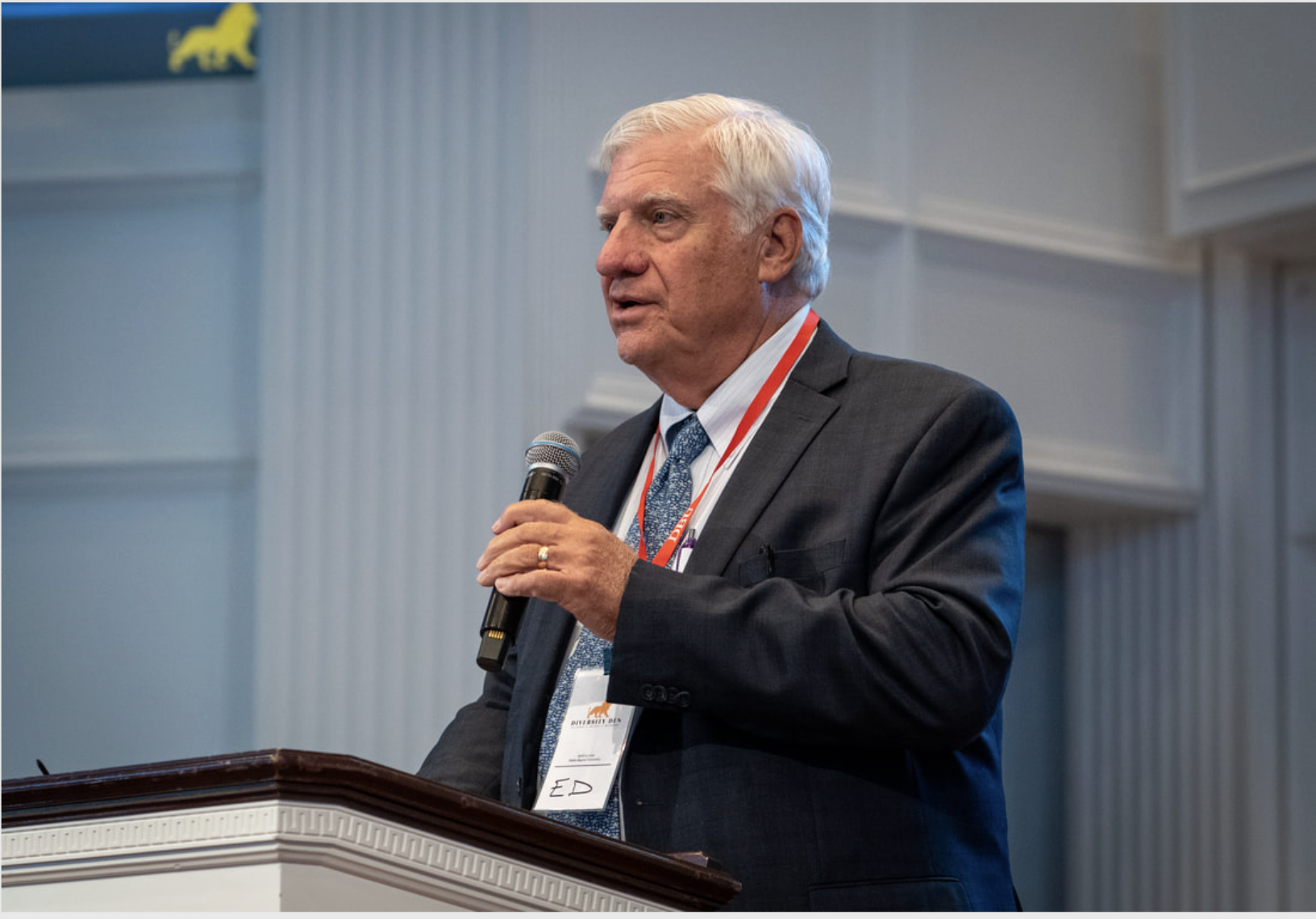
Ed Pearce thinks he can do better.
Pearce is a former general counsel turned investor and the founder of Lion’s Den, a Dallas-based pitch competition and investor network that has quietly put up numbers that would make the Shark Tank sharks uncomfortable. Forty-five percent of companies that pitch at Lion’s Den walk away with capital. The network has produced exits of $60 million, $88 million, and $180 million. Close to thirty portfolio companies are currently scaling toward their own exits, having grown from $1-3 million in annual revenue to $29-35 million. By any measure in venture capital, it is an exceptional track record.
The difference, Pearce will tell you, is that Lion’s Den runs on biblical principles. And the numbers suggest he might be onto something.
Pearce sat down recently with Rabbi Rami Goldberg on Biblical Money, the podcast produced by Israel365 exploring faith, finance, and the wisdom of the Hebrew Bible on wealth and business. Over the course of their conversation, Pearce laid out a vision of investing that is equal parts rigorous and idealistic – and, he argues, more profitable because of it, not in spite of it.
A Redemptive Shark Tank
The name Lion’s Den is a deliberate reference to the book of Daniel. The format borrows from Shark Tank – entrepreneurs pitch to a room of investors, capital changes hands, deals get done. But Pierce bristles at the comparison beyond the structural similarity.
“We don’t like vulture investors,” he said flatly. “We want people who are going to nurture the company, understand its purpose, and really come around the founders.”
In practice, this means Lion’s Den operates on what Pearce calls “patient capital” – the understanding that a company worth backing is worth giving time to breathe. The conference draws over 600 accredited investors, ranging from high-net-worth individuals to an $8 billion institutional fund out of Boston. They are vetted not just for their balance sheets but for their disposition toward the companies they back. The investors Pierce wants are not looking for a quick squeeze. They are looking for something to build.
This is not charity. Pearce is emphatic on that point. Lion’s Den deals exclusively in for-profit companies, and profitability is a genuine requirement. But profitability, in his framework, is a floor rather than a ceiling. Above it sits what he calls the “triple bottom line” – profit, social impact, and the ethical culture of the company itself. “You can be profitable by killing your employees,” Pierce said. “That’s not what we’re trying to do.”
What Faith Actually Does in a Deal Room
The obvious skeptic’s question is whether the faith dimension is real or decorative – whether it changes anything in the actual mechanics of evaluating a company or whether it is just branding for a certain kind of investor.
Pearce’s answer is that it changes everything, though not in the way most people expect. Lion’s Den does not require its companies or investors to sign doctrinal statements. Nobody checks a box at the door. “We don’t care whether you’re Baptist, Methodist, or somewhere in between,” Pierce said. “We just want people to come and experience good networking.”
What the faith framework actually produces, he argues, is a community with a shared set of assumptions about integrity, long-term thinking, and accountability – assumptions that happen to make for better business. The network that forms around the conference is tighter and more resilient than what you typically find in secular venture capital, precisely because the participants share a reason for being there that goes beyond the transaction. “You come to the conference for networking,” Pearce said, “and it’s faith-based networking. That’s just there.”
Rabbi Rami, who hosts Biblical Money through Israel365 – the Jerusalem-based organization at the forefront of building Jewish-Christian relationships around a shared commitment to Israel and the Hebrew Bible – pushed Pearce on how you actually measure a founder’s character when the financial statements only tell part of the story. There is no audited spiritual statement, after all.
Pearce acknowledged the difficulty. Part of the answer is rigorous pre-screening – Lion’s Den receives well over a hundred applicants annually and invests heavily in preparing the companies that make the final ten. Part of it is pattern recognition built over a decade of deals. And part of it, he admitted, is that the community itself functions as a filter. Founders who share the network’s values tend to find their way in. Founders who don’t tend to weed themselves out.
The Proof of Concept
Pearce’s best illustration of what all this looks like in practice did not come from a spreadsheet. It came from a lunch.
Allison and Stephen Ellsworth, this year’s keynote speakers at Lion’s Den, came out of Pearce’s church small group in Dallas years before anyone had heard of them. They went on Shark Tank with a probiotic beverage called Poppy, grew it with the help of their investor into a recognizable brand, and recently sold the company for two billion dollars.
Pearce had lunch with Allison shortly after the sale. He asked her the question anyone would ask. Was she going to buy a yacht? Dallas Cowboy owner Jerry Jones, he noted, has a hundred-million-dollar one.
She wasn’t. “That’s just a crazy investment,” she told him. “It costs more and more and more.”
For Pearce, that answer is the whole argument in a single sentence. The Ellsworths did not build a two-billion-dollar company by accident, and they did not lose themselves in the process of building it. They still want their children raised with the values they came in with. They are taking better vacations than they used to, Pierce noted with a laugh. But the yacht stays where it is.
In a venture capital world that has made a sport of excess and short-termism, that kind of groundedness is rarer than it should be. Pearce has spent ten years trying to make it less rare. The numbers suggest he is making progress.
To hear the full conversation, listen to the episode on Biblical Money, Rabbi Rami Goldberg’s podcast exploring faith, finance, Bible, and business.