




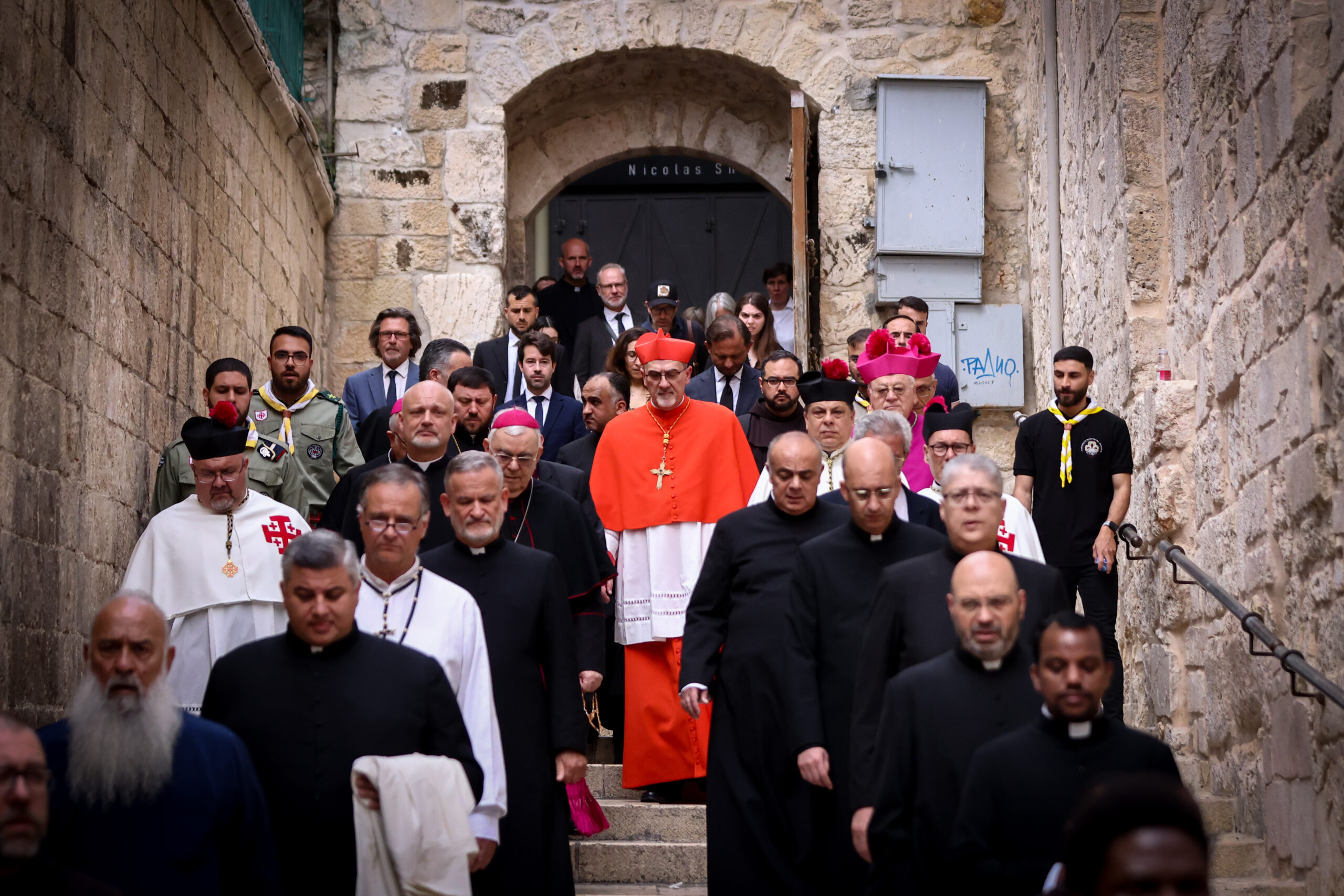
On Palm Sunday, Israeli police blocked Cardinal Pierbattista Pizzaballa, the Latin Patriarch of Jerusalem, and Father Francesco Ielpo, Custos of the Holy Land, from entering the Church of the Holy Sepulchre to lead prayers marking the start of Holy Week. The move triggered an immediate international storm — and within hours, Israel backed down. The condemnation ignored the guilty party that had caused the closure: the Iranian regime, which has targeted Jerusalem’s holy sites.
The Latin Patriarchate called the initial blocking a “grave precedent,” one that “disregards the sensibilities of billions of Christians” and constitutes “a manifestly unreasonable and grossly disproportionate measure.” The institutions led by Pizzaballa and Ielpo said it was the first such incident in centuries. The traditional Palm Sunday procession through Jerusalem was canceled entirely due to the Iranian missile attacks targeting Israel’s urban centers.
The international response was swift and sharp. French President Emmanuel Macron condemned the decision, warning of what he called “an alarming proliferation of violations of the status quo of Jerusalem’s Holy Sites” and calling for unrestricted worship for all religions. Italian Prime Minister Giorgia Meloni called it “an offense not only to believers, but to every community that recognizes religious freedom.” Italy’s Foreign Minister Antonio Tajani went further, declaring the move “unacceptable” and summoning Israel’s ambassador for clarification. Spain, Portugal, Poland, and Malta joined the criticism. U.S. Ambassador Mike Huckabee called it “an unfortunate overreach already having major repercussions around the world,” adding that blocking the Patriarch “for a private ceremony is difficult to understand or justify.”
Israel reversed course the same day. Jerusalem District Commander Deputy Commissioner Avshalom Peled and David Sub-District Commander Dvir Tamim met with a representative of the Latin Patriarchate and hammered out a framework allowing all Christian denominations to worship at the church under wartime conditions. Prime Minister Netanyahu then issued a direct order: “I have instructed the relevant authorities that Cardinal Pierbattista Pizzaballa, the Latin Patriarch, be granted full and immediate access to the Church of the Holy Sepulchre in Jerusalem.” His office stated there had been “no malicious intent whatsoever, only concern for his safety.”
The anger directed at Israel over Christian holy sites followed weeks of identical condemnation over its closure of Al-Aqsa Mosque, known in Jewish tradition as Har HaBayit, the Temple Mount, Judaism’s holiest site, to Muslim worshippers. Israeli authorities barred Muslims from Friday prayers at Al-Aqsa for four consecutive weeks. That closure, too, generated widespread outrage, framed by media outlets and foreign governments as an act of Israeli religious oppression.
What both waves of condemnation ignored was a plain fact: Israel closed every holy site in Jerusalem’s Old City to all religions equally. Since March 6, the Church of the Holy Sepulchre, Al-Aqsa Mosque, and the Kotel, the Western Wall, have all been sealed under the same Home Front Command security directives. No religion received preferential treatment. No religion was singled out. Every worshipper — Christian, Muslim, and Jewish — was barred from their holiest ground for the same reason: Iranian missiles.
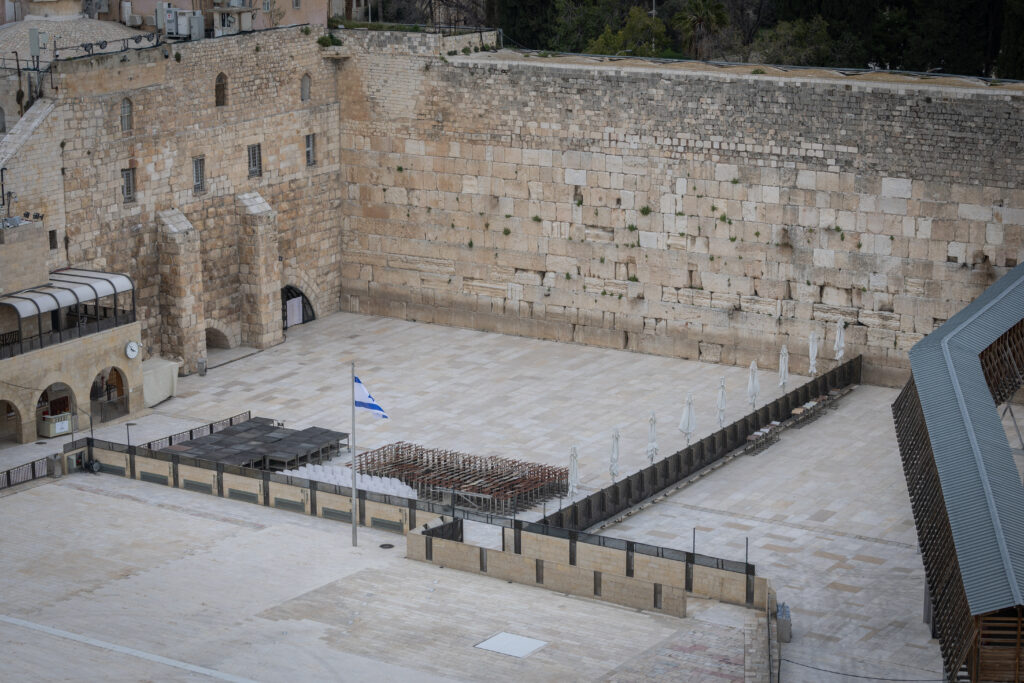
The concern was real. Earlier this month, fragments from intercepted Iranian missiles fell across Jerusalem’s Old City, landing near the Temple Mount, the Western Wall, and the Church of the Holy Sepulchre. Minor structural damage was reported in the Jewish Quarter. The Old City’s medieval alleys cannot accommodate emergency vehicles; a single missile fragment in that terrain can be catastrophic. Israel’s security authorities capped gatherings nationwide at 50 people, contingent on proximity to shelters, and sealed the Old City to all but residents and shopkeepers.
Not only do the Iranian attacks violate international law by using anti-personnel cluster ammunitions to target civilians, but by targeting the Temple Mount, the Islamist regime is preventing the vision of the prophet Isaiah who wrote: “My house shall be called a house of prayer for all peoples.” (Isaiah 56:7). Iran has been targeting that house. Its missiles have fallen on ground sacred to three faiths. Yet not one of the governments that rushed to condemn Israel over the Palm Sunday incident — not Macron, not Meloni, not Huckabee — issued a parallel condemnation of the Islamic Republic for targeting Jerusalem in the first place.
The media coverage compounded the distortion. The watchdog organization CAMERA documented how a Guardian article and accompanying video framed the Al-Aqsa closure as an Israeli effort to “entrench control over Jerusalem’s most sensitive holy sites”, while making no mention that the Church of the Holy Sepulchre and the Western Wall were closed under the same directives. The Guardian piece even described Jewish visitors to the Temple Mount as conducting “incursions”, language lifted directly from Palestinian Authority and Turkish state media. It referred to those visitors as “settlers,” a categorically inaccurate claim, since there is no way to determine whether any individual Jewish visitor to the site lives within Israel’s 1949 boundaries or in Yehuda v’Shomron, Judea and Samaria.
France 24 covered the same closures accurately, reporting that Israeli authorities had shut Al-Aqsa for Muslims, the Church of the Holy Sepulchre for Christians, and the Western Wall for Jews, a straightforward presentation of what actually happened. After CAMERA filed a complaint, Guardian editors corrected the article, adding language acknowledging that the closure applied to all holy sites in the Old City. The video report has not been corrected.


