
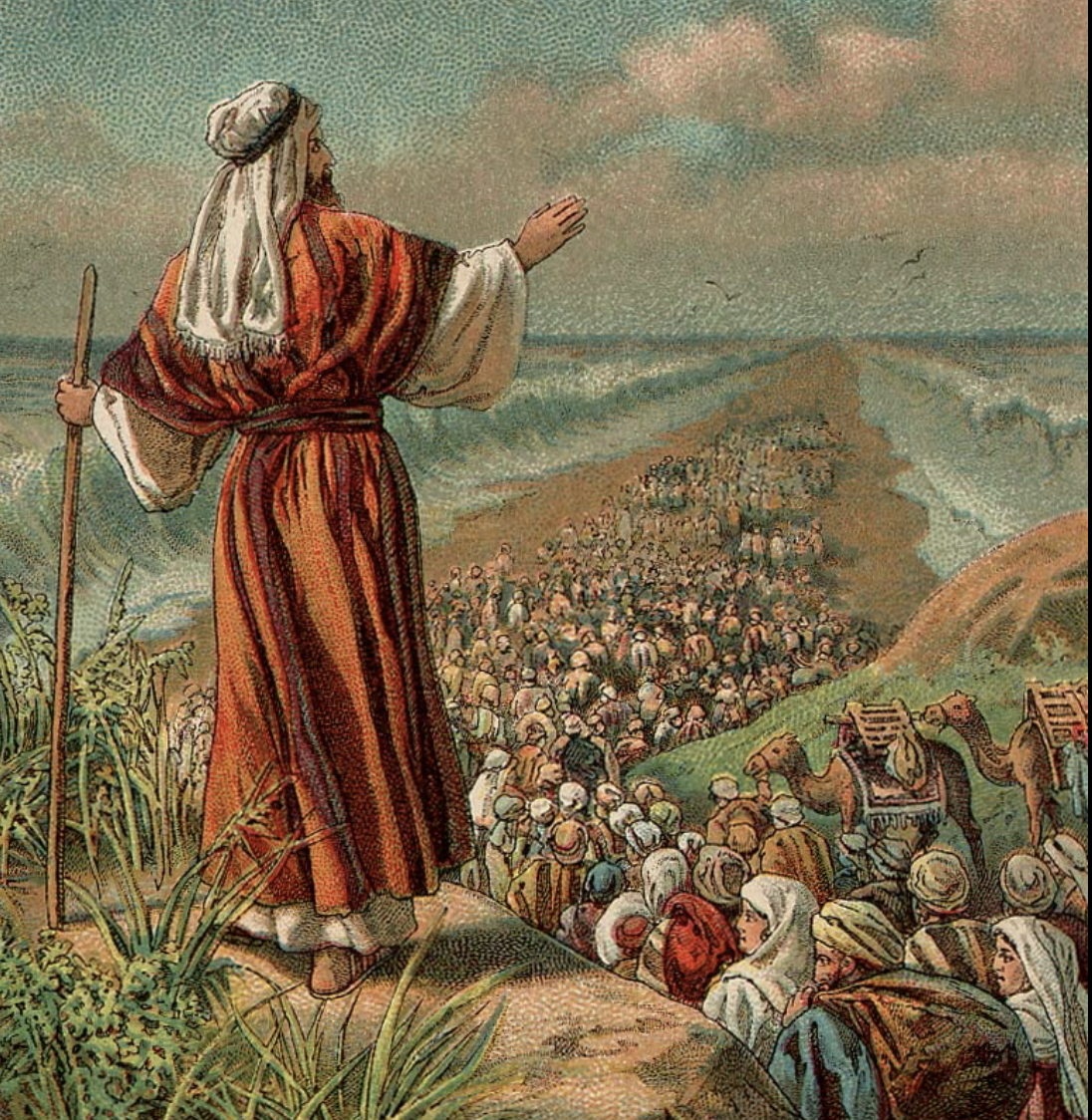
The Passover seder tells the story of the Exodus in extraordinary detail. It goes through the ten plagues one by one. It recounts Pharaoh’s stubbornness, the suffering of the slaves, the night of liberation. And in all of that, across the entire text of the Hagada, which has been recited by Jews at their seder tables for over two thousand years, Moses is never mentioned. Not once.
Moses was the greatest prophet in Jewish history, the man God spoke to face-to-face, the central figure of the entire Exodus story. And yet the Sages made sure the seder would not be about him. Their reasoning was straightforward: if you walk away from the evening remembering Moses, you’ve missed the point. God redeems. Not Moses, not any particular leader, not any human being who happened to be in the right place at the right time. The seder teaches that lesson so thoroughly that it removes even the temptation.
That insight was one of many in a wide-ranging pre-Passover webinar hosted by Israel365, where Rabbi Pesach Wolicki and Rabbi Rami Goldberg walked viewers through the seder from beginning to end. Watch the full webinar here.
Rabbi Wolicki opened with a question most people have never thought to ask: why is the entire evening called a seder? The word isn’t Hebrew for celebration or memorial or feast. It means, simply, order — a sequence of steps. Why would Jews name their most beloved ritual after something so mundane?
Because the name is the point. The seder’s fixed structure of 15 steps, its specific foods, its songs — all of it is making a theological argument without stating it outright. History has a structure. It is not chaos. There is a God who governs it, and the entire arc of Jewish experience, from slavery in Egypt to the ingathering of exiles in our own time, is one coherent story moving toward redemption. “To people who don’t believe in a God who controls history,” Rabbi Wolicki explained, “there is no connection between what happened yesterday, what happens today, and what happens tomorrow. But in the biblical perspective, all of history is one story — one long sweep where God is in control.”
That argument runs beneath every ritual of the evening, but nothing makes it more memorable than the song Dayenu.
Dayenu means “it would have been enough for us.” The song lists, one by one, the things God did for the Jewish people during the Exodus, and after each one, the whole table sings: dayenu — it would have been enough. Here are a few lines from the song:
Had God taken us out of Egypt but not punished the Egyptians — dayenu, it would have been enough. Had he split the sea for us but not brought us across it on dry land — dayenu, it would have been enough. Had he brought us to Mount Sinai but not given us the Torah — dayenu, it would have been enough. Had he given us the Torah but not brought us into the Land of Israel — dayenu, it would have been enough.
Read literally, the song makes no sense. What good is splitting the sea if you don’t cross it? What would standing at Sinai without receiving the Torah even look like? Rabbi Wolicki explained: “When we say it would have been enough for us, it doesn’t mean we would have been totally satisfied. It means that every step of the journey, all by itself, is reason enough to praise God.” Gratitude doesn’t have to wait for the finish line. Every step God takes toward us is worth acknowledging, even when the journey isn’t over.
Dayenu is also, in a quiet way, a song about living in the middle of the story — grateful for what God has done, while knowing the journey isn’t finished. That’s not an abstract feeling for Jews in Israel right now. It’s daily life. Families have husbands and fathers on reserve duty. Businesses have been shuttered for months. And Passover is arriving — a holiday that is, among other things, expensive. Matzah, wine, the seder plate, a festive meal — for a struggling family right now, it all adds up fast.
| Help Needy Israeli families celebrate Passover this year.Israel365 is raising funds to help feed needy families across Israel who cannot afford to mark the holiday. The Hagada itself opens with an Aramaic paragraph — one of its oldest lines — inviting anyone who is hungry to come and eat. That’s not just poetry. It’s a commandment. If you’ve been moved by the story of Passover, this is a direct way to live it.Feed the Needy this Passover |
The seder service itself opens with a powerful invitation: “All who are hungry, come and eat,” welcoming everyone in need to join us at our table. This is why Israel365 is raising funds this Passover to help feed needy Israeli families who cannot afford to mark the holiday. Donate here.