

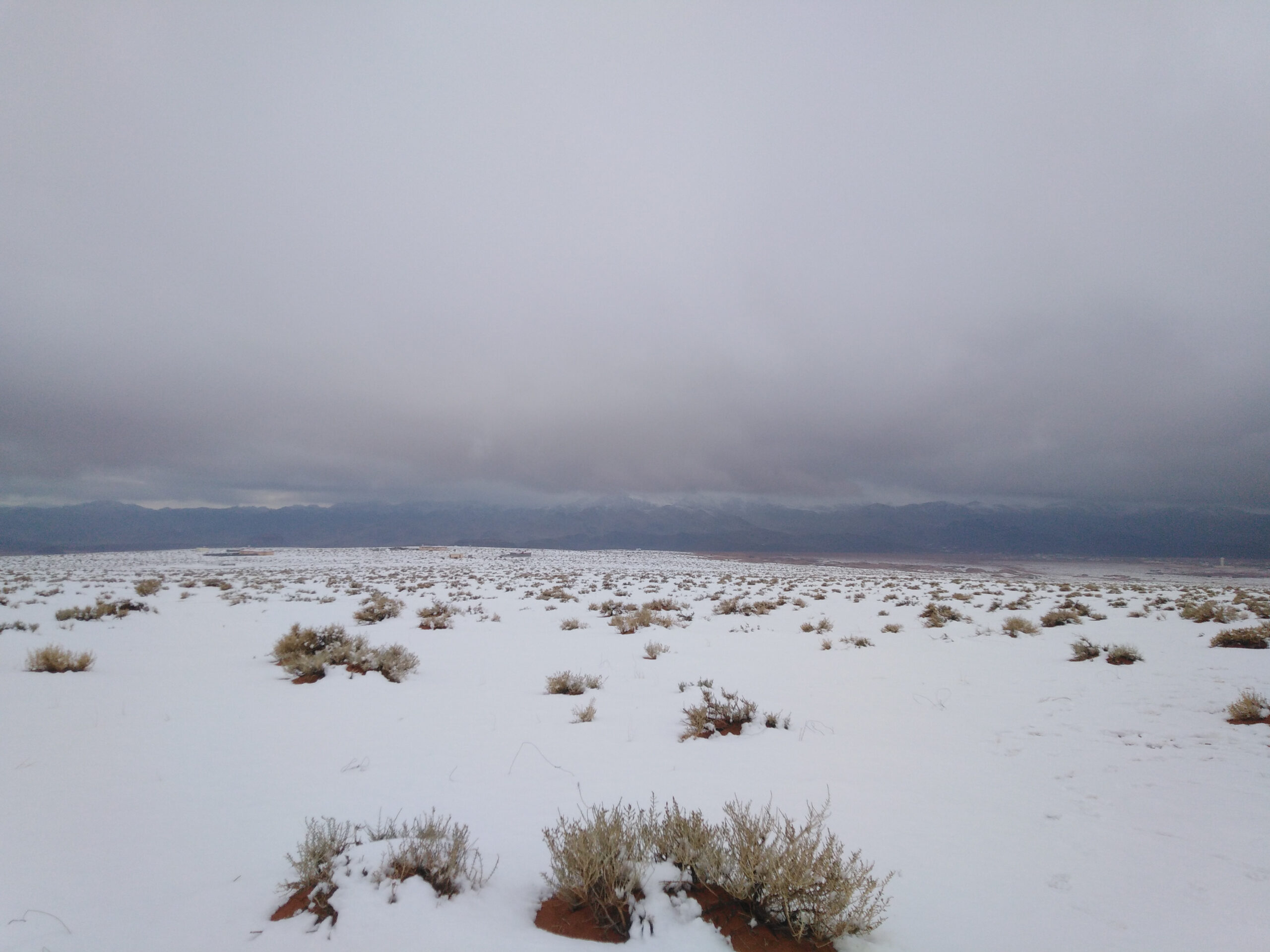
A rare snowfall blanketed parts of the Arabian desert this week, turning stretches of land along the Saudi–UAE border into a continuous white expanse and drawing widespread attention after video footage spread on X. One clip shows a car driving through snow-covered terrain under heavy gray clouds, with camels visible standing on ground that is normally parched and brown. The scale of the snowfall is striking, covering vast open areas rather than isolated hills or peaks.
According to Khaleej Times, meteorologists said the snowfall and accompanying rainfall were caused by a powerful weather system that pushed temperatures below freezing in higher-altitude regions. A prolonged period of low-pressure systems over the Middle East brought heavy rain across the region in recent days, creating conditions that allowed snow to fall in areas where it is rarely seen. Temperatures reportedly dropped to as low as minus four degrees Celsius, with forecasts indicating snow could even reach the northern parts of Riyadh.
Snow was reported on December 18 in parts of Saudi Arabia and Qatar. Residents in northwestern Saudi Arabia celebrated the event, with footage showing adults and children singing and dancing as snow fell across the desert landscape. While such scenes are unusual, they are not entirely without precedent. Regions such as Tabuk, Hail, Al Jouf, and surrounding desert areas are known to experience occasional winter snowfall when cold air masses collide with moisture-laden systems moving in from the Mediterranean.
Snow blankets Jabal al-Lawz in Saudi Arabia's Tabuk with temperatures dropping to -4 degrees Celcius. pic.twitter.com/S97WnlHELo
— Al Arabiya English (@AlArabiya_Eng) December 18, 2025
Gulf News quoted Saudi astronomer Mohammed bin Reddah Al Thaqafi, who said that winter snowfall in parts of the Kingdom is a recurring phenomenon rather than a true anomaly. He explained that northern Saudi Arabia can experience snow between December and February, though the timing is irregular and dependent on shifting weather patterns rather than any predictable cycle. Al Thaqafi identified areas such as Jabal Al Lawz in Tabuk, mountainous regions of Hail, parts of Al Jouf and the Northern Borders, and the highlands of Abha in Asir as the locations most likely to record snowfall. Some winters pass with little or no snow, but these regions remain the most consistent for such events.
The Bible presents snow not as a meteorological surprise but as something fully under Divine control. In Job, God confronts human certainty about the natural world: “Have you entered the storehouses of the snow, or have you seen the storehouses of the hail?” (Job 38:22). Snow is described not as an accident of nature but as something stored and released by God at His discretion. The verse emphasizes authority, not wonder.
The Sages taught that the weather is not background noise to history. It is one of the instruments through which God governs the world. When snow falls in a desert known for heat and drought, it exposes how fragile human expectations really are. The landscape people assume will always remain the same can be overturned overnight.
#VIDEO: A rare scene as snow falls over Al-Ghat governorate, north of Riyadhpic.twitter.com/sMdA6zN4LL
— Saudi Gazette (@Saudi_Gazette) December 18, 2025
Such rare weather patterns may very well be a sign of the Messianic era, as the prophet Isaiah speaks repeatedly of deserts blooming in his description of the end of days.
The arid desert shall be glad, The wilderness shall rejoice And shall blossom like a rose. Isaiah 35:1
I am about to do something new; Even now it shall come to pass, Suddenly you shall perceive it: I will make a road through the wilderness And rivers in the desert. Isaiah 43:19
The prophet also understands snow to be a fortuitous omen that signifies God’s forgiveness.
“Come, let us reach an understanding, —says Hashem. Be your sins like crimson, They can turn snow-white; Be they red as dyed wool, They can become like fleece.” Isaiah 1:18
#PICTURES: A layer of snow on the highlands of Trougina pic.twitter.com/WAuyDYwgAN
— Saudi Gazette (@Saudi_Gazette) December 17, 2025
The snowfall in the Arabian desert is not just a striking visual. It is a reminder written across the land that nature does not answer to climate averages or long-term assumptions. The Bible insists that control over the elements belongs to God alone, and events like this force that reality into plain view, even in places defined by sand and sun.