


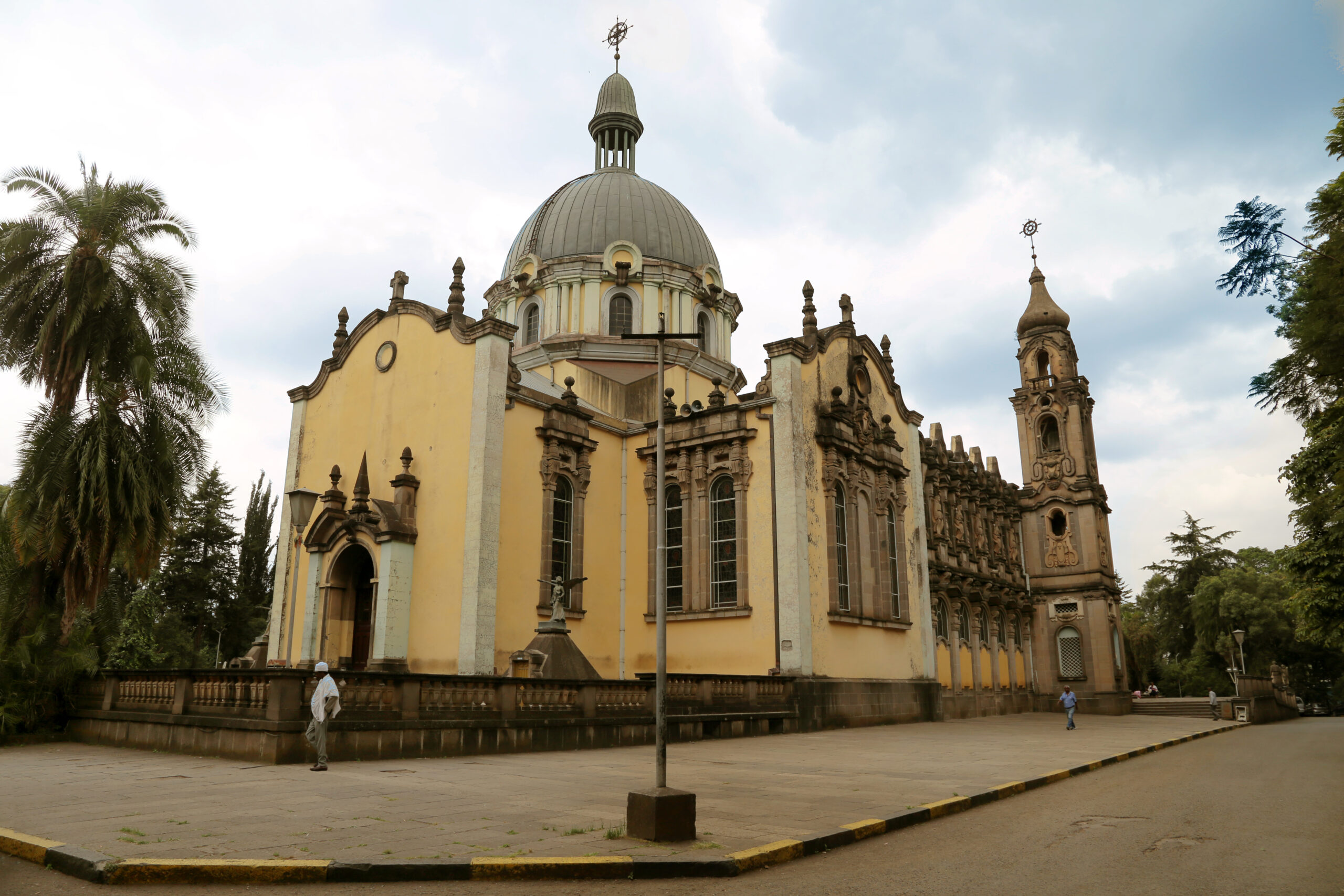
Thirty-six Orthodox Christians were lowered into a single grave at St. Raphael Church in the Ethiopian village of Chole this week, victims of a Saturday massacre that tore through farming villages in Ethiopia’s Oromia region. Children and elderly people were among the dead. The killing came one day after masked gunmen opened fire on a church funeral in Karak, Jordan.
Armed men attacked Orthodox Christian villages and churches in the Shirka district of East Arsi Zone, about 170 miles south of the capital, Addis Ababa, on Saturday, October 24. Residents and the Armed Conflict Location and Event Data project (ACLED) told AFP that at least 43 people were killed and 18 wounded. The Arsi diocese of the Ethiopian Orthodox Tewahedo Church counted 42 dead. Other local counts reached 51, and some bodies had not yet been recovered.
The church’s Holy Synod puts the toll higher. It confirmed that at least 60 Orthodox Christians were killed and 20 injured in attacks between October 20 and 24, with 46 killed in Shirka and 14 in the neighboring Merti district. Twenty homes were burned to the ground.
“The attack is said to be religiously motivated and to have targeted Orthodox Christians,” ACLED said. The gunmen hit the Chole, Birbo and Sole areas of the district. They struck the Digelu Medhane Alem Church, looting and damaging it, and torched and looted homes. The assault set off clashes with local militias that lasted through Saturday afternoon and evening.
The attackers also took hostages. “My sister and uncle were killed, and several of my relatives were taken hostage in Chole ward of Shirka district,” one resident told AFP by phone, asking to remain anonymous.
Survivors told BBC Amharic that security forces stationed nearby reached the area but failed to stop the killing. A deacon from one of the targeted churches said, “We are deeply shocked by these tragic killings and are appealing to the government to intervene and restore security.” One local official blamed a rebel group called the Alliance for Survival. The state-run Ethiopian Human Rights Commission said only that it was “following the situation.”
The Arsi zone is majority Muslim, and Orthodox Christians live there as a minority.
Christianity is Ethiopia’s largest religion, practiced by 59% of the population. King Ezana adopted the faith in the fourth century CE, making Ethiopia one of the first kingdoms in the world to officially embrace Christianity, and it has survived the expansion of Islam as a Christian state.
Gunfire at a funeral in Jordan
The day before, on Friday, October 23, gunmen attacked a funeral at the Greek Orthodox church in the village of Hamoud, in Jordan’s Karak governorate, about 110 miles south of Amman. Three masked gunmen fired into the crowd from behind trees and a wall, then stormed the church courtyard, shouting “Allahu Akbar” as they shot. Between 150 and 200 mourners were inside and outside the church. The death toll rose to nine on Saturday, with nearly 40 wounded.
“All of a sudden, three masked men appeared, armed with automatic weapons, and began firing indiscriminately at those of us standing outside,” witness Saed al-Halaseh recalled. Another mourner, Dorgham Halasa, said the gunfire erupted 15 minutes into the funeral. “It was a weird situation, and heavy gunfire,” he said.
Jordan’s Interior Minister Mazen Al-Faraya called it a “terrorist attack carried out by a group of extremists.” King Abdullah II wrote that “the terrorist attack against Karak will be met with the harshest retaliation” and vowed to punish the perpetrators “with an iron fist.”
Prime Minister Jafar Hassan said the attack was the product of terrorist ideology and blind extremism rooted in takfir, the jihadist practice of branding others as infidels whose blood may be shed.
Jordan declared three days of national mourning. Greek Orthodox Patriarch of Jerusalem Theophilos III condemned the attack as “vile and cowardly.”
Christians make up between two and three percent of Jordan’s population, and Karak is home to one of the kingdom’s largest Christian communities. The city has been targeted before. In 2016, Islamic State terrorists holed up in Karak’s Crusader-era castle and killed 10 people, including security officers and a Canadian tourist.
A year of bloodshed across Africa
Shirka has been hit again and again. By March, the death toll there had already reached 164 for the year. Between May 30 and June 1, as Ethiopia held its general elections, gunmen killed at least 37 Orthodox Christians across East Arsi, burned churches and torched more than 280 houses. One resident told the BBC that the attackers planted the flag of the Oromo Liberation Army as they advanced. The Ethiopian Human Rights Council has documented 432 civilians killed in targeted attacks on Orthodox Christians in East Arsi since 2021, with more than 14,000 driven from their homes.
Ethiopia is one front in a continent-wide war on Christians. Open Doors’ 2026 World Watch List counted 4,849 Christians killed for their faith worldwide in its reporting year, and 4,490 of those killings took place in sub-Saharan Africa. Nigeria alone accounted for 3,490. In Nigeria’s Benue State, 1,310 Christians were killed compared with 29 Muslims. In Plateau State, the count was 546 Christians and 48 Muslims. Open Doors calculates that a Christian is killed for his faith in sub-Saharan Africa every 1.95 hours.
The attacks of 2026 include:
- Nigeria, Palm Sunday: Gunmen opened fire in the streets of Angwan Rukuba, a mostly Christian community in the city of Jos, killing at least 27 people.
- Nigeria, Easter: Gunmen raided a Catholic church and an evangelical church in Ariko, Kaduna State, killing at least five. Troops rescued 31 worshippers abducted from the Easter services.
- Nigeria, April 21: Islamic State West Africa Province (ISWAP) terrorists killed 12 Christians and burned a church in Adamawa State.
- Nigeria, July: At least 30 Christians were killed in the village of Naridon, Kaduna State. “Every month, we bury our people,” local official Stephen Hajara told International Christian Concern.
- Nigeria, October: Gunmen stormed the rectory of Holy Trinity Catholic Church in Karku, Kaduna State, killing three people and abducting 11, including the parish priest.
- Democratic Republic of Congo, Maundy Thursday: The Islamic State-linked Allied Democratic Forces (ADF) attacked Bafwakao village, killing at least 43. “The attackers surprised the population in their sleep; the victims were killed by gunfire, and several were beheaded with machetes,” a local civil society representative said.
- Democratic Republic of Congo, May: ADF terrorists slaughtered 21 people in Biakato on May 13 and killed 17 more Christians in Mambasa territory on May 19.
- Democratic Republic of Congo, June 2: ADF fighters killed at least 24 Christians in Mbau, near Beni, among them a local pastor and his wife.
- Burkina Faso, May 11: Islamists killed 21 people in Kokoana, near the border with Mali, deliberately hunting down Christian leaders. “The terrorists went to the home of Pastor Etienne Keïta and murdered him in front of his family,” a local worker said.
- Mozambique, February 23: Islamic State Mozambique captured and executed two Christians on the road in Cabo Delgado’s Macomia district. The group has killed an estimated 2,000 Christians in the province since 2017.
President Trump designated Nigeria a Country of Particular Concern last year, writing, “Christianity is facing an existential threat in Nigeria.” On Christmas Day, he ordered strikes on Islamic State camps in Nigeria’s Sokoto state. In January, he warned, “If they continue to kill Christians, it will be a many-time strike.”
Secretary of War Pete Hegseth backed the president: “Either the Nigerian government protects Christians, or we will kill the Islamic terrorists who are committing these horrible atrocities.” In May, Nigeria’s Defence Headquarters announced that more than 20 ISIS/ISWAP fighters were killed in joint U.S.-Nigerian air strikes in Metele, Borno State. Speaking in Washington in June, Trump said, “As you know, we recently struck Nigeria and largely ended the slaughter of great Christian populations. You know, we hit them very hard. We knocked out their leader. We knocked out their second leader and their third leader.” Attacks on Nigerian Christians have continued since, including the July massacre in Naridon and this month’s raid on the rectory in Karku.
Israel’s stake
Prime Minister Benjamin Netanyahu has framed the persecution of Christians as part of a global war on the Judeo-Christian West. Addressing Christian leaders in the United States in January, he described radical Shi’ite Islam led by Iran and radical Sunni Islam driven by the Muslim Brotherhood, with Qatar and Turkey as its backers. He said that only one country in the region consistently protects Christians and allows them to thrive: Israel.
Rabbi Pesach Wolicki, executive director of Israel365 Action, wrote in an op-ed published by Israel365 News that Netanyahu’s remarks deserved far more attention than they received. Nine of the 13 countries where Open Doors ranks Christian persecution as most extreme are Muslim-majority states, he noted. “Slaughter of Christians is not a deviance in these countries: It is a systemic feature of jihadist Islamist rule,” Wolicki wrote. He described the regular massacres of Christian villages in Nigeria as “October 7-style attacks” that Western media ignore.
Wolicki argued that Israel defends Christians “as a strategic imperative,” alongside the moral one. “Jerusalem understands what too many Western leaders still refuse to admit: Jihadist Islam cannot be accommodated, but must be confronted and defeated,” he wrote. “After October 7, Israel has learned that it cannot secure its future by defending borders alone.”
The numbers bear out Netanyahu’s claim. Christians now make up just 3% of the population of the Middle East and North Africa, down from 13% a century ago, according to Pew Research Center figures cited by Israel365 News. Israel runs the other way: its Christian population has grown from about 34,000 at the state’s founding in 1948 to more than 185,000 in 2025. Christians in Israel serve in the Knesset and the government, volunteer for the IDF in growing numbers, and attend university at higher rates than the general population.
Under Palestinian Authority and Hamas rule, the picture is the reverse. Bethlehem was 86% Christian in 1948 and is less than 12% Christian today. Gaza’s Christian community under Hamas has collapsed to fewer than 1,000 people.
Ethiopia’s Jews still waiting
Ethiopia’s remaining Jews are caught in the same war. Thousands with close family in Israel wait in Gondar and Addis Ababa for permission to make aliyah (immigration to Israel). Gondar, once the capital of the Ethiopian empire and a historic center of the Beta Israel (House of Israel) community, sits in the Amhara region, where the army has battled the Fano militia since 2023. In September, seven armed groups, including Fano and the Tigray People’s Liberation Front, announced an alliance against Prime Minister Abiy Ahmed’s government.
The line between Ethiopia’s persecuted Christians and its waiting Jews runs through many families. Most of those waiting are Falash Mura, descendants of Beta Israel Jews whose families converted to Christianity under pressure in the 19th and 20th centuries. Israel365 News reported in 2023 that two-thirds of immigrants from Ethiopia between 2020 and 2022 identified as Christians, according to Population and Immigration Authority data analyzed by the Israeli Immigration Policy Center (IIPC). Of the more than 5,000 who arrived in Operation Tzur Israel, 3,301 identified as Christians and about 1,773 as descendants of Jews. None qualified under the Law of Return. They received citizenship as a humanitarian act of family reunification and must convert to Judaism after arriving. Since 2000, only about 10% of Ethiopian immigrants have identified as Jews on arrival.
Dr. Yona Cherki of the IIPC said many of the immigrants have no proof of their claimed Jewish ancestry. “The State of Israel should enable every Jew who wishes to immigrate to Israel to do so,” Cherki said. “Conversely, those who are immigrating don’t hold the right to do so.” In 2024, then-Ashkenazi Chief Rabbi David Lau warned the Aliyah Ministry that Christian missionaries were infiltrating Israel through the Ethiopian aliyah program and called for the program to end.
Aselachao Ababa, an aliyah activist from Lod, told Walla last month that his relatives in the Gondar area live in constant fear. “They are afraid. They can’t move around freely,” he said. “Yesterday, they told me about a neighbor of theirs who was killed, and they sent me pictures of a house that was completely damaged by gunfire.”
His family has already paid a price. “My relatives were kidnapped, and we had to pay a ransom from the whole family,” Ababa said. Travelers are stopped on the roads, he added, especially those known to be coming from Israel. One relative, whose parents already live in Israel, has been moved from place to place out of fear he will be kidnapped. “There has been no aliyah for four years,” Ababa said. “People here are worried, and the people there are still waiting.”
The community has buried its own before. In 2023, three people waiting in Gondar to join family in Israel were killed in shootings during unrest in Amhara, and Israel evacuated more than 200 Israeli citizens and Ethiopian Jews from the city during fighting between the army and Fano. In November 2020, Girmew Gete, 36, became the first member of Gondar’s Jewish community killed in the Tigray war.
Before calling new elections, Israel’s government committed to the expedited absorption of another 7,000 immigrants from Ethiopia and India. The International Christian Embassy Jerusalem (ICEJ), which has sponsored flights for more than 3,400 Ethiopian immigrants over the past 15 years, is raising funds to bring them home. A recent group of 27 Ethiopian Jews arrived on ICEJ-sponsored flights, among them a 92-year-old grandfather. Another arrival, 62, had set out through Sudan 38 years ago and was abducted and separated from his family. His name was inscribed on the Mount Herzl memorial to Ethiopian Jews who died on the journey to Israel. When he finally reached Jerusalem, his name was removed from the list of the dead.

