


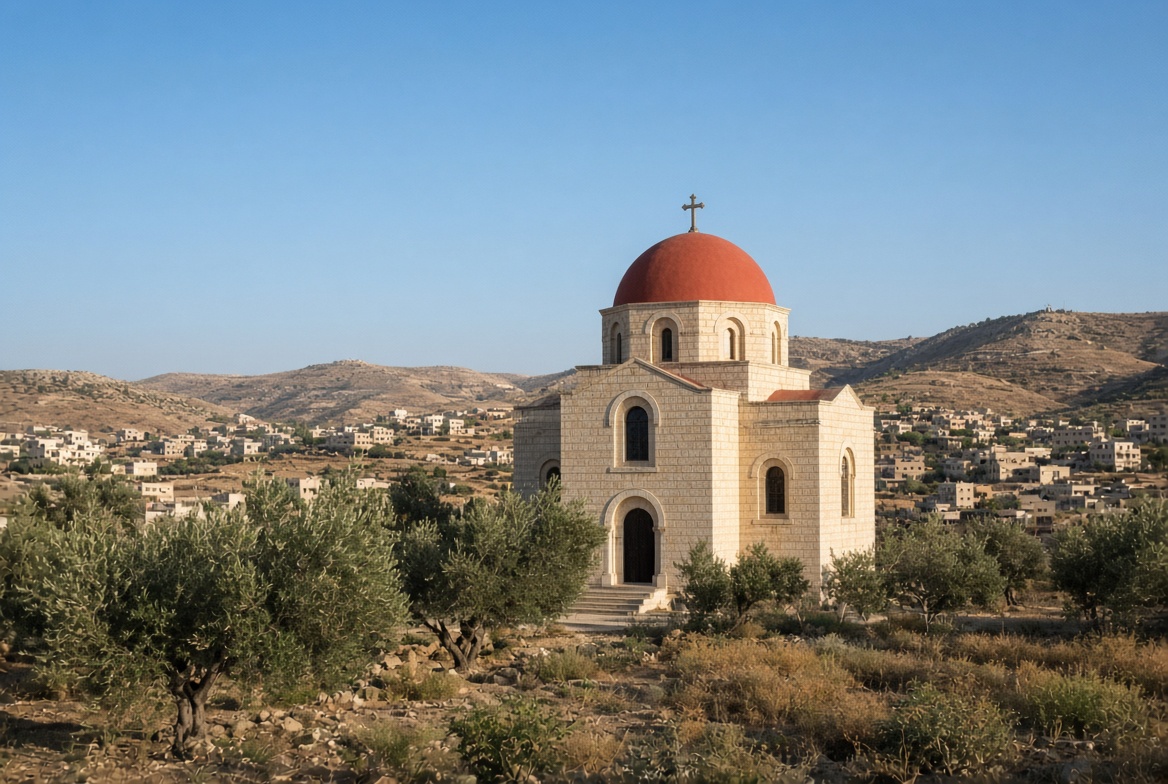
The massacre exposes the lie Tucker Carlson has sold American Christians: that Jordan is a haven for Christians and Israel is their enemy.
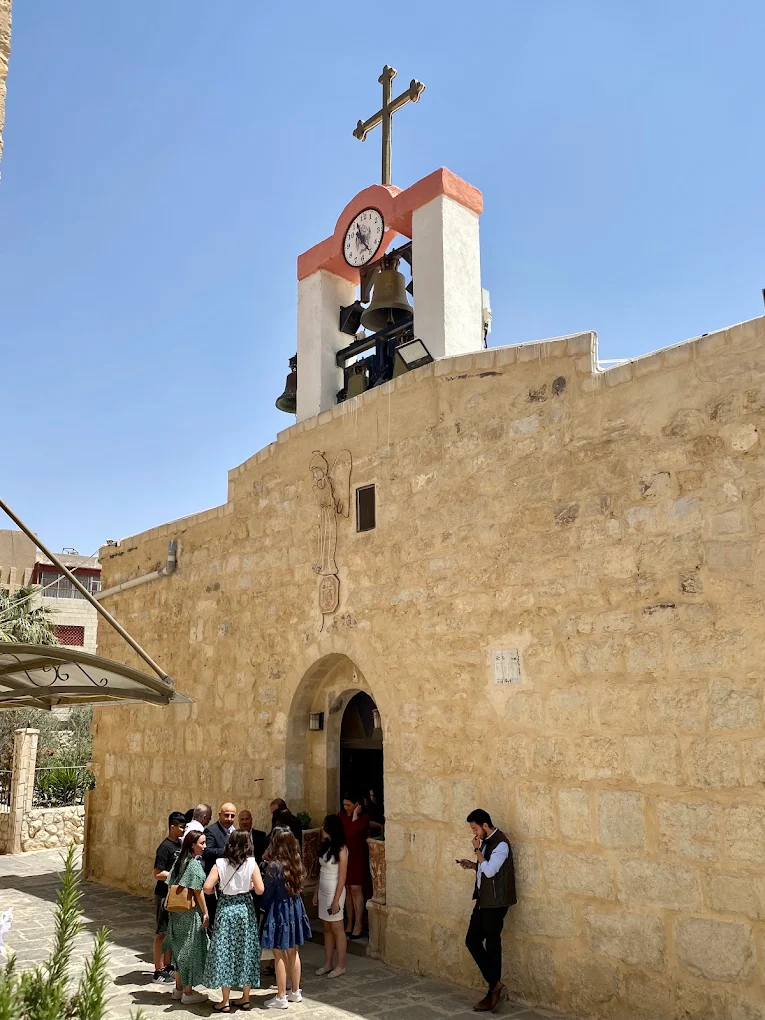
The mourners had gathered at St. George’s Greek Orthodox Church to bury one of their own. Fifteen minutes into the service, the shooting began. Three masked gunmen fired into the crowd from behind trees and a wall, then stormed the church courtyard, shouting “Allahu Akbar” as they shot. When it was over, at least eight Christians were dead and some 40 wounded in the village of Hamoud, in Jordan’s Karak governorate, in what Jordan’s prime minister called the product of “extremist terrorist ideology rooted in takfir,” the jihadist practice of branding others as infidels whose blood may be shed.
The attack
The attack took place on Friday afternoon, October 23, about 55 miles south of the capital, Amman. Between 150 and 200 people were inside and around the church when the gunmen arrived by car, according to witnesses. Most of the victims were between 50 and 70 years old.
CCTV footage verified by the BBC shows two gunmen entering through the church’s vehicle gate, pulling back, and returning with a third man carrying a semi-automatic rifle. Survivors told the Jordanian channel Al-Mamlaka they heard an explosion as the funeral procession began. Other footage shows the attackers firing at a group of men trying to flee the building.
“We were more than 150 people inside and outside the church,” survivor Dorgham Halasa told the Associated Press. Another witness told CNN that the shooting went on for a long time, with the gunmen shouting “Allahu Akbar” as they fired into the courtyard where most of the mourners stood.
Survivor Saed al-Halaseh, who hid behind a car, said the gunmen returned to finish off the wounded. “It was truly a massacre,” he said.
Jordan’s Petra News Agency put the death toll at eight, including a woman who died of her wounds hours after the attack. Other outlets reported nine dead. Of the 40 wounded, 27 remained hospitalized on Saturday. A Muslim funeral-goer was among those shot outside the church.
Jordan, and especially Karak, has been seen as a symbol of religious coexistence, al-Halaseh claimed, despite Israeli Jewish visitors to the kingdom routinely recounting Jordanian authorities banning the entry of religious Jewish items such as phylacteries (tefillin) or a tallit. About 90 kilometers (55 miles) south of the capital, Amman. Karak is home to a minority Christian population.
‘Rooted in takfir’
Jordanian officials have not named a group, but they have named an ideology.
“What happened in Karak was the result of extremist terrorist ideology rooted in takfir (declaring others to be infidels), and we will not allow society to go down this path,” Prime Minister Jafar Hassan said, according to Petra. Takfir comes from the Arabic word kafir, meaning unbeliever, and refers to declaring a person an infidel or apostate. Mainstream Islamic scholarship hedges the practice with strict limits, but jihadist movements such as ISIS and al-Qaeda wield it broadly: once a person is declared an infidel, his life and property are considered forfeit. ISIS used takfir to justify the slaughter of Christians, Yazidis and Shiite Muslims across Iraq and Syria, as well as fellow Sunnis who refused its rule. When the head of Jordan’s government blames takfiri ideology, he is pointing directly at that jihadist worldview.
Interior Minister Mazen al-Faraya called the attack “unprecedented” and said it was carried out by “a group of extremists” with “no relationship to humanity.”
King Abdullah II visited the wounded at Prince Ali Military Hospital and vowed that “the terrorist act that targeted Karak” would be met “with the harshest penalties.” He ordered a review of the kingdom’s security procedures for responding to terror attacks. The government declared three days of national mourning.
Counterterrorism analyst Rohan Gunaratna attributed the attack to the Islamic State and published a claim, attributed to the group, stating, “We have tortured the Christians of Karak in retaliation for Islam and the Islamic State.” He reported that authorities identified three suspects from a single local family within an hour of the attack. Jordanian authorities have not confirmed the claim, and the government continues to describe the attackers as unknown assailants. As of Sunday, the gunmen remained at large and no arrests had been announced.
Karak has been targeted before. In December 2016, ISIS claimed a series of shooting attacks in the city, ending in a standoff at Karak’s Crusader castle, that killed seven police officers, two local civilians and a Canadian tourist.
Jordan’s Christians have been targeted before, though never on this scale. In 2008, a Lebanese Christian choir was attacked in Amman, and that same year saw an attempted attack on churches and a Christian cemetery. In 2009, security forces foiled a plot to bomb a Roman Catholic church. In September 2016, Nahed Hattar, a writer from a Christian family, was shot dead on the steps of an Amman courthouse, where he was standing trial for “insulting Islam” after sharing a cartoon that mocked the Islamic State’s vision of paradise. In August 2018, an ISIS-inspired cell bombed a police vehicle at a music festival in Fuheis, a predominantly Christian town near Amman; the raid that followed left five security personnel dead. Counterterrorism analyst Rohan Gunaratna called the Karak massacre a notable departure from the attacks Jordan has experienced over the past two decades: this time, the target was a Christian funeral and a church.
The Karak massacre also follows a pattern of jihadist attacks on churches across the region. In June 2025, a suicide bomber struck Mar Elias Church in Damascus during Sunday services.
International condemnation
Lebanese President Joseph Aoun, the Arab world’s only Christian head of state, called the shooting a “heinous terrorist attack.” The U.S. Embassy in Amman offered “our most heartfelt condolences to the victims and survivors of the terror attack today at a church in Karak.” A spokesman for UN Secretary-General Antonio Guterres said an attack “not only on a place of worship but during a funeral procession is especially heinous.”
The Tucker Carlson narrative
The massacre lands on a claim that has gained ground among some American conservatives: that Christians in the Middle East are safer under Muslim rule than in Israel.
In August 2025, Tucker Carlson hosted Mother Agapia Stephanopoulos, an American-born Orthodox nun who spent years in Bethany and Jerusalem, for an episode titled “Here’s What It’s Really Like to Live as a Christian in the Holy Land.” She blamed Israel for the decline of the region’s Christians and dismissed concern about Islamist violence.
“They are not imperiled by Muslims in Palestine. That is an absolute fact,” she told Carlson. “Pious Muslims are not jihadists,” she said, adding that this held true in “Syria or Lebanon or Iraq.” She described Hamas as a movement whose purpose “is primarily to resist and to protect their people and their land.”
In February 2026, Carlson took his show to Jordan itself. Filming at Bethany Beyond the Jordan, the traditional site of the baptism of Jesus, he interviewed Anglican Archbishop of Jerusalem Hosam Naoum for an episode titled “The Shocking Reality of the Treatment of Christians in the Holy Land by US-Funded Israel.” Carlson praised the Jordanian government’s preservation of Christian holy sites and contrasted the kingdom with Israel.
“I think Americans watching this may be confused to hear that a Muslim king of Jordan is giving money to Christian holy sites,” Carlson said.
Israeli Christian leaders rejected the comparison at the time. Calev Myers, an Israeli civil rights attorney and chairman of the Judeo-Christian Zionist Congress, called Carlson’s report from the Jordanian border “a master class in gaslighting.”
Jordan’s leaders have spent the days since the attack insisting that Christians are part of the national fabric, and the kingdom’s Christian minority has deep roots in Karak. On Friday, in that same governorate, Christian mourners at a funeral were gunned down by men whom Jordan’s own prime minister described as driven by takfiri ideology.
This is a developing story.

