

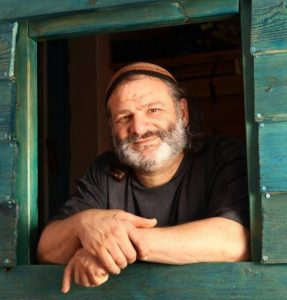

If history were a single week, the Zohar teaches, humanity is now living through Friday afternoon, the frantic hours before the Sabbath when everyone races home to cook, clean and prepare. According to Efraim Palvanov, that final countdown began in 1989, and two of the most powerful men on earth are now playing roles the Bible scripted long ago: Vladimir Putin as Gog, the ruler from the land of Magog who attacks Israel in the final war, and Donald Trump as a figure who could become either the redeemed Esau who stands with Israel or Armilus, the arrogant world-ruler the Messiah is destined to destroy.
Palvanov, dean of a Jewish high school in the United States and author of a widely followed YouTube channel on Jewish mysticism and prophecy, laid out the case in a nearly hour-long interview broadcast on JTV on October 14.
“Incredible things are happening in the world super fast,” he said. “It’s really fascinating to learn about all these textual sources that were written thousands of years ago, and just basically almost today you read it, it’s like you’re reading the news.”
On Trump, he stressed that the outcome remains open.
“Again, this is all speculation,” Palvanov said. “I think that Trump has that potential that it could go either way. He has the free will to choose to go either way.”
The suggestion raises an obvious question for Trump’s many supporters among Bible-believing Christians and Jews: who is Armilus, and why would a Bible scholar who praises the president’s support for Israel place him anywhere near that name?
The Wicked One of Isaiah
Armilus appears nowhere in the Hebrew Bible by name. He enters Jewish tradition through the Aramaic translation of the Prophets known as Targum Yonatan, which reads him into Isaiah’s prophecy of the Messiah, the shoot from the stump of Jesse:
“But with righteousness shall he judge the poor, and decide with equity for the meek of the land; and he shall smite the land with the rod of his mouth, and with the breath of his lips shall he slay the wicked.” (Isaiah 11:4)
Where the Hebrew text speaks of “the wicked,” the Targum names him: the Messiah will slay “Armilus the wicked.” From that single verse, an entire tradition grew.
Armilus takes center stage in a cluster of Hebrew apocalyptic works from the early medieval period, most famously Sefer Zerubbavel, written around the seventh century CE. There, he is a Roman figure, his name likely derived from Romulus, the legendary founder of Rome, and he is described as Satan’s offspring. Rabbi Saadia Gaon, the towering tenth-century sage, incorporated him into his philosophical masterwork Emunot v’Deot (Beliefs and Opinions), describing Armilus as the enemy who kills Mashiach ben Yosef, the Messiah descended from Joseph, before he himself is destroyed by Mashiach ben David, the final Messiah from the line of King David.
Palvanov drew a sharp line between Armilus and Gog, two figures often lumped together.
“There’s another figure who has that, called Armilus, which is different than Gog,” he said. “Armilus is the one that’s associated with Satan and with those kind of evil, impure forces. Gog is more of a political figure.”
The sources portray Armilus as an emanation of the Sitra Achra, the “Other Side,” the Kabbalistic term for the forces of impurity.
“The texts describe him as actually having two heads, so to speak,” Palvanov explained. “Not literally two heads, but he’s a two-faced person, and he kind of shapeshifts. He changes who he is, his public persona. He’s described as a figure who is incredibly haughty, who has a huge ego and who seeks to dominate the whole world. It doesn’t say about Gog that he wants to rule the whole world. Armilus, it says, wants to rule the whole world.”
Kedar and Qatar
Palvanov said an early medieval prophetic text that details three phases of a war with Iran at the end of days describes Armilus as allied with the descendants of Kedar. Kedar was the second son of Ishmael, listed in Genesis as one of the twelve princes who fathered the Arab tribes.
“One of his sons is Kedar. And today’s country, Qatar. The name Qatar actually comes directly from Kedar,” Palvanov said. “So it mentions Armilus being tied to Kedar, Qatar.”
“And I suggested that it could potentially be somebody like a Donald Trump, who is very much involved with that world, with the Saudis and the Qataris, the Bnei Kedar, who does have a huge ego,” he said.
Palvanov anticipated the objection. “But Trump is so pro-Israel, right? But that’s the whole thing of Armilus being described as a two-faced person,” he said. “He is like the embodiment of the Western world and he seeks to rule the world and he kind of bullies the whole world.”
He pointed to the renaming of the Gulf of Mexico as the Gulf of America and the president’s push to acquire Greenland. “He wants Greenland, and he wants this, and he wants that,” Palvanov said. “So Donald Trump seems to fit the bill better. Again, this is all speculation.”
The Good of Esau
The interviewer raised a very different reading of Trump from Rabbi Mendel Kessin, a prominent teacher of Jewish eschatology, who has argued for a decade that Trump is the reincarnated Esau, returned at the end of days to repair his ancestor’s failure by partnering with Israel against evil.
“I said the same,” Palvanov responded. “I think that Trump has that potential that it could go either way.”
Kessin’s framework places Putin and Trump in the same biblical family. In a lecture covered by Israel365 News, he taught that Esau, the ancestor of Edom and Rome, split in the Christian era into three national expressions: his arrogance became communist Russia, his deceit became Europe, and his appetite for pleasure became America. Of the three, Kessin argued, only the American branch carries the potential for repair. “Donald Trump is that man, that part of Esau,” he said, pointing to Trump’s recognition of Jerusalem as Israel’s capital as the fulfillment of Esau’s biblical role. In Kessin’s reading, the Sages’ teaching that Esau’s head lies buried in the Cave of the Patriarchs in Hebron shows that part of Esau is holy, and America is that head.
Kessin himself has warned that the repair is far from guaranteed. For years he has called Trump the tov she’b’Eisav, the good aspect of Esau, and identified him as a gilgul, or reincarnation, of the Roman emperor Antoninus, the righteous gentile who befriended Rabbi Yehuda HaNasi, compiler of the Mishnah. Earlier this year, Kessin told his students, as reported by Israel365 News, that something had gone wrong. “All of a sudden, Trump is not doing his job, which is amazing,” he said, faulting the president for failing to finish the confrontation with Iran. Kessin drew a parallel to Pharaoh, who exercised free will through the first five plagues before God hardened his heart, and wondered aloud whether God is now doing the same to Trump.
Palvanov described a president caught between two camps.
“He’s being pulled, I think, by two sides because on the one hand, he’s being pulled by the Tucker Carlson side, which is very anti-Israel,” he said. “And people are saying that JD Vance looks more like he’s good friends with Tucker Carlson. He’s more critical of Israel. And then on the other hand, you have maybe the Marco Rubio side and those who are very pro-Israel, and the evangelical Christians that are very pro-Israel.”
“Today in the Christian world in America, you have two opposites,” Palvanov continued. “On the one hand, you have a far right that’s super anti-Israel and thinks Israel is like the root of all evil. And then you have the opposite side, which thinks that Israel is a fulfillment of prophecy and we should work together with Israel because we have a common enemy in Islam.”
“I think it’s up to him to decide which side he’s going to be on and where this is going to go in the near future,” he said.
The interviewer added that Kessin views the assassination attempts against Trump as divine wake-up calls, warning the president against pursuing what he called shallow peace prizes and against stopping short of delivering a fatal blow to the Iranian regime.
The tension between the two Trumps played out in the headlines the very week the interview aired. On October 16, Trump signed an executive order waiving sanctions on Russia under the newly passed Lindsey O. Graham Sanctioning Russia and Iran Act, following a deal allowing Moscow to resume diesel exports to global markets. Senators had warned that the revenue could help Russia deepen its security cooperation with Iran.
Putin as Gog
On Gog, Palvanov was far more definite. Ezekiel opens his prophecy of the final war with a precise geographic address:
“Son of man, set thy face toward Gog, of the land of Magog, the chief prince of Meshech and Tubal, and prophesy against him.” (Ezekiel 38:2)
“We don’t know much about Gog, who he is,” Palvanov said. “It says that he is nasi rosh, he’s the president. He’s like the head of Meshech and Tubal, which is some kind of presumably Eastern European power. It says he’s from eretz haMagog. The most ancient sources say Magog is what we would call Scythia, which is basically southern Russia, that Caucasus region north of the Caucasus, Crimea, Russia, Ukraine.”
Three verses later, Ezekiel names Gog’s allies, with Persia at the head of the list:
“Persia, Cush, and Put with them; all of them with shield and helmet.” (Ezekiel 38:5)
“So all the way back to Ezekiel 2,500 years ago, there’s a prophecy of Iran playing an active role at the end of days and being like the first oppressor of Israel,” Palvanov said. “And these prophecies were recorded in the Midrash and Talmud before there was even Islam.”
He emphasized that Iran’s main ally is Russia. “It’s all over the news even now. They just signed another new agreement. They’re supplying each other with rockets and drones,” he said.
The record bears him out. Putin and Iranian President Masoud Pezeshkian signed a 20-year Comprehensive Strategic Partnership Treaty in the Kremlin in January 2025, covering military-technical cooperation, intelligence sharing and a pledge not to aid any aggressor against the other. It entered into force on October 2, 2025. That December, the two countries’ foreign ministers signed a first-ever joint consultation program for 2026 to 2028. In June of this year, Tehran and Moscow signed a $25 billion nuclear cooperation agreement with Russia’s state nuclear corporation, Rosatom, even as Iran negotiated with Washington over its nuclear program.
Palvanov described Gog as a political actor with economic motives. He noted that the only other person named Gog in the Hebrew Bible is a descendant of Reuben, from the tribes of Israel.
“It’s a political thing,” Palvanov said. “He’s a political figure who for political and economic reasons attacks Israel at the end of days.”
The Pipeline October 7 Killed
The economic motive, Palvanov argued, is the key.
“In the lead-up to October 7, what we had was all over the news: Israel and Saudi Arabia about to close a peace treaty,” he said. “And included in that peace treaty was a pipeline from Saudi Arabia through Israel across the Mediterranean to Europe. And Vladimir Putin wouldn’t like that because his main source of income is oil and gas.”
The plan he described was real. At the G20 summit in New Delhi in September 2023, the United States, India, Saudi Arabia, the United Arab Emirates and the European Union unveiled the India-Middle East-Europe Economic Corridor, known as IMEC, linking India to Europe by sea and by rail across the Arabian Peninsula, with Israel’s port of Haifa as the gateway to the Mediterranean. Plans included pipelines for hydrogen produced in Saudi Arabia and the UAE. President Joe Biden later described it as a project running from Riyadh through Israel to Greece, with a pipeline across the Mediterranean into Europe, and linked the October 7 attack to the push for Israel’s regional integration. Romana Vlahutin, the former EU special envoy for connectivity, said the project made Iran, China, Russia and Turkey nervous. One month after the corridor was announced, Hamas invaded southern Israel. The corridor stalled, and Saudi Arabia is now reportedly examining a route through Syria that would cut Israel out entirely.
“October 7 played right into his hand,” Palvanov said. “It killed the Israel-Saudi peace deal, killed that pipeline. Russia still has their kind of chokehold on the oil and gas, and also it got the world’s back off of Russia because until October 7, all the attention was on Russia’s aggression in Ukraine.”
“As soon as October 7 hit, now the villain’s Israel again,” he continued. “The university campuses are shutting down because of Israel. Billions of donations are now going to Gaza. And you have Ukraine and Zelensky complaining about this.”
“Literally days after October 7th, Putin’s the one that’s inviting Hamas to Russia,” Palvanov said. “And of course, Russia does not consider Hamas a terrorist organization, unlike most of the Western world.”
On October 26, 2023, less than three weeks after the massacre, a Hamas delegation led by senior politburo member Moussa Abu Marzouk arrived in Moscow at the Kremlin’s invitation. Iran’s deputy foreign minister, Ali Bagheri Kani, was in Moscow at the same time and met with the Hamas delegation. Hamas issued a statement praising Putin’s efforts. Israel’s Foreign Ministry demanded that Russia immediately expel the terrorists, calling the invitation an undignified move that provides “a tailwind to terror.”
“And also Assad, shortly after, in the aftermath of this war, the Assad regime collapses,” Palvanov added. “And where does Assad go from Syria? He flees to Russia.” In December 2024, as rebels entered Damascus, Bashar al-Assad flew to Moscow, where the Kremlin said Putin personally decided to grant him and his family asylum.
Then Palvanov offered one more detail.
“It’s just fun to point out also that October 7th is Vladimir Putin’s birthday,” he said. “So who knows? Maybe there is a connection. I think it’s highly possible that this is who it is because he had everything to gain from it and he is this European power. Magog is Scythia and so on. All these kind of little bits and pieces fit.”
Persia Against Arabia
Palvanov said the war now raging in the Gulf appears in ancient Jewish sources. He cited the Midrash in which Rabbi Shimon bar Yochai teaches that when Persian horses are seen tied in the Land of Israel, the footsteps of the Messiah are near. He also cited a prophecy preserved in Yalkut Shimoni, a medieval Midrashic anthology, describing the king of Persia provoking the king of Arabia in the year the Messiah is revealed.
“In the year that the Messiah comes, you will see a conflict between Iran and the whole world, that Iran will kind of bring the whole world to its knees,” Palvanov said. “And maybe they meant because of the oil, because of the Straits of Hormuz, the economics, in addition to the terrorism and the actual military conflict.”
“It says Iran will go to war with Arabia, and we’re seeing that happening right now,” he said. “Iran is launching missiles at its Arab neighbors even more than it is at Israel. And Iran is supplying the Houthis, which are now fighting Saudi Arabia. Attacks on the Saudi Arabian airports, and things are heating up over there.”
The numbers support him. After the United States and Israel struck Iran on February 28, launching the 2026 Iran war that killed Supreme Leader Ali Khamenei, Tehran retaliated against its Arab neighbors, hitting Saudi Arabia, the UAE, Kuwait, Bahrain, Qatar and Oman. The UAE’s Defense Ministry reported that Iran fired 550 ballistic missiles and more than 2,200 drones at the Emirates alone. Saudi Arabia reportedly struck back at Iranian territory in late March.
This month, Iran’s Houthi proxies in Yemen took the war to Saudi civilian aviation. The Saudi-led coalition said Riyadh’s King Khalid International Airport was targeted in 20 Houthi attacks since the start of October, with 17 killed and 333 injured between October 7 and 11. The October 10 strike alone killed 12 people and wounded more than 300, the deadliest attack on Saudi soil in more than a decade. The head of the Houthi media office boasted that the group had “shut down Riyadh international airport.”
“At the end of that conflict, Messiah will arise for Israel and for the whole world,” Palvanov said, “because ultimately the messianic age is not just for Israel. It’s for everybody. It’s peace and prosperity for the entire planet.”
The Horse and the Sea
Palvanov also pointed to a numerical link in Exodus. Beshalach, the weekly portion describing the splitting of the Red Sea, has a gematria, or numerical value, of 340, identical to Paras, the Hebrew word for Persia.
“Throughout Tanakh you see this theme of the horse as the symbol of the military oppressor, whether that’s the Greeks or the Romans or the Egyptians,” he said. “In the splitting of the sea, it mentions the horse many, many times more than anywhere else in the Torah.”
The Song of the Sea opens with az yashir Moshe, which literally reads “then Moses will sing,” in the future tense.
“Our Sages say it’s actually a vision of the future, the fall of the final horse,” Palvanov said. He added another connection: “We happen to be in the year of the horse” on the Chinese zodiac.
The Countdown Began in 1989
Palvanov did the math on the Zohar’s Friday afternoon. The six days of creation correspond to 6,000 years of history, and the Jewish calendar has just entered the year 5787.
“The very first word of the Torah, Bereishit, which in Aramaic is bara shit, He created six,” he explained. “And the letter aleph appears in the first verse in the Torah six times. And aleph literally in Hebrew means a thousand.”
The Zohar sets the final starting point for the footsteps of the Messiah at six hours before the cosmic Sabbath.
“If you do the math, six hours would be a quarter of a day. So that’s a quarter of a millennium. So that’s 250 years,” Palvanov said. “So that’s the year 5750, which began in September of 1989. The Zohar calls it the time when the people go to draw water for the last time before Shabbat.”
“Within weeks the Berlin Wall comes down, the Soviet Union collapses, the Cold War comes to an end,” he said. He listed the birth of the World Wide Web, the discovery of ancient anointing oil in the Judean Desert, the launch of the first GPS satellites, and the start of the Human Genome Project, “which leads to biotechnology, which leads to things like the COVID pandemic.” That same year, he noted, Ali Khamenei took power in Iran and the Islamic Republic launched its nuclear program in cooperation with Russia.
“So basically everything that we see in the world today, whether it’s the war with Iran, post-pandemic, the biotechnology, the artificial intelligence, all of that began at the end of 1989, just like the Zohar prophesied,” Palvanov said.
140 Nations
Palvanov also cited a Midrash teaching that 140 nations will gather in Israel at the end of days.
“Two thousand years ago when this prophecy was made, it was very hard to envision 140 different nations bringing their troops to Israel,” he said. “But today, if you look at the United Nations peacekeeping forces, how many countries provide some kind of personnel? It’s about 140 countries.” UN figures in recent years have put the number of troop and police contributors at roughly 120-125.
“It’s not like, will it happen? We’re in it,” Palvanov said. “We already have an international force with boots on the ground in Israel, in Kiryat Gat. They have this command center, and there are troops from all over the world there.”
US Central Command opened the Civil-Military Coordination Center in Kiryat Gat on October 17, 2025, to oversee the Gaza ceasefire. Within a month, nearly 50 countries and organizations were involved. Associated Press reporters saw personnel there with the flags of Cyprus, Greece, France, Germany, Australia and Canada. Israel’s Channel 12 has reported that Greece, Morocco, Indonesia, Kosovo, Kazakhstan and Albania have expressed interest in joining an International Stabilization Force for Gaza, with Georgia and Vietnam in talks to join them.
The Greatest Sign
For all the talk of war, Palvanov said the clearest proof of the approaching redemption grows on trees. The Talmud in Tractate Sanhedrin teaches that there is no clearer sign of the end than the Land of Israel giving forth its fruit.
“That’s an incredible thing that we see today, that you can get Israeli produce literally everywhere in the world, in Australia, in America, in England,” Palvanov said. “That’s never happened in history.”
He cited Mark Twain and Ulysses S. Grant, who both described the land as barren when they visited in the 19th century. “Both of them describe Israel as dead, barren, as a cursed land,” he said. “For the past 2,000 years, no other nation has been able to make any kind of successful state or kingdom in the Holy Land. Not the Crusaders, not Saladin, not the Muslims, not the Turks, nobody.”
He also offered a reminder that the darkest prophecies are conditional. “We have a principle in Judaism that negative prophecies don’t have to be fulfilled,” Palvanov said. “Negative prophecies are given as warnings. Positive prophecies will be fulfilled.” He pointed to Nineveh, which repented at Jonah’s warning and was spared, and to the Talmud’s resolution of Daniel’s vision of the Messiah arriving on the clouds of heaven and Zechariah’s vision of him arriving poor and riding a donkey: if Israel merits, the redemption comes swiftly and gently; if not, it comes through hardship.
“We don’t want war. We don’t need war,” Palvanov said. “If that’s where sinful leaders take us, then it’s kind of what’s going to happen. But it doesn’t have to happen. There’s a better way to do it.”
That leaves the decisive variable where the Bible always places it: in human choice. Putin, in Palvanov’s reading, chose his side when he hosted Hamas three weeks after the massacre. Trump has not yet been forced to choose, and the same president whom one rabbi calls Esau repaired, and another warns could become Armilus, holds the answer in his own hands. The clock on the wall says Friday afternoon.
