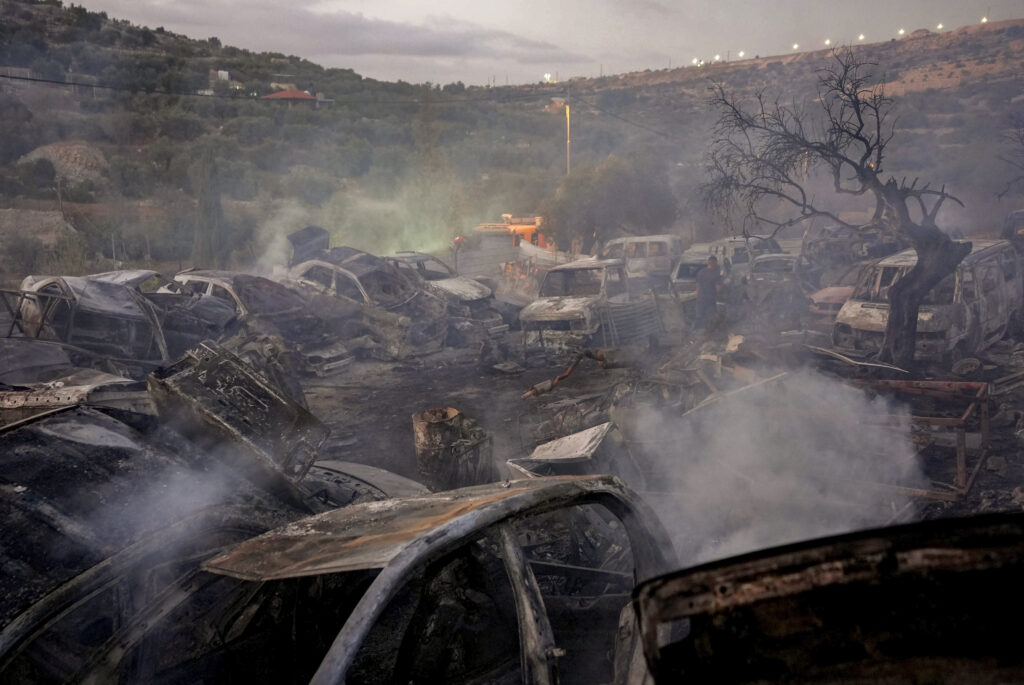

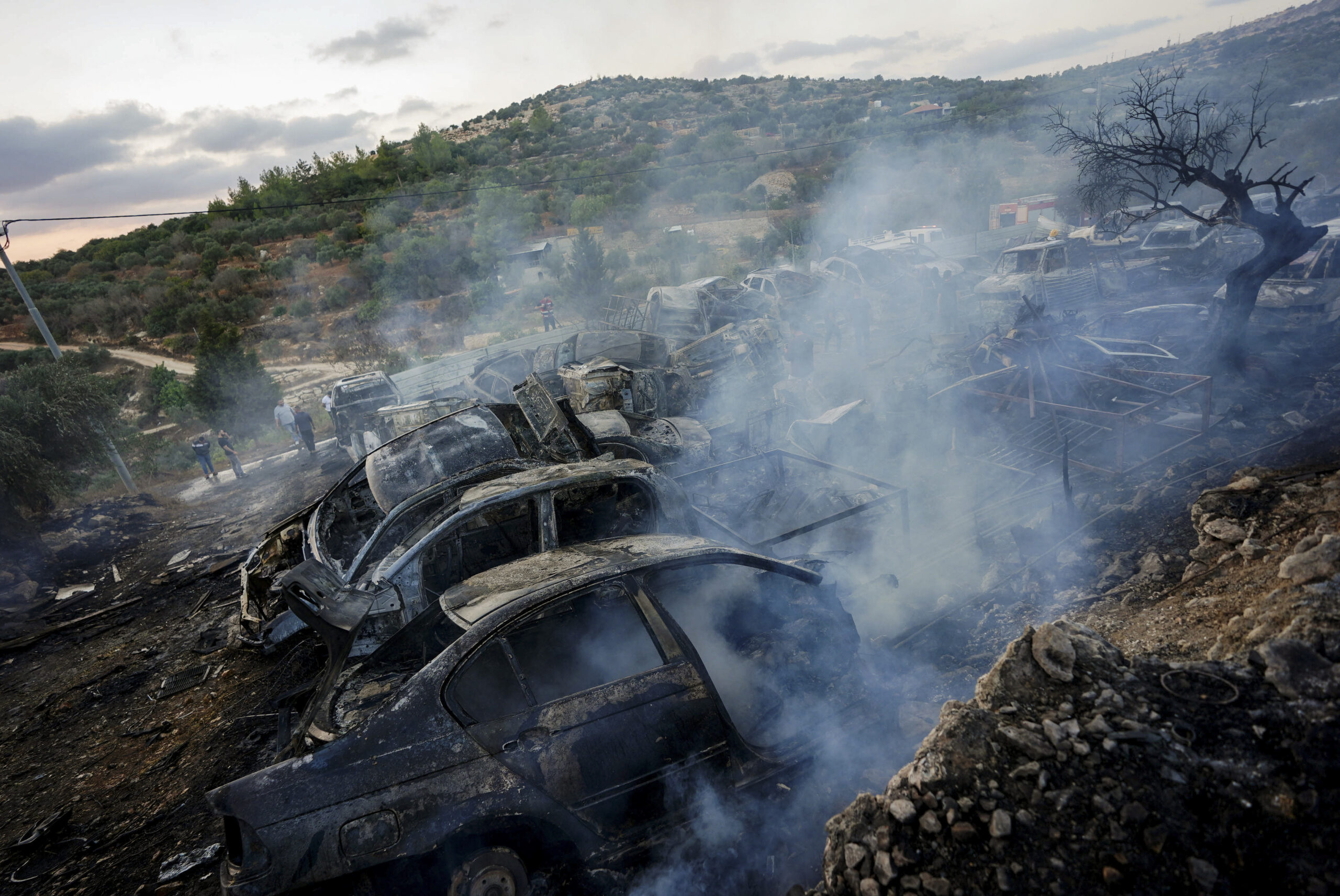
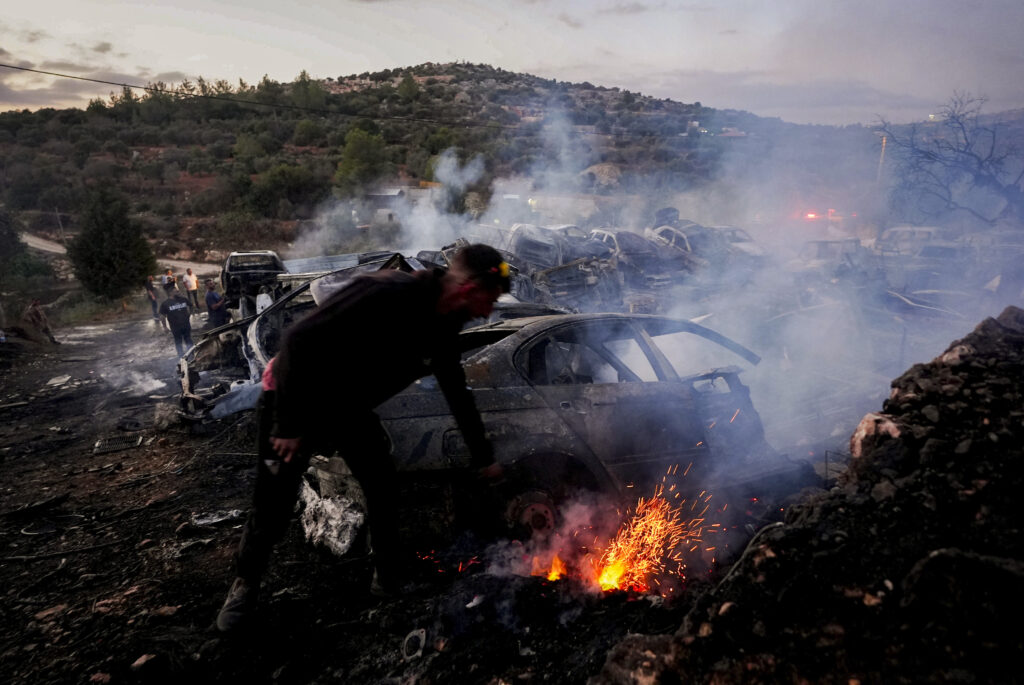
Arabs from the village of Ein Yabrud came up to a Jewish hilltop in Binyamin this week with tires and flammable junk, blocked the access road, and set it all on fire. Within minutes, the flames jumped to a car lot belonging to Arabs from their own village. By the end of the day, the village was telling anyone who would listen that settlers had torched the cars.
The hilltop had it all on video.
The incident took place early in the week at Kfar Ana, a Jewish settlement point between Beit El and Ofra, Arutz Sheva reported on Tuesday. According to the report, the Ein Yabrud residents tried to start a fire at the site and barricaded the road leading up to it with burning tires and other flammable objects. Minutes after the barricade went up in flames, the fire spread to a nearby Arab-owned car lot. Residents of Ein Yabrud then announced that “the car lot was set on fire by settlers.” Kfar Ana residents reported the incident to security forces, but the arsonists escaped.
“Today we are witnessing another blood libel as part of the ‘settler violence’ campaign, and it has been disproven,” the residents of Kfar Ana said in a statement. “This is a systematic, deliberate and false attempt to smear the hilltop residents, something that unfortunately succeeds at times and even receives cooperation from Israeli media outlets.”
“This time, by a miracle, we managed to document the incident from beginning to end and refute the disgraceful accusations,” they continued. “This is not always possible because of the terrain and the complexity of such incidents. This is the time to remind the people of Israel: when you come across a report of ‘settler violence,’ take it all with a grain of salt and check carefully that you are not falling prey to a malicious and antisemitic campaign.”
A script with a long run
Kfar Ana’s camera caught a scene that has played out across Judea and Samaria for more than a decade. The accusation goes out first, the wire services carry it around the world, and the investigation arrives weeks later to a much smaller audience.
In November 2014, residents of al-Mughayyir, the same village behind this year’s poisonings near Alon Road, told the world that Jewish settlers had torched their mosque. Village head Faraj al-Naasan told the Associated Press the Jews were to blame, and photographs of burned Qurans ran across the international press. Villagers rioted at the entrance to al-Mughayyir and kept the IDF and police from investigating the scene. A month later, fire investigators working with police and the Shin Bet found no flammable liquids and none of the graffiti that marks so-called price tag attacks. Judea and Samaria fire investigations director Shai Turgeman concluded there was “a high likelihood that there was an electric failure around the heater and this was not arson.” The space heater had been removed from the mosque by villagers after the fire.
In July 2025, the Greek Orthodox Patriarch Theophilos III and Latin Patriarch Cardinal Pierbattista Pizzaballa stood beside the Church of St. George in the Christian Arab village of Taybeh, flanked by 20 foreign diplomats, and announced that “radical Israeli settlers” had tried to burn it. US Ambassador Mike Huckabee came to see the damage and called the desecration of a church an act of terror. The Taybeh municipality’s own video showed the supposed arsonists, teenage farmhands from the neighboring Jewish ranch, running toward the flames to put them out. Israel Police found no damage to the church. A resident of the Jewish farm said Arabs from Taybeh had set fire to open fields four times in one week to keep Jewish shepherds from grazing there. Huckabee later clarified, “I have NOT attributed the cause of fire to any person or group as we don’t know for sure.”
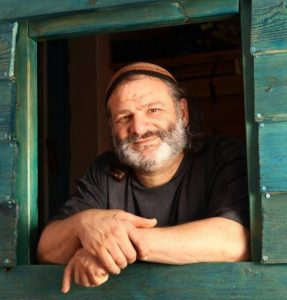
Last month, Huckabee visited Turmus Ayya, a few kilometers from Kfar Ana, and posted a video of a Jewish man driving past on an ATV, describing “criminal terror acts by a band of trespassers.” The driver turned out to be Amishav Melet, a member of the local security patrol responding to a report of dozens of vehicles massing at the edge of the village. “Dear Mike Huckabee,” Melet wrote after Shabbat. “Well, that was me. I was the driver of the Ranger you filmed.” Melet, whose brother Benayahu was killed in July defending hikers near Chavat Gilad, said the clips shown to the ambassador had been edited to cut the context. “I ask you to watch the full footage, rather than edited clips,” he wrote. Former US Ambassador David Friedman met Melet for coffee and described him as “a vegan, a pacifist and a farmer.”
The numbers behind the headlines tell the same story. The Regavim Movement analyzed the database kept by the United Nations Office for the Coordination of Humanitarian Affairs (OCHA), the main source for international reporting on “settler violence,” in a 125-page report titled “False Flags and Real Agendas.” Of 8,332 incidents logged between 2016 and 2023, 2,047 involved settlers as the victims. After filtering, Regavim found 833 incidents over seven years that might involve actual violence. Over roughly the same period, Shin Bet data recorded 6,068 serious Palestinian terror attacks from 2020 through 2022 alone.
“Ninety-five percent or more of the incidents that are reported as settler violence by the United Nations itself either didn’t involve settlers, didn’t involve violence, or didn’t happen in Judea and Samaria,” Naomi Kahn, director of Regavim’s International Division, told the JNS International Policy Summit in June. OCHA, she noted, files every peaceful Jewish visit to the Temple Mount as “storming Al-Aqsa” and counts it as settler violence.