

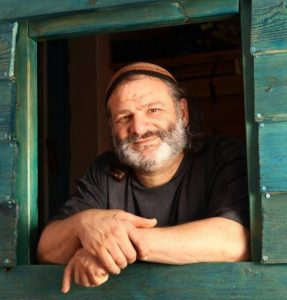
Before his students leave the study hall for the battlefield, Rabbi Dani Lavi gives them the same charge.
“You are the fulfillment of the dream of the generations,” he tells them. “For thousands of years, two thousand years, we had no state, we had no independence, we had no ability to defend ourselves. You are the soldiers of King David, of the King Messiah. You have the privilege of writing the chapters of the Bible yourselves. Everything you read about is now being fulfilled through you. You are bringing the people of Israel to its next stage, which is, a few more steps from now, what is called the complete redemption.”
Rabbi Lavi heads the Olamot (Worlds) Institute and teaches at the hesder yeshiva in Elon Moreh in Samaria, a program in which young men combine intensive Torah study with service in IDF combat units.
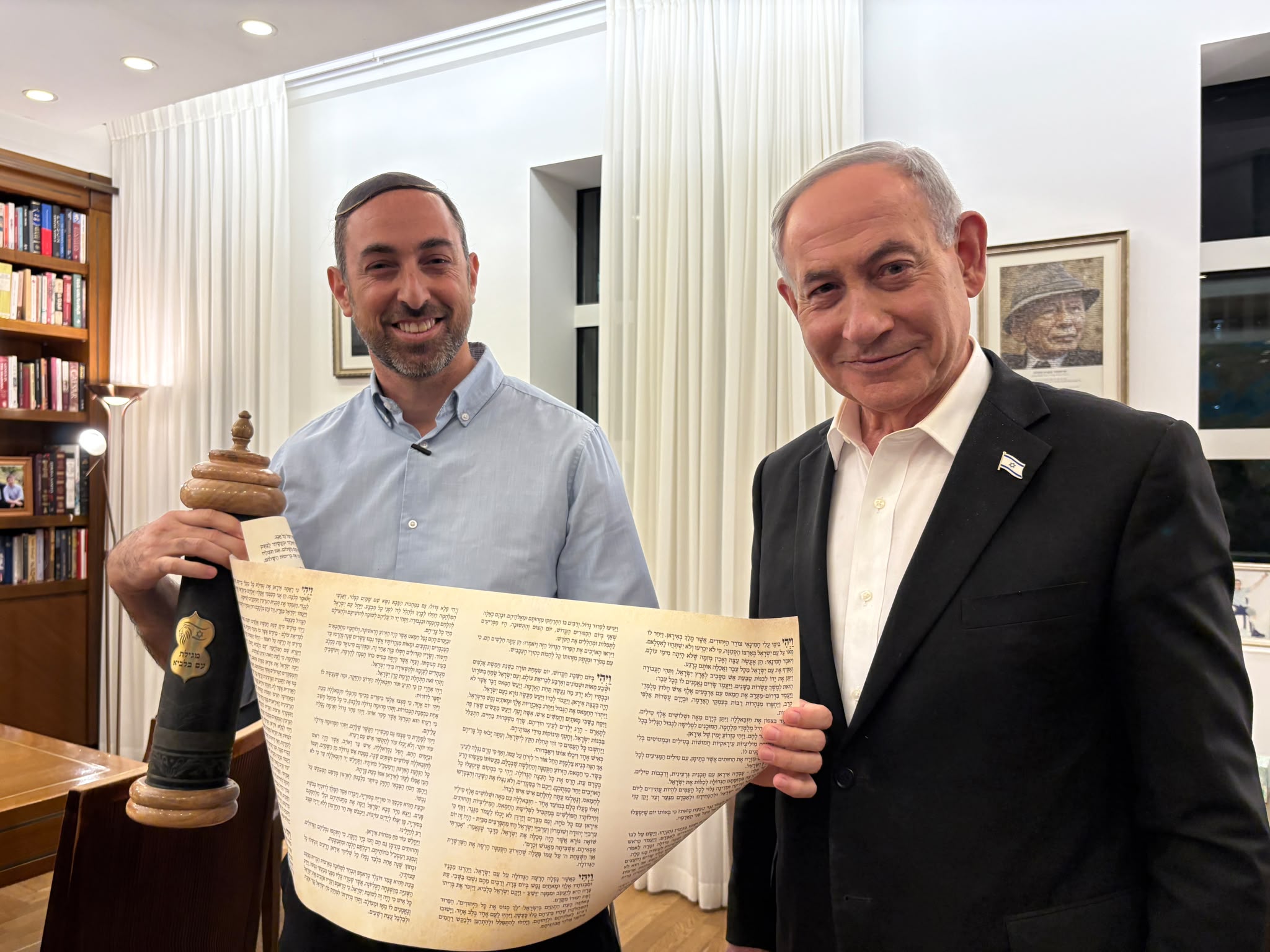
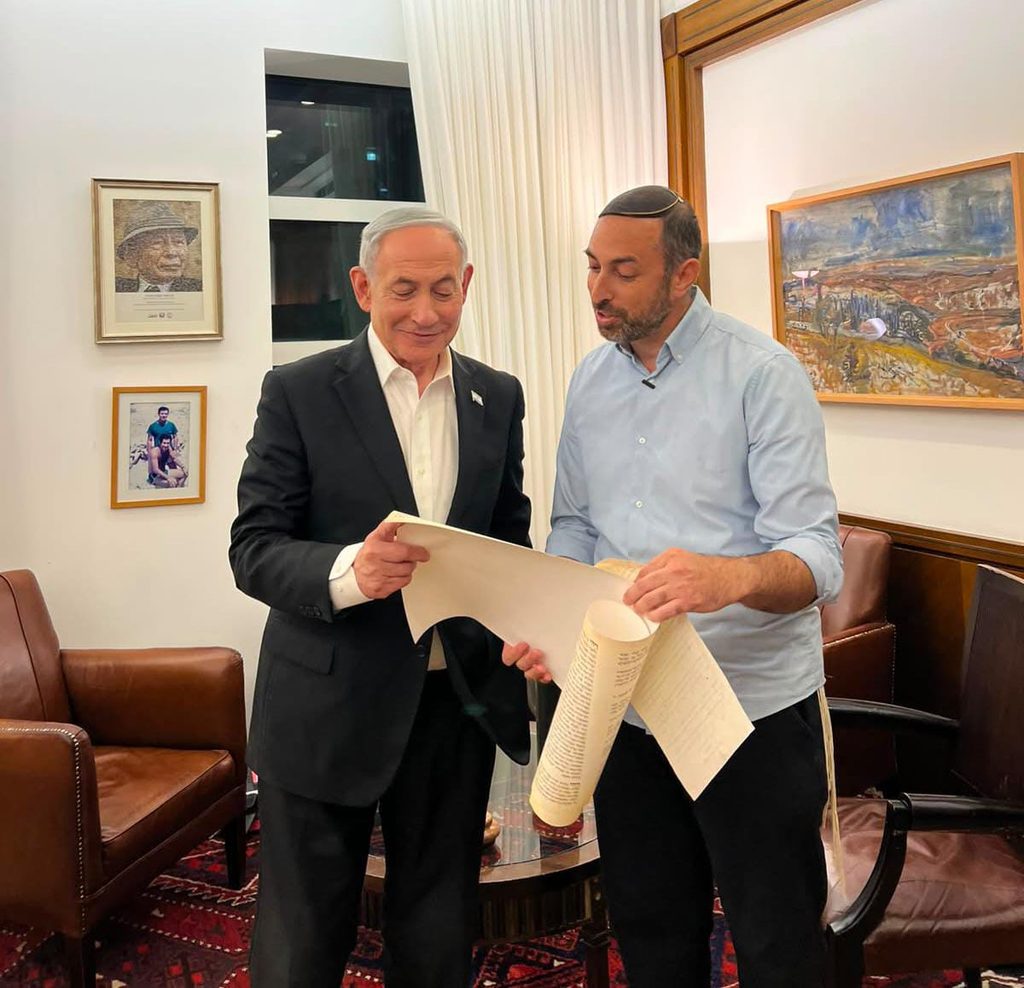
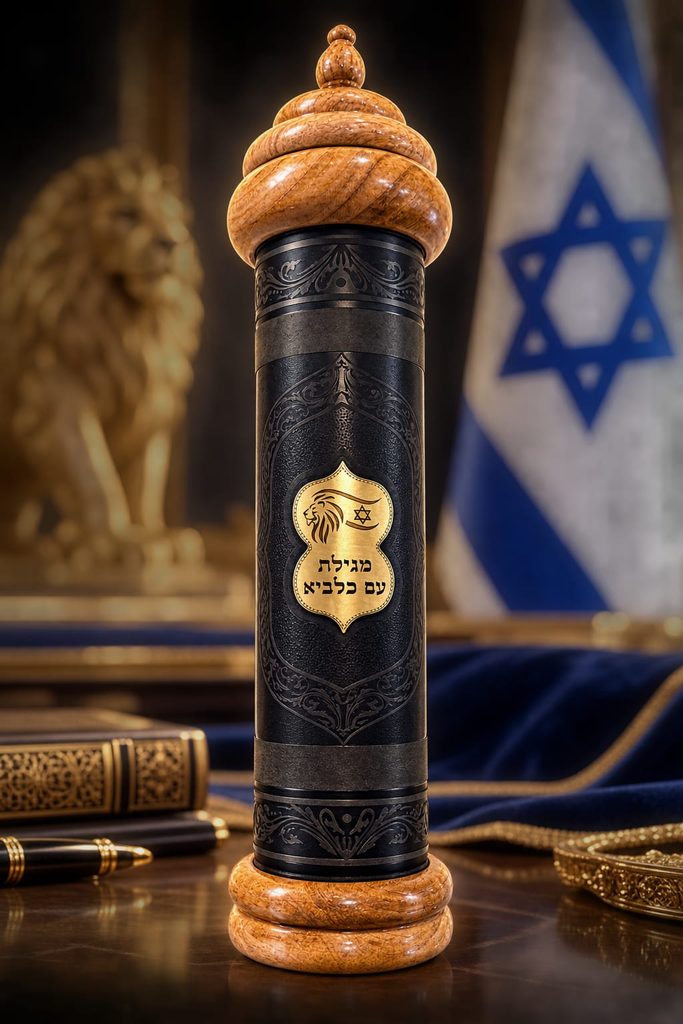
Rabbi Lavi recently carried that same conviction into the Prime Minister’s Office in Jerusalem. He presented Benjamin Netanyahu with The Book of the Rising Lion, a megillah (scroll) composed in the style of the Hebrew Bible that chronicles Israel’s war against Iran, written as though the Bible’s historical books had never stopped being written.
Israel named its June 2025 campaign against the Islamic Republic Am KeLavi, “A People Like a Lion,” rendered in English as Operation Rising Lion. Rabbi Lavi gave his scroll the same name: The Book of the Rising Lion. Both titles come straight from the blessing that the gentile prophet Balaam was forced to pronounce over Israel after he had been hired to curse it:
“Behold, a people that rises up like a lioness, and lifts itself up like a lion; it shall not lie down until it devours the prey and drinks the blood of the slain.” (Numbers 23:24)
Rabbi Lavi quoted that verse when describing Israel’s recovery after October 7, saying the nation, “as it is said, ‘a people rises like a lion,’ shook itself off from the dust and the ashes.”
“The goal of the Olamot Institute is to make the foundations of Jewish faith accessible in a way that is rational and relevant to our generation,” he told Israel365 News in an interview during Chol HaMoed Sukkot, the intermediate days of the Feast of Tabernacles. “Along with that, I teach in many other places.”
“What Would the Bible Look Like If It Were Still Being Written”
Rabbi Lavi explained that the scroll grew out of a feeling that ordinary history books cannot capture what Israel has lived through since the Shabbat Simchat Torah massacre of October 7, 2023.
“I felt that I had to give expression to this enormous sense of gratitude,” he said. “I tried to think about what it would look like if the Bible had continued to be written in our time. I felt that we are living through events of biblical magnitude.”
The war touched him personally from its first days.
“Two of my students fell at the very beginning of the war,” he said. “Beyond that, there are of course other people I know. My brother is a battalion commander in the Combat Engineering Corps, and he fought throughout the war in a very, very difficult and intensive way, in Gaza and in Lebanon.”
“The war began with a very great tragedy, with thousands murdered and wounded and hundreds of hostages,” he said. “My experience was that the tragedy was of biblical proportions. That was the feeling.”
A Modern Reversal
Then, Rabbi Lavi said, the story began to turn. He described the months that followed as a modern venahafoch hu, the dramatic reversal described in the Book of Esther, when the day the enemies of the Jews planned to destroy them became the day the Jews ruled over their enemies.
“Slowly, slowly, a kind of process of venahafoch hu began to take place,” he said. “Step by step, the State of Israel truly, as it is said, shook itself off from the dust and the ashes. It began to fight back, and it began to restore its strength step by step.”
He singled out the September 2024 operation in which thousands of pagers carried by Hezbollah terrorists exploded simultaneously across Lebanon.
“I think one of the milestones was the pager operation, which truly aroused enormous amazement in the world and among the people of Israel,” he said. “It was an experience of a kind of modern makat bechorot, the Plague of the Firstborn. Targeted killings of the commanders.”
“After Operation Rising Lion, I felt the time of Iran, the feeling of very, very great gratitude, and also the tremendous success that was there, which afterward was upgraded in Sha’agat HaAri (lion’s roar),” Rabbi Lavi said, referring to the follow-up campaign. “It was a great experience, that the people of Israel are truly leading the world. The United States joined the people of Israel in its mighty campaign, and that partnership continues to this day in all the sanctions against Iran.”
Miracles for a Nation That Has Grown Up
Rabbi Lavi explained that miracles can be a product of God operating through Man. He explained with a teaching on the nature of miracles rooted in Jewish thought.
“People often look at the period of open miracles, the splitting of the Red Sea, as some kind of superior level,” he said. “According to many sources in Judaism, an open miracle suits the childhood period of the people of Israel. It is like a baby who, a moment before he rolls down the stairs, has a miracle. His father or his mother comes and saves him. The open miracles actually tell us that we are unable to do enough ourselves, so God has to step in.”
In this war, he said, God is doing something different with His people.
“This time God trusts us to be capable of carrying out the work,” he said. “The fact that we are in this war, and in the last centuries in general, without open miracles shows that the people of Israel has matured enough and is capable of acting on its own. We truly live inside a very, very great wonder. We have the privilege of performing these miracles with our own hands, and God gives us siyata dishmaya,” heavenly assistance.
The difficulty, he explained, is that miracles worked through human hands are hard to recognize as they happen. He cited the Talmudic principle ein baal haness makir benisso, “the one for whom a miracle is performed does not recognize his own miracle” (Babylonian Talmud, Niddah 31a).
“There is a very, very beautiful poem by Yehuda Amichai, the Israeli poet, called ‘Miracles,'” he said. “He writes that from far away everything looks like a miracle. When you look from a distance, in proportion, everything looks like a miracle. Suddenly you understand the great process. From up close, even a miracle does not look like one. Even the one who walked through the Red Sea as it split saw only the sweaty back of the one walking in front of him.”
He drew out the lesson.
“Even at the splitting of the Red Sea, what does a person see in the end?” he asked. “He is not seeing the great ‘wow’ at that moment. It is hard for him to walk. Maybe he is in the mud. He sees the one walking in front of him, and he feels the experience of fleeing from the Egyptians. Precisely because of the great challenges we had during the war, and I do not take them lightly, and all of us feel the pain of the fallen, the wounded and the hostages, some of whom came back with trauma, and those who did not come back, I said that the hardship and the pain must not overshadow the great light we are living in.”
“I wanted to zoom out on Israeli history in the years we are living through and say: dear friends, we are living inside a miracle,” he said. “We are living inside the next chapters of the Bible, which we ourselves have the privilege of writing.”
“Biblical Events in High Content”
Rabbi Lavi said Israelis still underestimate how close the country came to catastrophe.
“Just the thought that at the same time, Hamas and Hezbollah would attack, and Iran, and the Houthis, and the Iraqi militias, and the Syrians, when the Hermon was not yet in our hands, and the Arabs of Israel, and the Arabs of Judea and Samaria,” he said. “And I am not sure Egypt and others would have held back. You should know, their peace with us is not exactly so warm. The State of Israel truly could have been in danger of annihilation.”
“That is really part of what I feel in this scroll,” he continued. “We truly experienced a modern venahafoch hu. The Bible truly burst into our lives. The establishment of the State of Israel, of course, the whole exile and everything else, these are all biblical prophecies. But these three years, you know how on all kinds of snacks it is written ‘high sugar content’ or ‘high salt content’? So here we had biblical events in high content.”
The Meeting With the Prime Minister
During the meeting in the Prime Minister’s Office, excerpts from the scroll were read aloud to Netanyahu, who Rabbi Lavi said was deeply moved by the work.
“When I presented the scroll to the prime minister, I told him that we truly have the privilege of living through biblical events, and that he has the privilege, as the leader of the State of Israel at this time, of being a very central player in the scroll,” Rabbi Lavi said. “Then I turned to him and said that I believe the people of Israel today must move from a historical perspective to a biblical perspective.”
“The prime minister holds very, very strongly to the historical view,” he said. “In my opinion, we have to move to a biblical perspective. That means moving from a war for the existence and survival of the people of Israel to a war for the destiny and the message of the people of Israel. And the world, in my opinion, is waiting for this.”
Rabbi Lavi pointed to the spiritual and demographic crisis gripping much of the world.
“You see it in so many contexts,” he said. “You see what is happening today in Europe, the demographic crisis, the crisis of the Islamic takeover. You see what is happening in some of the Islamic countries themselves, Turkey and Iran. There is a demographic crisis there too. The people of Israel have a rare combination of technological superpower and a very, very strong sense of meaning and faith. That finds expression in the World Happiness Index, where we are consistently ranked highly, and also in our demographics. People believe that the world can be good, and so they bring children into it.”
That led to the line he delivered to Netanyahu.
“I told him that we need to move from ‘Start-Up Nation’ to ‘Ethical Nation,'” Rabbi Lavi said.
“The prime minister immediately told me, ‘We need both,'” he recalled. “I told him, certainly. If we are not a Start-Up Nation, no one will hear our message. The Start-Up Nation carries great importance, and it is part of how the people of Israel bring blessing and goodness to the world. It is still only the platform. It is the ground that allows us to bring our message, our spiritual and moral message, to the world. In my opinion, and according to what is called the Bible, whose path we continue, the main purpose of the people of Israel is to be ohr lagoyim, a light unto the nations. A light unto the nations is much bigger than a Start-Up Nation, much broader and much deeper. The two must come together.”
From Rising Lion to Roaring Lion: The Language Changed
Rabbi Lavi said he detected, in Netanyahu’s own words, the shift he was urging between the two Iran campaigns.
“I think this transition even happened a bit between Rising Lion and Roaring Lion,” he said. “Two operations, and you might ask what the difference is. The language was different. In Rising Lion, the words of the prime minister himself were that we went out on an operation for survival, for the existence of the Jewish people, because they rose up against us to destroy us. In Operation Roaring Lion, the discourse began to change. Netanyahu said, and I wrote it this way in the scroll as well, that we are not here in this war only for ourselves. It is a war for the Iranian people and for the peace of the entire world.”
“Something already began to change in the language,” he continued. “We understand that we carry a great responsibility for the entire world, beyond our own survival as the Jewish people. The reason we need to survive as the Jewish people is so that we will bring blessing to the world. If we forget that, it eats away at our very ability to survive.”
He said he believes Israel has already crossed into that new stage. “I think it is clear now that at some point in this war we moved to this stage,” he said. “Everyone is watching.”
Rabbi Lavi said he understands Netanyahu’s instincts. “I think his DNA is that of the defender of the Jewish people,” he said. “He cares for the existence of the Jewish people. He mentions it almost all the time. I wish for him that he would have the privilege of bringing Zionism to its next stage, which is, as I said, the message of the Jewish people.”
Sovereignty Flows From the Bible
That message, Rabbi Lavi told Netanyahu, finds concrete expression in the application of Israeli sovereignty to additional parts of the Land of Israel.
“If I am at the level of survival, then that is enough for me,” he explained. “What difference does it make whether something was promised to us in the Bible? That is enough for me. I can survive between Gedera and Hadera.”
A leader with biblical consciousness responds to the Land differently, he said.
“Someone with biblical consciousness does not go and start wars and bomb everyone in order to conquer more of the Bible,” he said. “When he has experienced an event as shocking as the Simchat Torah massacre in October that came from Gaza, he does not say, we want more of the same, and now foreign forces will come in and take control. He says, “Wait-the Land of Israel is crying out to me that I must return to her.” He seizes the opportunity. Once the war has already been forced on us, the time has come to realize the vision.”
“That is also something I told him at that point,” Rabbi Lavi said. “I wished him that he would apply formal sovereignty over additional parts of our land, because that is part of what comes out of biblical consciousness, and not out of survival consciousness.”
Netanyahu on the Secret of Jewish Eternity
Rabbi Lavi posed three questions to the prime minister. The first touched on a phrase Netanyahu invokes frequently.
“He mentions the concept of netzach Yisrael, the eternity of Israel, many times,” Rabbi Lavi said. “I asked him, Prime Minister, what is the secret of netzach Yisrael? It is clear that we are a wondrous people that survives against all the odds. The prime minister answered without hesitation: faith in one God, the Bible that we brought to the world, and our unique culture. That is the secret of netzach Yisrael.”
He then asked Netanyahu what drives antisemitism. The prime minister pointed to envy, along with opposition to the distinct message the Jewish people carry into the world.
“That truly shows how all these things are connected,” Rabbi Lavi said. “There is no existence for the people of Israel without its message. The moment there is a bug, something stuck in the message, existence itself is put in danger. That is why the next stage we must reach, develop, and nurture is the stage of the message. We are not here in this land because we have no other place to exist and because they killed us in the Holocaust. That was only a catalyst. We are here in this land, which is suited to the people of Israel, because we want to keep bringing deep blessing to the entire world.”
According to Israel National News, the third question asked Netanyahu to name the moment in the war when he felt divine intervention most strongly. He chose the decision to launch the strike against Iran, a country far larger in territory and resources, at a time when the United States had not yet committed to joining. Netanyahu said he signed the order with the words “May the Lord be our help.”
The Temple Generation
Rabbi Lavi spends his days with the young men who have carried this war on their shoulders, and he described them as a generation unlike any before.
“There was the older generation. Again, good people who did great things. Afterward it was called Dor HaNitzachon, the Generation of Victory, meaning that we must have a decisive outcome and cannot stop in the middle,” he said. “I think the youth of our day is greater than the Generation of Victory. I call it Dor HaMikdash, the Temple Generation. This is a generation that grew up with a different consciousness, and it is very, very special. I truly see them. They have a different spiritual DNA. It is more than refusing to stop in the middle and insisting on a decisive victory.”
The Holiday of the Nations
The interview took place during Sukkot, and Rabbi Lavi drew a direct line between the holiday and the global stakes of Israel’s war.
“Sukkot is truly the universal holiday of the people of Israel,” he said. “On it we offer 70 bulls, corresponding to the 70 nations of the world, because we want to care for the entire world.”
The Sages taught that the 70 bulls offered in the Temple over the seven days of the festival atoned for the 70 nations (Babylonian Talmud, Sukkah 55b). The prophet Zechariah foresaw a day when the nations would come up to Jerusalem each year to celebrate the holiday with Israel:
“And it shall be that whoever of the families of the earth does not go up to Jerusalem to worship the King, the Lord of Hosts, upon them there shall be no rain.” (Zechariah 14:17)
“The prophet says that whoever does not go up for the pilgrimage on Sukkot, there will be no rain on them,” Rabbi Lavi said. “That means this is the holiday that emphasizes that through the connection to the people of Israel, the nations merit abundance and blessing. And in this context, that is exactly the point where our existence and our destiny meet.”
Rabbi Lavi’s scroll ends where the Bible’s own story is heading, with the prayer that the great processes set in motion in these years reach their completion: the full redemption and the building of the Temple, speedily in our days. He has no doubt about how history will judge this era.
“In the end, we live inside a miracle,” he said. “We are living inside the next chapters of the Bible, and we ourselves are writing them.”