




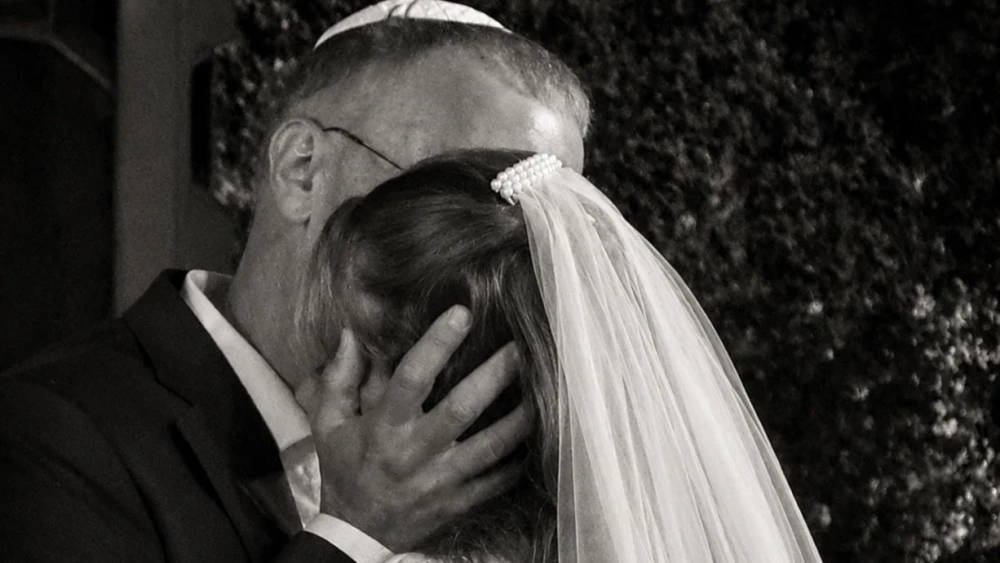
Tali Dee walked down the aisle Sunday wearing her mother’s wedding dress, three and a half years after a Palestinian terrorist gunned down that same mother and two sisters on a highway in the Jordan Valley. The dress made the event as if Lucy Dee herself was present at her daughter’s wedding in the only way left to her.
The wedding, held at Kibbutz Hulda, was shaped by the presence of those who could not be there. Maia’s friends sewed the chuppah, the wedding canopy under which Tali and her husband, Ariel Rosenfeld, were married, and dedicated it to her memory. The music was chosen in honor of Rina, the youngest of the three, who was fifteen when she was murdered. “They are a role model to all of how we can rebuild after tragedy,” the bride’s father, Rabbi Leo Dee, told JNS.
She carries her family’s love with her.🤍
— Israel in New York (@IsraelinNewYork) September 1, 2026
Three years after losing her mother and two sisters in a devastating terror attack, Tali Dee walked down the aisle wearing her mother’s wedding dress.
“We can’t let the terrorists achieve what they were trying to achieve, which was to… pic.twitter.com/GxbZYvWoOg
Lucy Dee, 48, and her daughters Maia, 20, and Rina, 15, were shot to death y Palestinian terrorists on April 7, 2023, while driving through the Jordan Valley toward Tiberias for a Passover getaway. The terrorist opened fire on their car near the Hamra junction, hitting the vehicle with 22 rounds from a Kalashnikov rifle, first as it drove, then again at close range after it crashed. Maia and Rina were pronounced dead at the scene. Lucy was airlifted to Hadassah Ein Karem hospital in Jerusalem, where she died of her wounds. Her organs were donated and saved five lives.
Hamas’s Al-Qassam Brigades claimed the attack. The following month, Israeli forces killed three men during a raid in Nablus, identifying two of them as the Hamas terrorists responsible for the shooting and the third as an accomplice.
Rabbi Dee, left to raise his three surviving children alone, wrote a personal essay in the days before Tali’s wedding that laid bare what grief does to a family preparing for joy. He did not write about the wedding day itself. He wrote about the week before it, the week nobody warns you about.
“A week before my daughter Tali’s wedding, people kept saying to me, ‘You must be so excited!'” Dee wrote. “And of course, I knew I should have been.” But he was not excited. He was sad, and he named the reason with a bluntness that cuts through any easy narrative of healing. “Sometimes the most painful part of a celebration isn’t the celebration itself,” he wrote. “It is the days leading up to it.”
He described what should have been happening in his home that week: a mother fussing over the dress, the flowers, the seating plan, the thousand small decisions that suddenly feel enormous. Lucy was not there to do any of it. Neither were Maia or Rina. “There was a gaping hole in the preparations,” Dee wrote, “because this was precisely the time when the three of them should have been most involved.”
Others stepped into the void. Tali’s sister Keren organized the bachelorette party, took her to the mikveh, the ritual bath, and stayed beside her through every preparation, doing, in her father’s words, “all the things a sister — and sometimes a mother — would normally do.” Dee’s new wife, Aliza, whom he married in August 2025, threw herself into the details as well. Still, Dee wrote, “three people were sorely missing, and for me their absence was most painful in that strange vacuum before the wedding.”
Then came the day itself, and everything changed. “It was simply overflowing with simcha,” Dee wrote, “joy.” Hundreds of friends and family surrounded the couple with dancing and singing. “Instead of being dominated by the three people who were missing, the evening was dominated by the hundreds of people who were there,” he wrote. “Of course Lucy, Maia and Rina were in our hearts, and always will be, but loss was not the defining emotion of the wedding. Joy was. Love was. Gratitude was.”
Dee drew a lesson from the experience that reaches beyond his own family. He wrote that grief is loudest not on the holiday or the milestone itself, but in the quiet days of preparation leading up to it, when everyone else is consumed with shopping lists and seating charts and the bereaved sit inside an empty space nobody else notices. “These are the quiet moments, before the guests arrive and before the shul fills up, when absence can be loudest,” he wrote. His call to readers, issued days before he watched his daughter marry in her murdered mother’s dress, was simple and direct: reach out before the holiday, not just during it. “You don’t need to fix their loneliness or take away their grief,” he wrote. “Sometimes it is enough to remind someone that, amid everyone else’s frantic preparations, they have not been forgotten.”
Tali met Rosenfeld, an officer in the Israeli Air Force and an eighth-generation Jerusalemite, on a trip to Poland with her religious seminary to tour the Nazi death camps, where she was introduced to his mother and sister. Dee has called it the shidduch, the matrimonial match, made in Auschwitz. The two dated for two years while serving together in the Air Force.
Rabbi Dee’s own remarriage last year was not without incident. Hours before his wedding to Aliza Teplitsky, a native of Toronto, he was detained on the Temple Mount for putting on tefillin, the phylacteries worn during Jewish prayer, a practice Israeli police have long restricted at the site under a status quo policy favoring Muslim worship there. At that wedding, too, his daughters, Keren and Tali, spoke publicly about their late mother and voiced their support for their father in building a new life.
Looking back on Sunday’s wedding, Dee said it fulfilled something Lucy had wanted for their children before she was killed. “This was her mother’s dream,” he said, “that we should come to Israel and the kids establish themselves for life.”


