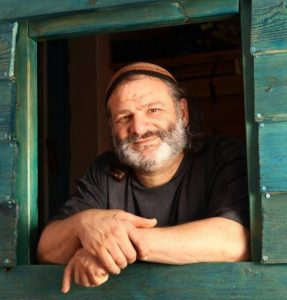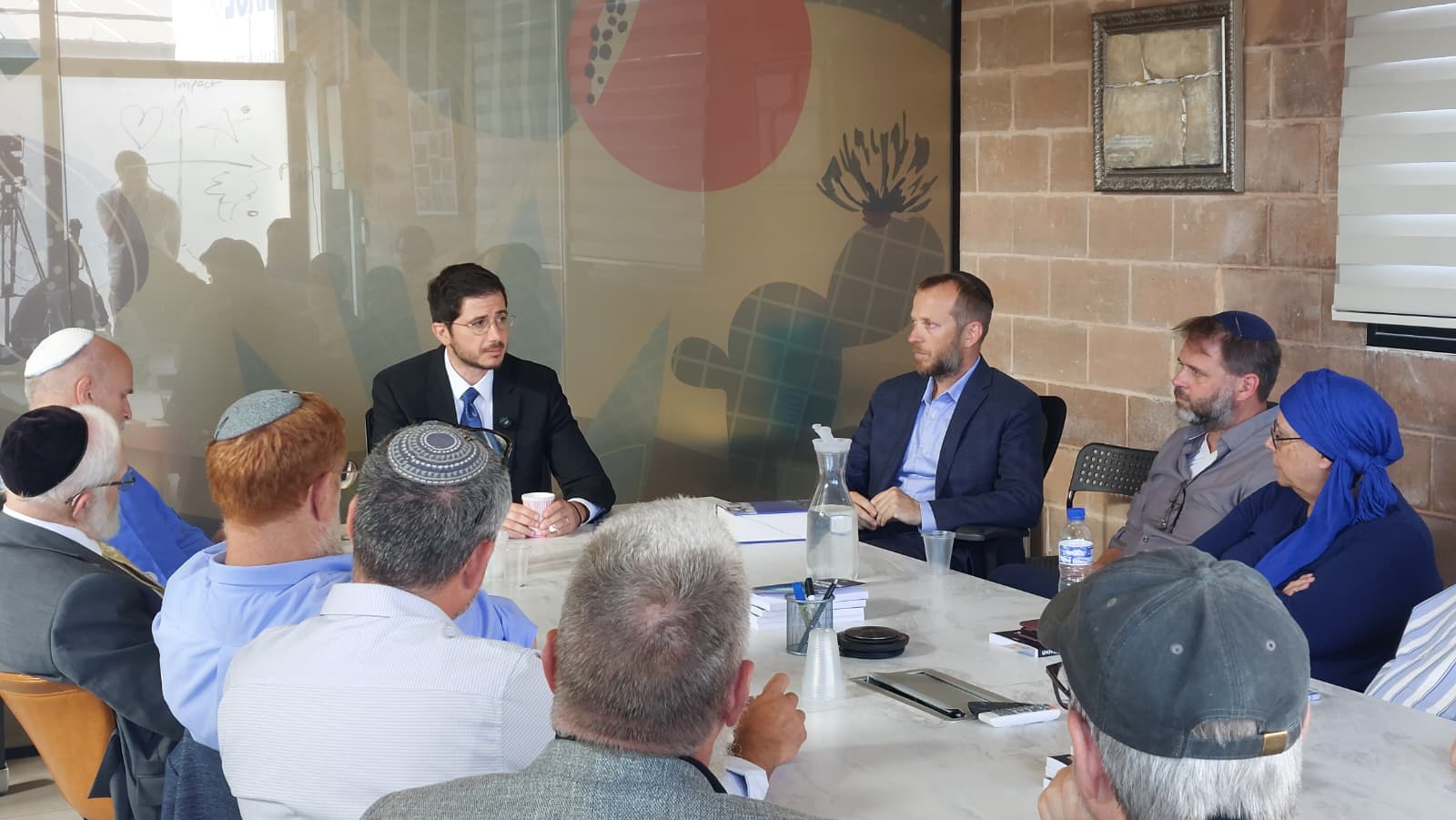
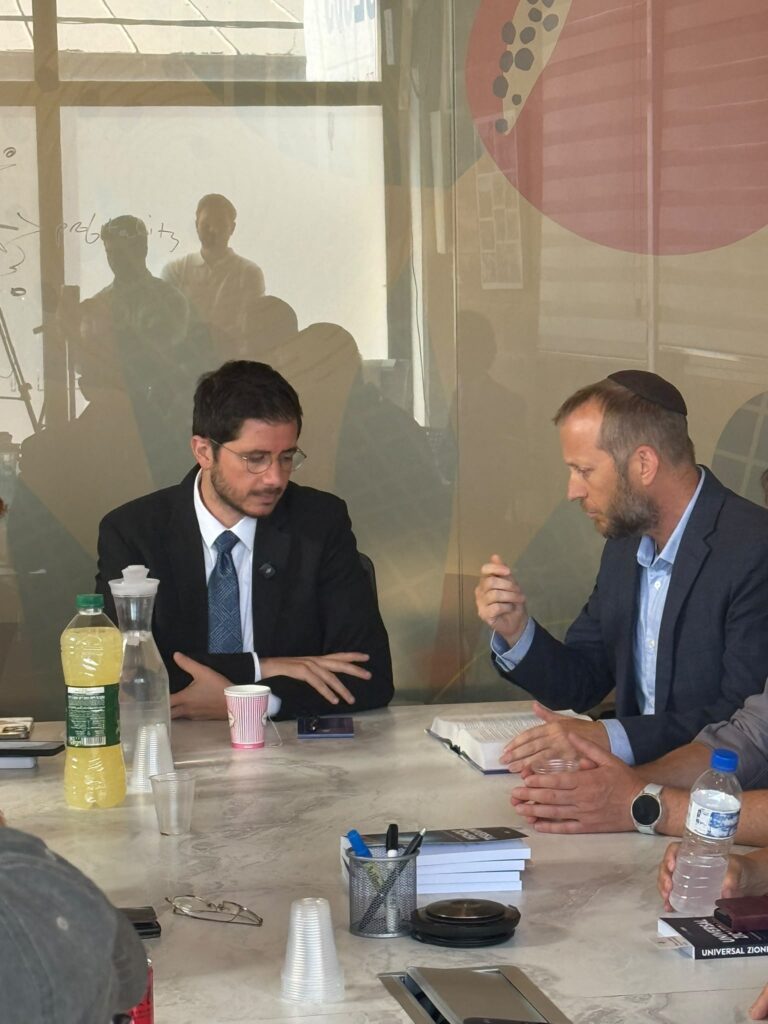
Israeli society gives Arab Christians a combination of “freedom, opportunity, and belonging,” which is why many of them “are proud to be Israeli,” Israel’s ambassador to the Christian World, George Deek, said at the Israel365 offices in Beit Shemesh.
Deek’s comments referred to a May public-opinion survey of Arab citizens of Israel published by Tel Aviv University’s Konrad Adenauer Program for Jewish-Arab Cooperation. Among Christian Arab respondents, Israeli identity was the most commonly cited as the most important component of their personal identity: 37.8% named their Israeli identity as most important, compared with 33.4% who chose their Arab identity, 24.9% who chose their Palestinian identity, and 3.9% who chose their Christian identity.
“Israel has succeeded where much of the region has failed: it has created a society in which Arab Christians can preserve their faith and identity while participating fully in the life of the state,” Deek said. “Christians in Israel worship freely, receive a strong education, build successful careers, and serve in medicine, law, diplomacy, academia, business, and public life. That combination of freedom, opportunity, and belonging is why many Arab Christians are proud to be Israeli.”
He cautioned, however, that “pride should never be taken for granted” and that more had to be done to ensure equal opportunity for Israel’s Arab Christians. Deek called on the state to invest in Christian towns and institutions, confront crime and discrimination, protect Christian holy sites, and respond firmly to every act of harassment or religious hatred. He added that Arab Christians should also take on a stronger and more consistent role in shaping the country’s policy and representing Israel internationally.
“The goal should not be to ask Christians to choose between being Arab, Christian, and Israeli,” he said. “Israel is at its best when its citizens can be all three, confidently and without apology.”
Deek’s remarks came during a Sunday meeting with a small group, at the Israel365 office in Beit Shemesh. Deek comes from a centuries-old Christian family in the port city of Jaffa. “We are a family that can prove the longest continuous lineage in the city of Jaffa, about 370 years, which makes us the natives and everyone else in the city an immigrant,” he told the group.
Deek, who earned his law degree from Reichman University, has served in Israel’s Foreign Ministry since 2008. He was Israel’s ambassador to Azerbaijan from 2019 to July 2025, becoming the first Christian to hold that post in the country’s history. He was appointed Israel’s envoy to the Christian world in April, the first person ever to hold the position.
Deek has made similar arguments elsewhere, tying Israel’s outreach to Christians directly to the land’s role in Christian origins. In an interview after his appointment, he said the decision to create his post rested on three foundations: the special connection between Christians and the land of Israel as the birthplace of Christianity; the deep historical bond reflected in the churches of the Holy Land, where Jews and Christians share biblical values that gave rise to democracy, individualism, and freedom of conscience; and the importance Israel places on relations with people of every faith. “I think that Israel, while it cherishes all faiths and denominations, has a special relationship with the Christian world, because Christianity was born in this land, and Israel is the guardian of the holy places for Christianity as well as for Judaism,” he told CBN News. He has urged Christian visitors to walk the actual ground where their faith’s history unfolded. “I want them to connect to their Scripture, I want them to connect to the roots of their values, by simply going to those places,” he said.
Israel’s official Foreign Ministry-run X account has made the same case in miniature, tying specific places to specific figures from the Gospels. Marking the feast day of Saint Mary Magdalene, the account noted that her name means “Mary of Migdal,” after a Jewish town on the shore of the Sea of Galilee that still exists today. Migdal, it said, remains “a prosperous agricultural Jewish village” to this day, in the same location and under the same name, two thousand years after the woman for whom it was named lived there.
Deek has also pointed to hard numbers as evidence that his outreach corrects a distorted picture. Israel’s Christian population has grown from roughly 34,000 in 1948 to more than 180,000 today, and the country now counts some 300 churches, double the number that stood at the state’s founding. He has contrasted that growth with what he calls the erasure of Christian communities elsewhere in the region: “We see the ethnic cleansing of the region from its Christians, who have been diminished from 20% of the population of the Middle East to less than 2% of the population today,” he said. “All those places that used to have thriving Christian communities today have been reduced to nothing.”
Deek framed Israel’s treatment of its Christian minority as part of a broader struggle over the future of religious and ethnic diversity in the Middle East. “Israel is a home to thriving minority communities, whether Muslim or Christian or Druze or others, showing a different model to the rest of the region,” he said. He argued that his advocacy on behalf of the Jewish state was inseparable from his concern for Arab Christians and other minorities. “I don’t do this because I care about Jews more than I care about others,” he said. “In fact, I do this precisely because I care for the future of my community, my people.” He added: “A Middle East that has no room for a Jewish state is a Middle East that has no room for anyone,” describing Israel’s right to exist as central to safeguarding the rights and existence of other minorities in the region.
Rabbi Tuly Weisz, founder of Israel365, who hosted the meeting, told the Post afterward: “We know all of the frustrations that everybody has, and the fact that Israel has not been doing enough to meet the needs of our Christian allies, or doesn’t respond appropriately when something unfortunate happens. This is why I was so excited to hear that the government finally did appoint a special envoy. We really all just want to help him.” Israel365, which focuses much of its work on the relationship between Israel and Christian and conservative audiences abroad, launched the Israel Truth Network to respond rapidly to false claims made about Israel. Weisz said the initiative followed a recommendation from the late pro-Israel Christian activist Charlie Kirk, who was assassinated last year.
The picture Deek describes is borne out by the government’s own numbers. Israel’s Central Bureau of Statistics reported ahead of Christmas 2025 that some 184,200 Christians live in the country, about 1.9% of the population, and that the community grew by 0.7% over the previous year. Nearly 79% of Israel’s Christians are Arab, concentrated largely in the Northern and Haifa districts, with Nazareth home to the largest Christian population in the country at close to 19,000, followed by Haifa, Jerusalem, and Nof HaGalil. Christian students make up a share of Israel’s university population disproportionate to their numbers in the general public, with women outnumbering men among Christian students by a wider margin than among Jewish students. Nearly 68% of Christian citizens over the age of 15 are employed. Israel’s official X account has pointed to the same trend as evidence of integration rather than mere tolerance. “Israel’s Christian community is an active and integral part of the country’s economy and society,” it said, noting that Christian unemployment runs below both the OECD and Israeli averages and that the community shows little reliance on welfare. “The data reflects a community that is thriving and deeply integrated.”
That trajectory sets Israel apart from the rest of the region. Christian communities across the Middle East have been shrinking for decades under the weight of persecution, war, and emigration. Iraq’s Christian population has fallen from an estimated 1.2 million in 2011 to roughly 120,000 today, largely a result of the Islamic State’s campaign against religious minorities. Syria’s Christian community has declined from about 1.5 million before its civil war to an estimated 300,000. Bethlehem, the birthplace of Jesus, was roughly 80% Christian while under Israeli control; since the Palestinian Authority assumed control of the city, that share has fallen to about 20%, according to Prime Minister Benjamin Netanyahu. In several regional states, conversion from Islam to Christianity remains a criminal offense that can carry prison time or worse, and religious affiliation listed on state identity documents shapes access to education, employment, and safety.
Israel is the one country in the region where the opposite has happened: its Christian population has grown every year for decades, protected by a legal framework that guarantees freedom of worship and full civic participation. Churches operate openly across Nazareth, Haifa, and Jerusalem, Christian schools and hospitals serve both Christian and non-Christian Israelis, and Arab Christians sit in the Knesset, practice law and medicine, and serve in Israel’s diplomatic corps, with Deek himself chief among them. “While the Christian community in Israel is growing and prospering, Christians in neighboring countries are experiencing a sharp decline due to systematic intimidation and repression,” Netanyahu said in December, citing Iraq, Syria, Lebanon, Turkey, and areas under Palestinian Authority control. “The persecution of Christians or followers of any other religion is unacceptable and must not be tolerated.”