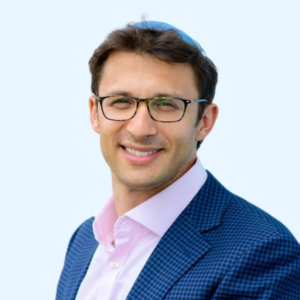
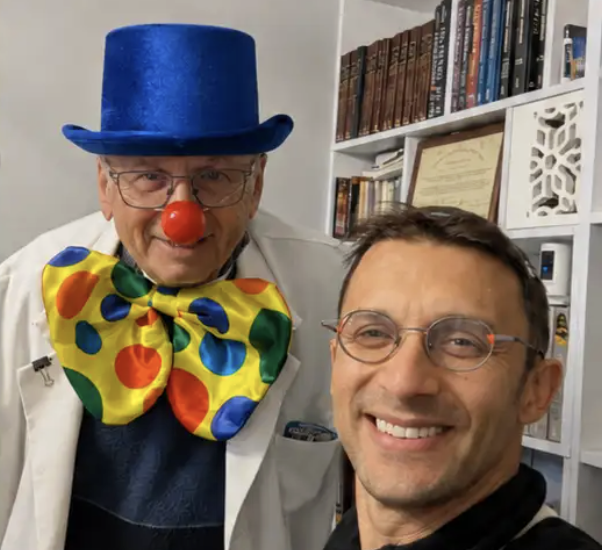
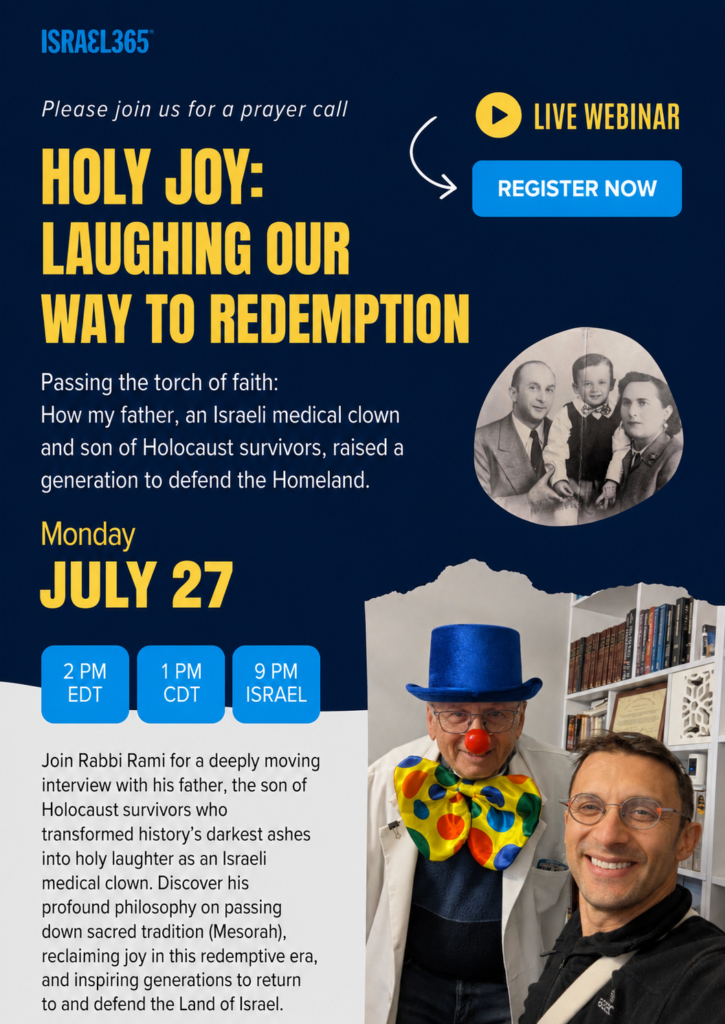
My father is a medical clown in Israeli hospitals. He is also the son of Holocaust survivors, a retired American businessman, and the grandfather of soldiers in the Israel Defense Forces. On our upcoming prayer call, I am going to sit down with him and ask him how one life holds all of that.
I want to tell you a little of the story first, because it starts long before the red nose.
My grandmother spent the war years in hiding, sheltered by a Christian family who took in fifteen Jews and risked their own lives to do it. Her brother kept her alive from the outside, paying off guards when it came to that. Once, a Nazi guard accused her to her face of being a Jew. She talked her way out of it. Her sister survived with her.
My grandfather spent those same years in uniform. First the Polish army, then the Russian army, and then the British army. In 1946 he reached the shores of British Mandate Palestine. He wanted to stay, but circumstances took him to Galveston, Texas, and then to New York, where he met my grandmother. My father was born in Brooklyn.
My grandfather worked in catering. One afternoon he was walking with my father on his shoulders and they passed a Jewish day school. He looked up at the building and said, “One day, my boys will go to this school.”
He took a second job pressing ties to pay the tuition, and my father and his brother went to that school. Everything in this story runs through that decision. The Torah those boys learned in Brooklyn is the reason my father raised his children on the Land of Israel, and the reason his grandchildren guard it today.
That is what Jews mean by Mesorah, the chain of tradition passed from one generation to the next. It rarely looks like a ceremony. Usually it looks like a man deciding what his children’s education is worth and then working until it is paid for.
My father grew up in that house. He started his career as a social worker, moved into business, and eventually built a successful company of his own. He could have taught me about margins and contracts. He taught me one thing instead, and he repeated it until it stuck.
“The most important asset you have is your name. Everything you do must protect it.”
Solomon said it first: “A good name is more to be desired than great riches” (Proverbs 22:1). Honestly, I did not appreciate the lesson until I began meeting people who had done business with my father. The sentence is always the same. Your father? Honest as they come. Decades of deals, and no one with a complaint.
He was equally passionate about supporting Israel. He made sure we marched in the Israel Day Parade and brought us to Jerusalem for our bar mitzvahs. Nobody in our house ever argued about Israel. It was simply where we belonged.
So when my parents sold their company and made Aliyah, no one in the family was surprised. They had been going home for fifty years.
What came next did surprise us. My father was in a new country, in a new stage of life, with the kind of background that opens doors in Israeli business. Then COVID arrived, the hospitals filled, and he saw an advertisement looking for medical clowns. He applied.
Today he puts on a blue top hat, a bow tie the size of a dinner plate, and a red nose, and he walks into wards where people are frightened and in pain.
Some people assumed he was stepping down in the world. My father is convinced he was promoted, and he explains by citing a tradition from the Jewish sages. Rabbi Beroka was standing in the marketplace with Elijah the prophet and asked him whether anyone present had a share in the World to Come. Elijah pointed out two ordinary men. Rabbi Beroka went over and asked them what they did for a living. They told him they were comedians. When they found someone who was depressed, they cheered him up, and when they found two people quarreling, they made peace between them.
Two clowns in a marketplace, and they were the ones the prophet picked out of the crowd as holy people destined for heaven!
My father does not care whether a patient is two years old or a hundred and two. If he can get a smile out of a suffering person, he has done his job.
“Then our mouths shall be filled with laughter” (Psalm 126:2). The Psalmist describes the return of the exiles to Zion, the moment when the improbability of coming home breaks out of a person as laughter. That verse is being fulfilled in my family in real time. My grandmother hid from men who wanted her dead. Her great-grandchildren guard the borders of a Jewish state. Her son spends his mornings making sick Israeli children laugh.
This Monday, July 27, I am hosting a prayer call with Israel365, and my father will be my guest. I am going to ask him about all of it: the years in hiding, the three armies, the school on the corner, the business ethics that outlasted the business, and the joy he brings to hospital rooms in the Land of Israel every week.
Info for the webinar:
Holy Joy: Laughing Our Way to Redemption
Monday, July 27 2 PM EDT | 1 PM CDT | 9 PM Israel