

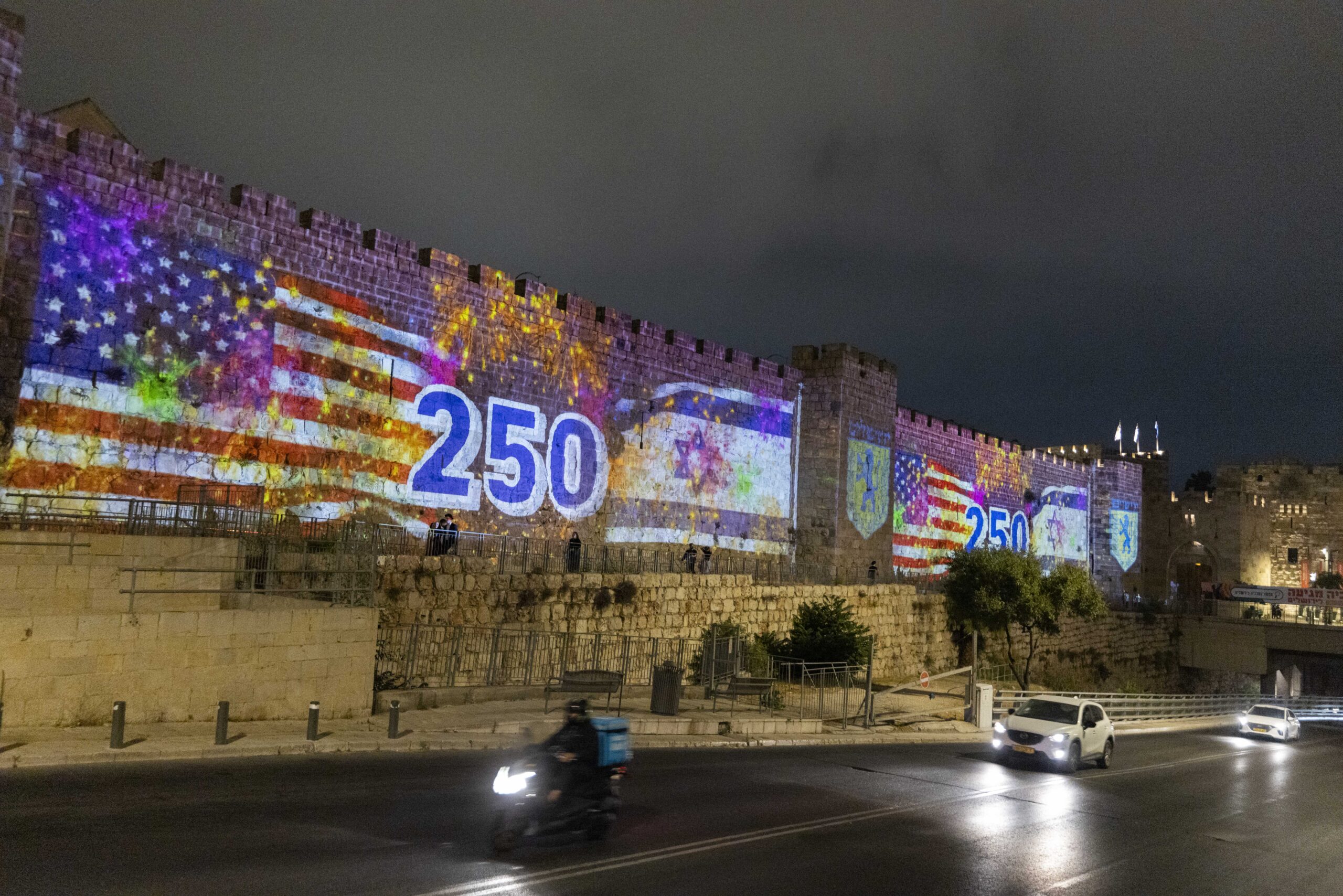
In August 1790, George Washington sat down to answer a letter. The Hebrew Congregation of Newport, Rhode Island, had written to their new president, anxious men in a young country, unsure whether the freedom they had just won would extend to a people rarely welcome anywhere. Washington wrote back with a line drawn straight from the prophet Micah. The United States, he promised, would be a place where “every one shall sit in safety under his own vine and figtree, and there shall be none to make him afraid.”
He did not reach for a phrase of his own invention. He reached for a Hebrew prophet, borrowing an image from Micah that had been a favorite of the Revolution, and he assumed, correctly, that the Jews of Newport and his fellow Americans alike would recognize it. At the founding of the American republic, the common language between a president and one of the country’s oldest Jewish communities was the Hebrew Bible.
We have grown used to hearing that America and Israel are allies. Allies share interests: they sign agreements, coordinate defense, trade weapons systems, and share intelligence. All of that is real, and all of it matters. But as the events playing out in today’s political arena show us, that’s all fragile; interests shift, administrations change, and an alliance built only on interest always sits a single election away from cooling.
If that were the whole story of the bond between these two nations, it would not explain Washington quoting Micah, and it would not explain why so many Americans feel something for Israel that goes deeper than foreign policy and that they themselves often struggle to name.
So what is the thing they cannot name?
It is not political, and it is older than any treaty. Many of the men who built the United States believed they were building something the Bible had described first. They spoke of a new Zion, gave American towns names like Salem, Hebron, and Bethel, and drew on the language of Scripture to explain the meaning of freedom.
When Americans later looked for a symbol of liberty, they found one on a bell in Philadelphia already cast with the words of Leviticus: “Proclaim liberty throughout the land, to all its inhabitants” (Leviticus 25:10).
America did not merely admire the Hebrew Bible. America drew deeply from its foundation, from people who understood that the idea of a nation under God, accountable to a moral law it did not author, entered the world through Israel.
That is an inheritance, not merely an alliance. And the difference is everything. You can walk away from an ally. You cannot walk away from where you came from.
That is why a prayer matters here in a way that a policy statement never could. There is a prayer, recited in synagogues across Israel every Sabbath, that asks God to bless the State of Israel as “the beginning of the flowering of our redemption.” A version of that prayer now exists for both nations at once, and reading it slowly is the quickest way to understand what binds them. It opens facing America:
Our Father in Heaven, help and bless our country, the United States of America. Place love and brotherhood among all the inhabitants of our land. Bless all the leaders of these states, and place within their hearts a spirit of wisdom and understanding, to uphold the peace and freedom of the land.
Notice what it asks for, and what it does not. Not power, not wealth, not victory over enemies. It asks for love and brotherhood among the inhabitants, and for wisdom in the hearts of leaders, so that peace and freedom hold.
Those are the exact things a divided America is starving for right now, in a season when neighbors can barely speak across a political line. The prayer does not treat America as a superpower to flatter. It treats her as a country in need of blessing, which is the truest and most loving way to see any nation, including one’s own.
Then the prayer turns east:
Bless the State of Israel, the beginning of the flowering of our redemption. Fulfill in it the verse that is written: “For Torah shall go forth from Zion, and the word of the Lord from Jerusalem.” Spread a shelter of peace over the entire world, and may all who dwell on earth live in security.
Here is the whole architecture of the shared destiny in two sentences. Israel is asked to become what the prophet Isaiah promised: the place from which the word of God goes out to the world (Isaiah 2:3). And the blessing does not stop at Israel’s borders or at America’s. It widens to a shelter of peace over the entire world, security for all who dwell on the earth.
Two nations, named and loved, and through them a hope for everyone.
An alliance asks what two parties can do for each other. What binds America and Israel begins with an older and deeper question: what is a nation actually for?
The founders answered that question in the language of the Hebrew Bible because they knew no better language for liberty under God. They believed their country existed for something the God of Israel had set in motion long before, and they were not embarrassed to say so.
The congregation that received Washington’s letter still worships in Newport, in the oldest synagogue building in the United States. More than thirty thousand people of every faith walk through it each year. The letter and the building outlasted every political quarrel of their century, which is roughly the point.
Their descendants have grown more embarrassed. A great deal of American life now runs on the quiet assumption that the country invented its own values out of nothing, that liberty and human dignity and the rule of law are simply modern good ideas with no particular parentage.
That assumption is not only false. It is dangerous. A value cut off from its root will not survive the first hard winter, and the generation that forgets where liberty came from may become the generation that discovers it can be taken away.
Which brings us back to Washington and his fig tree.
He did not have to explain the reference because his readers already knew it. That shared knowledge, Christian and Jew reading the same Book and hearing the same promise in it, formed the real foundation of the friendship between these two peoples. It still does.
To pray for America and Israel in the same breath is not to confuse the two. It is to remember, out loud, that their stories have always been connected.
That is why this prayer belongs not only in a synagogue or a sanctuary, but in the home. It reminds us that America’s freedom and Israel’s calling both point back to the same source, and that both nations still need the blessing, wisdom, and protection of the God of Israel.
We printed these words on brushed aluminum for exactly that reason, so the prayer you have just read can hang on a wall where your family passes it every day, not filed away but kept in plain sight. Hang it by the door, and everyone who enters your home reads the same promise Washington sent to Newport.
The flags are different. The covenant beneath them is one.
Get the Prayer for the United States of America and Israel art for your home here.