



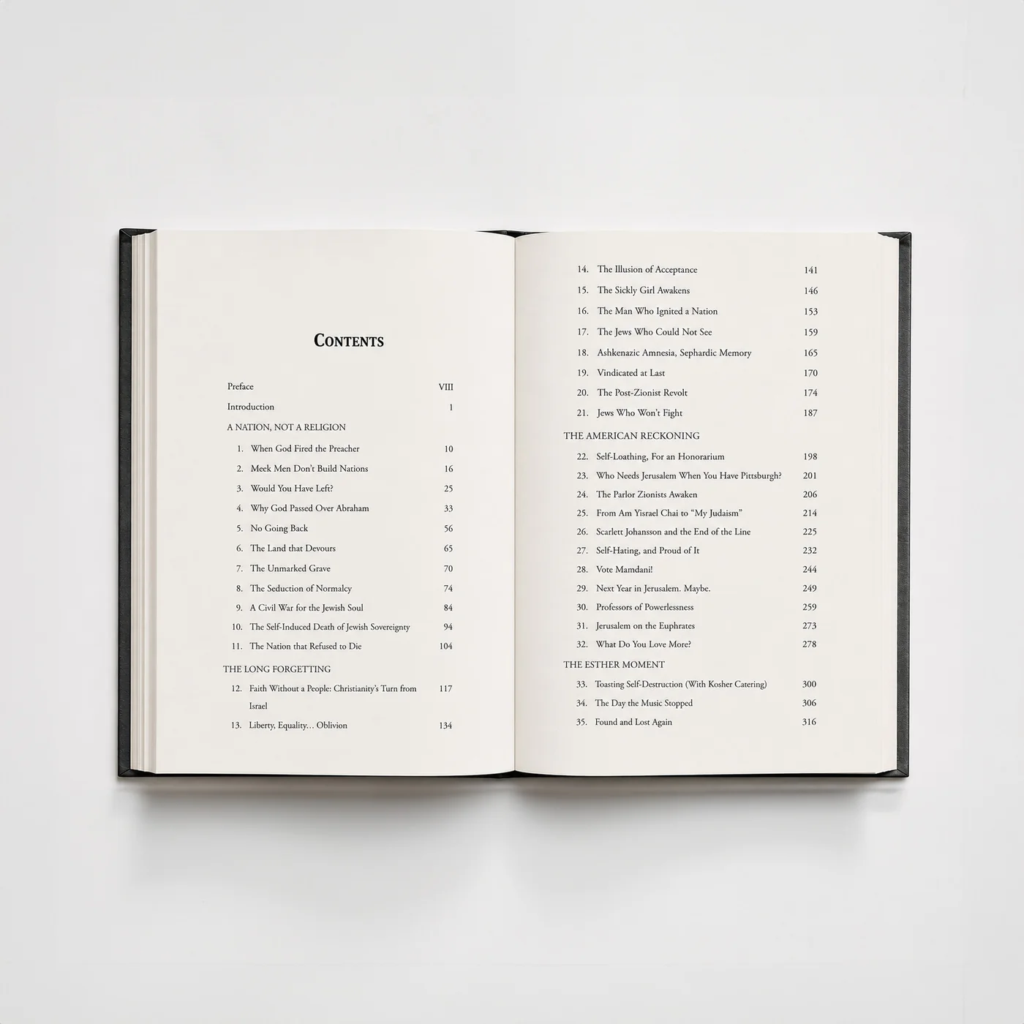
In Part 1 of this conversation, Rabbi Elie Mischel, author of the newly published Countdown: American Jews and God’s Plan for Redemption, explained why he believes God is using today’s antisemites as unwitting messengers to force American Jews to confront a question they have spent two centuries avoiding: who are they, really – a religion or a nation? In Part 2, we turn to the Book of Esther, the crisis within American Jewry, the tragedy of intermarriage, and what Rabbi Mischel is ultimately asking American Jews, and their Christian friends, to do.
Zahava Schwartz: You use the Book of Esther as the central lens for understanding American Jews today. Why Esther specifically?
Rabbi Elie Mischel: All the books of the Bible are relevant for all time — that is a foundational Jewish belief. What we read in any book of the Bible is not simply history. It is a blueprint for what we are living through right now. Christians call certain books of the Bible “the historical books.” But Jews call them the “prophetic books,” because we believe they are describing stages in the unfolding story of Israel that are as relevant today as when they were written.
But when it comes specifically to the Jews of America, there is no book of the Bible more relevant than the Book of Esther. The Book of Esther is completely focused on exile. There is almost no mention of the land of Israel, no mention of sovereignty or nationhood. It is a book about what Jewish life looks like — and what dangers it faces — when Jews are scattered among the nations. It is a template for exile in every generation. And when you read it carefully, the parallels to American Jewish life today are clear.
ZS: What are those parallels specifically?
REM: Let me first correct something most people don’t realize about the timeline of the Book of Esther. Most people assume the story takes place shortly after the Babylonian exile. It doesn’t. The Book of Esther takes place at least fifty years after the rebuilding of the Second Temple in Jerusalem. By the time Haman rises to power, the Jewish people already have a rebuilt Temple and a functioning community in the land of Israel. The national revival is in full swing. And yet the vast majority of Jews chose to stay in Persia. They looked at the Temple in Jerusalem and said, “No, thank you. Persia is our home now.”
Sound familiar? Here we are, seventy-eight years after the founding of the modern State of Israel. The Jewish people have a sovereign homeland, an army, a thriving nation. And yet most American Jews are happy exactly where they are. They’ve said no thank you to Jewish nationhood and destiny in the land of Israel.
And then look at Mordecai and Esther themselves. Their very names tell the story. Mordecai derives from Marduk, the chief Babylonian god. Esther derives from Ishtar, the Babylonian goddess. Their parents had Hebrew names. They gave their children Persian names — a very classic immigrant story. Esther was so thoroughly assimilated that nobody in the palace knew she was Jewish. Think about what that means. She wasn’t just keeping a low profile. She had no visible connection to the Jewish community whatsoever.
ZS: The traditional reading of Mordecai and Esther portrays them as pious heroes. You’re reading them very differently.
REM: I am, and I think it’s actually the more powerful reading. The Talmud tends to portray Mordecai and Esther as very holy, pious Jews — classic Jewish heroes in the traditional sense. But I believe the simple reading of the text tells a different story, and there is a minority view among the sages that supports it.
Take Mordecai’s refusal to bow to Haman. Every commentator asks: why? There is no Jewish law prohibiting bowing to a government official — that was standard practice. Haman was not a false god. So why would Mordecai risk the lives of every Jew in the Persian Empire over this?
My answer, following Rabbi Yaakov Medan, is that it was not a religious act. It was an act of national pride. Mordecai was one of the very few Jews of his era who simply refused to bow before a virulent antisemite. He felt that the dignity of the Jewish people depended on someone making a stand, even at enormous personal cost.
He reminds me of what I call the “October 8th Jews” in America — people like Michael Rapaport, who may not be particularly religious, but who woke up the morning after October 7th and said: I am a Jew, and I will not stay silent. They started wearing Star of David necklaces, speaking out publicly, defending Israel at real personal and professional cost. That is Mordecai in the Persian era. Not necessarily a great Torah scholar, but rather a Jew who rediscovered his national pride and refused to bow.
ZS: The Jews of Persia woke up, fought back, and won. Isn’t that a victory worth celebrating?
REM: It is absolutely a victory, and we celebrate it every Purim. But it is an exile victory — and that is also its tragedy.
What God ultimately wants from the Jewish people is not merely that we survive in exile with renewed pride. God’s entire plan for the world depends on the Jewish people returning to the land of Israel, establishing sovereignty, and from there becoming a light unto the nations, as Isaiah prophesied. An awakened Jewish community in Persia, or in America, that stays in Persia, or stays in America, has not fulfilled that mission. It has taken one step and stopped short of the destination.
After the story of Esther comes the story of Ezra and Nehemiah. Ezra leads another wave of Jews back to Israel — but again, it’s a small fraction of the Jews living in the Persian diaspora. Even after the awesome miracle of Purim, the vast majority did not go all the way. The Sages say that this is why the Second Temple was ultimately destroyed. The Jews of that generation did not “rise up like a wall” and return to the land en masse. They woke up — and then went back to sleep.
That is the warning embedded in the Book of Esther for American Jews today. The Hamans of our time — Tucker Carlson, Ilhan Omar, Maureen Galindo — are waking people up. The question is what American Jews will do with that awakening. Will they fight back, regain their comfort and their status, and go back to sleep? Or will they hear the deeper message and “rise up like a wall” and return home to Israel?
ZS: You’re quite hard on the Orthodox community in this book — not just on secular or Reform Jews. Why?
REM: Because the Orthodox community should know better, and that is precisely what makes their failure so painful.
What this entire book is about is that Jews have tragically turned being Jewish into “Judaism” — a religion similar to Christianity or Islam. That is a fundamental misunderstanding of what we are. And I find that even among the most devout Orthodox communities in America, many have fallen into exactly this trap. They are Torah scholars who have somehow missed one of the most fundamental elements of the Torah: that we are a nation.
What they have created is something that resembles authentic Jewish life in many ways — the Shabbat, the kosher laws, the prayer, the learning — but is missing its very foundation. A Torah community in America that does not place Israel at the very center of its consciousness, that does not understand that living in sovereign Israel is the fulfillment of everything it studies and prays for, is not fulfilling God’s will — no matter how many hours a day its members study Torah.
ZS: And the Haredi refusal to serve in the IDF — you see that as the same error taken to its extreme?
REM: Exactly. And when you’re actually living in Israel, as the Haredim are, the absurdity becomes almost impossible to comprehend.
The refusal to serve is not simply a question of whether they are doing their fair share, or whether the army is sufficiently religious. It goes to the heart of identity. By refusing to participate in the defense of the nation, the Haredi community is essentially declaring: we are a religious group, not a nation. We don’t fight wars. We pray and study.
But the Bible is filled — from beginning to end — with our greatest leaders, our holiest figures, fighting to defend the people of Israel. Moses, Joshua, David, the Maccabees. The idea that Torah greatness is incompatible with national defense is not Jewish. It is a rejection of the Torah’s national vision for the Jewish people.
And to hold that position while living in Israel, while your brothers and sisters are fighting and dying to defend the country you live in — that is not just a theological error. It is a moral failure.
ZS: Intermarriage rates among non-Orthodox American Jews are approaching 75%. Is there any coming back from that?
REM: It is one of the most painful realities I grapple with in this book. We have already lost millions of Jews — people whose parents intermarried, whose connection to the Jewish people was severed, who are simply gone. That is a tragedy of enormous proportions, and I don’t think anyone has a magic solution.
What I do believe is this: redemption is happening in Israel. Step by step, we are moving forward. The real question is how many American Jews will be part of it. And I believe that all of us — Jews and non-Jews who care about the land and people of Israel — have an obligation to do everything in our power to reconnect as many of these Jews as possible to Jewish nationhood and to Israel. Every single Jew is a treasure. We are such a small people. We cannot afford to lose a single one.
I don’t know that we can undo what has already happened. But we can fight for every Jew who is still reachable.
ZS: The book has sharp edges. You challenge, you provoke, you make people uncomfortable. How do you hold that together with the love you clearly feel for the community you’re writing about?
REM: For me, the number one principle is honesty. I believe that real love does not mean putting your head in the sand and pretending everything is fine. When you see people you love in genuine danger — spiritual danger, existential danger — you must speak the truth. Loudly and clearly.
I served as a rabbi in the American Jewish community for over twelve years. I will always be part of that community. These are my people, my friends, my former congregants in Livingston, New Jersey. I am not writing from the outside looking in. I am writing as someone who came from there, who loves them, and who is terrified of what is happening to them.
And here is what I want people to understand about all this evil that American Jews are facing today. The fact that God is sending these painful messengers — the Tucker Carlsons, the Ilhan Omars, the Maureen Galindos — is not a sign that God has abandoned American Jews. It is the opposite. It is a sign of incredible love. Why would He send these wake-up calls if He didn’t care? He cares enough to make it painful. He cares enough to force the question. That is what love looks like when the stakes are this high.
ZS: What do you want an American Jewish reader to feel when they finish this book?
REM: I want them to feel Jewish pride. Real, deep, unapologetic Jewish pride. The ideal would be for a reader to close this book and say: I want to go to Israel. I want to be fully part of the Jewish national story. But short of that, I want every American Jewish reader to rise up with clarity and with strength — to know who they are, to know what God wants from them, and to have the courage to meet this moment. Because if you have pride and you have clarity, those two things together will give you the strength to face what is coming, to hear what God is saying, and to bring other Jews along with you.
ZS: And what do you want a Christian reader to feel?
REM: My Christian readers are in no way secondary. The mistrust and misunderstanding between Jews and Christians is so often rooted in the fact that Jews have not presented themselves clearly to their non-Jewish friends. When you judge Israel by the standards of a religion, nothing makes sense. And if Jews don’t explain to Christians who we actually are — a nation, not a denomination, a people with a land and a destiny and a mission — then we are cheating our Christian friends.
Christians are looking to the Jewish people to play our critical, central role in redemption. They sense it. They feel it. That is why Christian Zionism exists. But if we are not honest about what our role is, if we are not playing it, then we are failing not only ourselves but our Christian brothers and sisters as well.
The time has come to speak openly and honestly about who we are and what we are here for. I believe that clarity — Jewish clarity about Jewish identity — is essential to the redemptive process that both Jews and Christians are waiting for. We are in this together. And the first step is telling the truth.
Rabbi Elie Mischel is the Director of Education at Israel365 and the author of Countdown: American Jews and God’s Plan for Redemption, available at israel365store.com.

