They carried their idols through the Red Sea.
Not the Egyptians — the Israelites. The Zohar, the foundational text of Jewish mysticism, is honest: the Israelites who walked between two walls of water on the night of the Exodus were idol worshippers. To dramatize the point, the Zohar describes thousands of Israelites clutching their idols as they crossed through the Red Sea.
Fifty days later, God gave these people the Bible.
This has always struck me as one of the strangest facts in Jewish history — and tonight, on Shavuot, the anniversary of the night God gave the Bible at Sinai, it is worth sitting with. Hundreds of years before the Exodus, God had far better candidates to receive it. Abraham discovered God on his own, through sheer force of reason and courage, in a world drowning in paganism. He spoke with God face to face and passed every test God placed before him. Isaac and Jacob followed in his footsteps, each building their own direct, personal relationship with the Creator. By any measure, these were the greatest human beings who ever lived.
Yet God didn’t give them the Bible. Instead, He waited hundreds of years, until their descendants were enslaved and broken in Egypt, until many had forgotten the God of their fathers entirely and were bowing to Egyptian gods — and that is precisely when He chose to give them the most important book in world history.
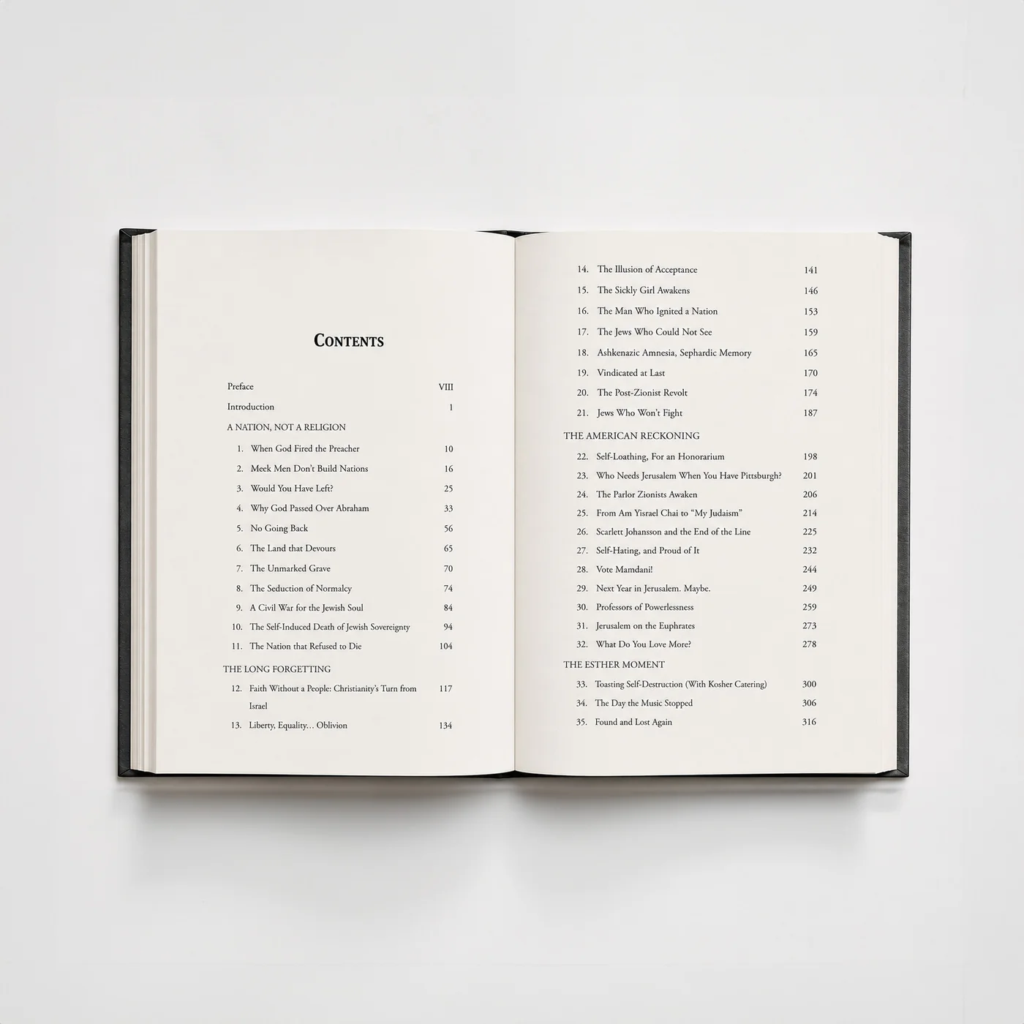
I’ve spent the last two years thinking and writing about this question, and I’ve come to believe it is directly connected to the greatest crisis facing the American Jews today. That crisis, and the answer to this ancient question, are the subject of my new book, Countdown: American Jews and God’s Plan for Redemption, published this week.
What is a Jew?
Walk into any Jewish community in America today and ask people what it means to be Jewish. Many will tell you it means belonging to a religion — the Jewish faith, one of the three great Abrahamic religions, alongside Christianity and Islam. Being Jewish, in this view, is essentially a faith — something practiced in synagogue on Saturday mornings, no different in kind from the way Christians practice their faith on Sunday. It is a private matter between a person and God.
But this definition immediately creates a problem. The majority of American Jews today do not believe in the divinity of the Bible. Most don’t observe Shabbat, keep kosher, or pray regularly. By the standard of any normal religion, they have left the faith. A Catholic who stops believing in Jesus and stops attending Mass has, in any meaningful sense, left Catholicism. A Muslim who abandons the five pillars is no longer practicing Islam.
So what exactly is a Jew who doesn’t believe in the Bible or observe its commandments? Is he still Jewish? If Judaism is a religion, the honest answer is: not really. And yet every one of these Jews knows, in his bones, that he is still Jewish — that no matter how far he drifts from synagogue or scripture, something binds him to his people that he cannot quite name and cannot quite shake. Anti-semites certainly don’t make distinctions. Neither does history.
That feeling has a name. It is called nationhood. And it is the key to everything.
———————————————————
Are Jews a religion or a nation? Tucker Carlson and Ilhan Omar are forcing that question on American Jews whether they are ready or not. Countdown: American Jews and God’s Plan for Redemption by Rabbi Elie Mischel argues that how they answer will determine the fate of all nations. Order your copy today.
———————————————————————————————————-
A Constitution for a Nation
Open the Bible and read it carefully. It certainly contains religious ritual and spiritual guidance for individuals seeking to draw close to God. But the overwhelming bulk of the Bible is something else entirely: laws governing courts and judges, rules of war and military conduct, the obligations of kings, the structure of a national economy, the rights of workers and the poor, the conduct of international relations. Laws governing what soldiers may and may not do in battle, how a king must behave, how courts must be structured, how land must be distributed, how foreigners living among the Jewish people must be treated.
The Bible assumes you are running a country.
This is not a minor point; it is the whole point. Before God gave the Bible at Sinai, He told the people of Israel: “You shall be for Me a kingdom of priests and a holy nation” (Exodus 19:6). Not a holy congregation or a religious community. A nation — with land, courts, an army, a government and borders to defend. A nation that would demonstrate to the entire world that every corner of human life can be governed by God’s law. As Rabbi Abraham Isaac Kook wrote, the goal is to demonstrate that “not only exceptional individuals — the wise, pious, monks and holy people — can live by the divine ideal, but entire nations as well, down to the lowest levels of society.”
No other civilization had ever attempted anything like this. Every spiritual tradition in history addresses the individual: how to pray, how to achieve salvation, how to purify the soul. The Bible’s ambition is categorically different. The shopkeeper and the farmer, the soldier and the judge — serving God not only in a house of worship, but through the way they conduct their daily lives as citizens of a nation governed by God’s law.
Why God Skipped the Forefathers
This is why God couldn’t give the Bible to Abraham, Isaac or Jacob. Not because they were unworthy — they were the greatest human beings who ever lived. But they were individuals, and the Bible was not written for individuals, however great.
God waited until 600,000 souls stood together at the foot of Sinai — broken, frightened, fresh from two centuries of slavery, many of them still spiritually lost — and gave them a document that would govern their courts, their wars, their economy and their relationship with every stranger living among them. He skipped the holy individuals and chose the imperfect nation, because that was always the plan. The idol worshippers stumbling through the desert weren’t a compromise. They were exactly what God was waiting for.
The Price of Forgetting
For two hundred years, Jewish leaders in Europe and America, under pressure to prove their loyalty to their host countries, redefined the Jewish people as a religion rather than a nation. Most American Jews have internalized this so thoroughly that Jewish nationhood feels foreign to them — and when that private faith fades, there is nothing left to hold them to their people.
I left America five years ago and moved with my family to Judea, to the hills where King David grew up. The distance has given me clarity about what is happening to American Jewry that I could not have had when I was still living there. American Jews are the last great exile community in the world — six million strong, the most accomplished Jewish diaspora in history — and they are losing their children to assimilation at a rate that makes their long-term survival a mathematical impossibility.
The root of this crisis is not antisemitism, though antisemitism is real and growing. American Jews have forgotten what God told them at Sinai: you are a nation, not a religion. A nation with a land, a history, a destiny and a constitution — given not to holy individuals but to an entire people, idol worshippers and all.
What the World Is Waiting For
The stakes of this confusion extend far beyond the Jewish community, which is why Countdown is written for Christians as well as Jews.
The prophet Zechariah saw a day when “ten men from every language of the nations shall grasp the garment of a Jewish man, saying: let us go with you, for we have heard that God is with you.” The nations of the world are waiting for the Jewish people to become what God called them to be at Sinai — a holy nation in their own land, demonstrating to the world that justice and power can coexist, that an entire society can be governed by God’s law. That vision cannot be realized by a scattered people who think they are a denomination. It can only be realized by a nation that knows what it is.
God was not looking for worthy individuals when He gave the Bible at Sinai. He was looking for a nation willing to accept a constitution and live by it. The idol worshippers said yes.
The question facing the Jewish people today — and facing everyone who understands that the Jewish story is bound up with the story of the world — is whether their descendants still will.
Countdown: American Jews and God’s Plan for Redemption is available now at www.israel365store.com.