

There’s a moment in the book of Exodus that most readers rush past.
The Israelites are in Egypt, hours away from the most dramatic night in their history. God is about to pass through the land and deliver His people. And His instruction to them is not what you’d expect. He doesn’t tell them to pray. He doesn’t tell them to gather. He tells them to take the blood of a lamb and mark the doorposts of their house.
Not their hearts. Their doorposts.
The entrance to a home is not just a threshold. It’s a declaration. It tells the world who lives there, what they believe, and whose they are. God understood that long before we did.
The Jewish people never forgot it.
This Shavuot, which begins tonight, May 21, Jewish communities around the world will celebrate the giving of the Torah at Mount Sinai. It’s the holiday that completes what Passover began. Freedom was never the destination; it was the precondition. The destination was the covenant, the word of God handed to a people and, through them, to the world.
One of the traditions of Shavuot is to fill homes and synagogues with greenery and flowers. The rabbis teach that Mount Sinai burst into bloom when God’s voice rang out, and Jewish families recreate that image in their own homes each year. The home itself becomes holy ground.
And that brings me back to doorposts.
For thousands of years, Jewish families have marked their doors with a mezuzah, a small case holding the words of Deuteronomy 6, the Shema. Every time a Jewish person enters or leaves their home, they pass beneath the name of God. The doorpost isn’t a decoration. It’s a daily reminder of who you are and who you belong to.
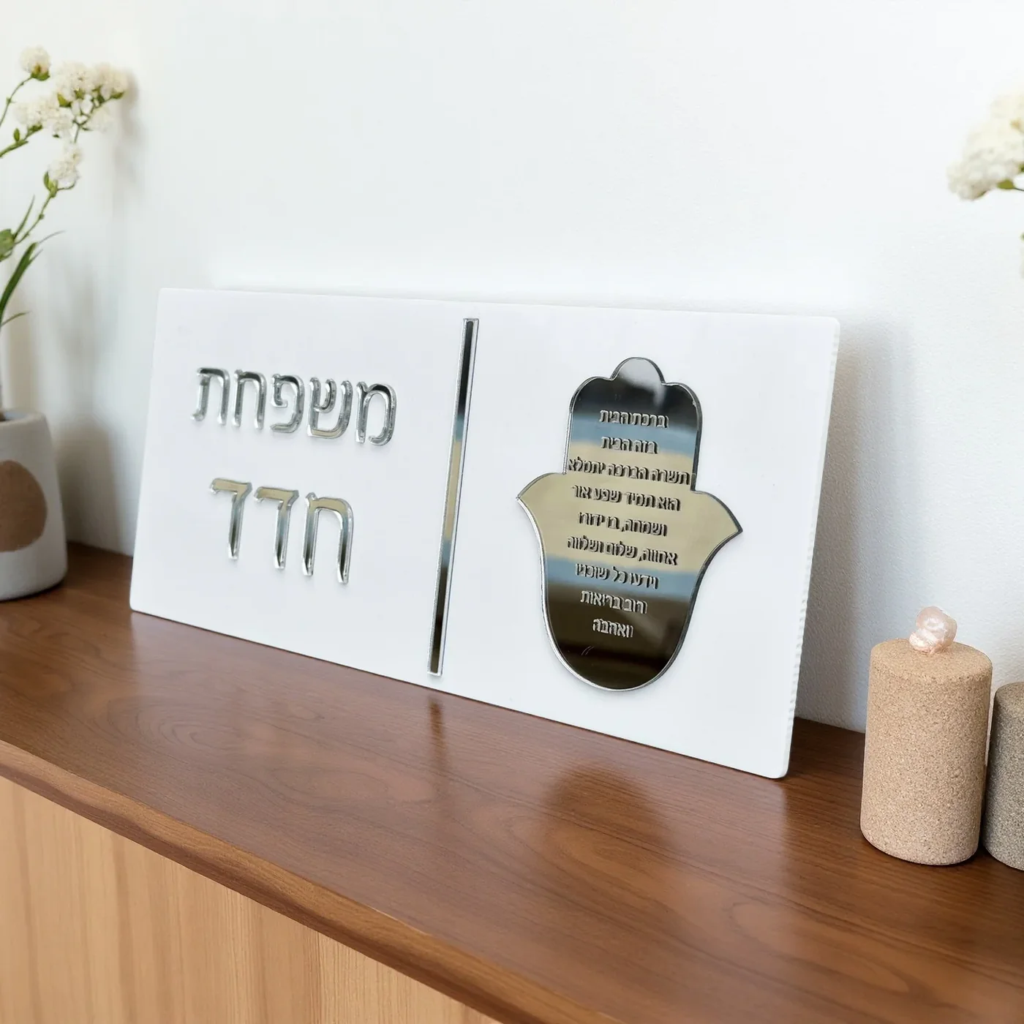
But there’s another tradition, not biblical, but culteral, quieter and less familiar to most Christian readers: the Hebrew family name displayed at the entrance of a home.
In Israel today, you see them everywhere. Outside apartments in Jerusalem, on doors in Tel Aviv, above entryways in the Galilee. A family’s name, written in the script of the Bible, marking the home as belonging to a people with a specific history and a specific covenant.
Hebrew is not like other languages. The rabbis teach that the world was created through Hebrew, that each letter carries weight beyond its sound. When a Jewish family puts their name in Hebrew on their door, they’re connecting the act of coming home to a story that began at a burning bush and runs through every page of scripture.
Evangelical Christians who love Israel have spent years with these pages. You know that shalom means more than peace, that hesed is more than love, that the name of God in Hebrew carries a weight that translation never fully captures. You understand, maybe better than most, that the language itself is sacred.
So why should that connection live only in your Bible?
Shavuot is about what we do with what we’ve received. For Jews, one of the answers has always been to make the home itself a testimony, to mark the door, to put the ancient name where you’ll see it every day. Our personalized Hebrew family name sign does exactly that. It takes your name and renders it in the script that carried God’s word to the world. It’s not a trinket. It’s a statement about who lives here and what they believe.
The process is simple. You enter your English last name, and the team handles the Hebrew translation and engraving. Signs ship within a few business days, so there’s still time to have yours before Shavuot on June 2nd. They start at $39.99, which for something that will still be on your door ten years from now is about as easy a decision as it gets.
Your name. In Hebrew. On your door. What a beautiful sight it will be.
Order your custom Hebrew family name sign here.