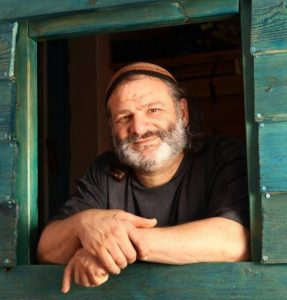


If you follow news about Israel, you almost certainly know who Rabbi Pesach Wolicki is. Since October 7th, he has become one of the most sought-after voices for anyone trying to understand what is actually happening in the Middle East — writing for the Jerusalem Post, appearing regularly on the Erin Molan show, building a YouTube channel that has exploded in viewership because his analysis cuts through the fog in a way that very few people can match. He doesn’t traffic in talking points. He explains the region with an intellectual honesty and sharpness that serious people find rare and refreshing.
What you may not know is that Rabbi Wolicki is, at heart, a Torah teacher.
A few years ago, I sat down with a rabbi whose name almost no one outside of Jewish-Christian relations circles had heard of. He was teaching Torah to Christian audiences, explaining the weekly Torah portion, unpacking the Psalms, walking believers through the Hebrew text with a precision and clarity that immediately impressed me. I left that conversation knowing two things: this man belonged at Israel365, and I wasn’t going to stop until he was part of our team.
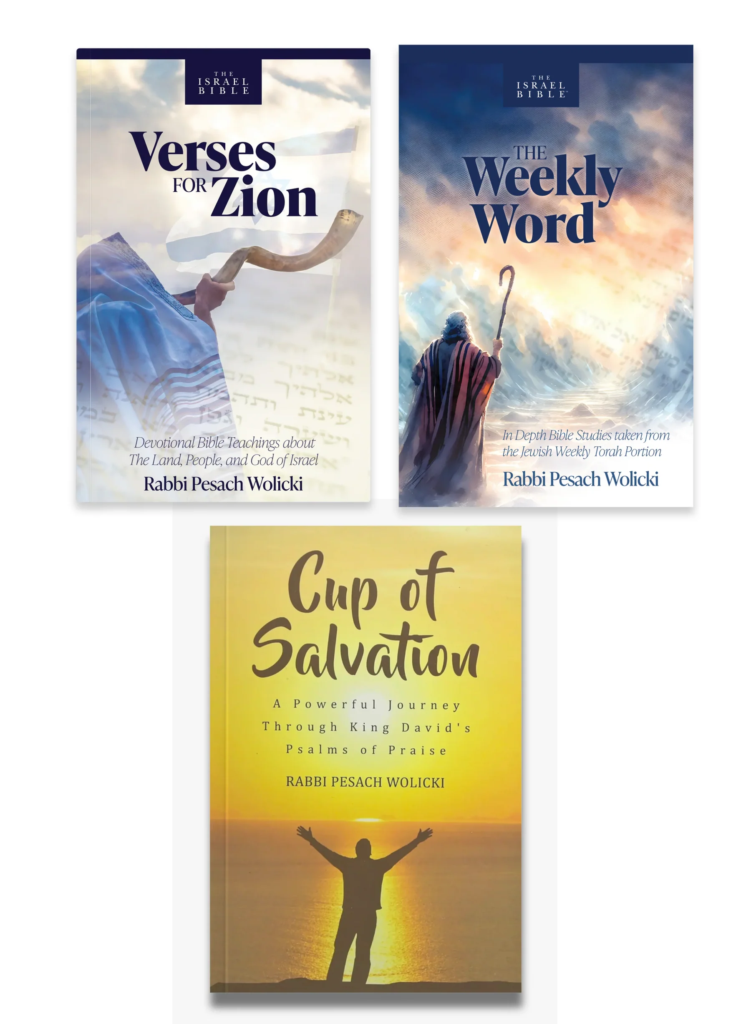
What brought him here had nothing to do with geopolitics. It was Torah. It was his extraordinary ability to open the Hebrew Bible to a Christian audience and help them see what Jews have always seen there — the covenant, the land, the people, the unfolding purposes of God. Those years of teaching produced three books — The Weekly Word, Verses for Zion, and Cup of Salvation — which together form the clearest window into how Rabbi Wolicki actually thinks. That was his calling, and it’s still what he tells me he misses most. Every so often, in the middle of everything else, he turns to me and says how much he wishes he had more time to simply study and teach the Bible.
I understand that feeling. But here’s what his growing audience may not fully appreciate: everything Rabbi Wolicki says about the Middle East flows directly from that biblical worldview. These are not two separate careers. They are the same mind operating on two levels.
One of his core argument, the one that separates his analysis from nearly everyone else doing this work, is deceptively simple. He argues that the West fundamentally misunderstands what drives people in this region, because the West insists on projecting its own secular assumptions onto cultures shaped entirely by religion. Give people jobs. Give them economic opportunity. Give them a stake in stability. And then, the theory goes, they’ll abandon extremism.
It sounds reasonable. It is completely wrong.
The men who flew planes into towers on September 11th weren’t poor. The leaders of Hamas are not suffering economically. What drives radical jihadists is not deprivation; it is religious conviction. It is a vision of holy war, of sacred obligation to slaughter and conquer, rooted in their reading of their faith. You cannot negotiate someone out of that with a trade deal, and you cannot understand it at all if you refuse to take seriously what they themselves say they believe.
This insight, which has earned Rabbi Wolicki a place among the most serious voices in current geopolitical analysis, is not the product of years studying foreign policy at some think tank. It comes directly from the Bible. The prophets of Israel were not naive about the nations of the world. They understood that nations are animated by something deeper than economics, that history is the story of competing visions of God and of man’s obligations before Him. That is the lens through which Rabbi Wolicki reads the headlines, and it is the lens the prophets gave him.
Those three books are now available together as The Rabbi Pesach Wolicki Trilogy, on sale at 33% off — $39.99 for all three. I’d encourage anyone who follows Rabbi Wolicki’s geopolitical analysis to read them, because you cannot fully understand where he is going without understanding where he is coming from.
The Weekly Word is a guide to the weekly Torah portion — accessible without being shallow, showing why ancient Scripture speaks directly to the present moment. Verses for Zion traces the biblical promises to the land and people of Israel in a way that genuinely changes how you read the news. And Cup of Salvation explains the deeper meaning of the Hallel — Psalms 113 through 118 — drawing on the original Hebrew to show why these Psalms have anchored Jewish and Christian devotion for millennia.
These books were written for Christian audiences who want to understand the Bible through Jewish eyes. But they are also the intellectual foundation of everything Rabbi Wolicki has said since October 7th — every television appearance, every op-ed, every YouTube video. The biblical worldview and the geopolitical analysis are not two separate projects. They never were.
Rabbi Elie Mischel is Director of Education and Content at Israel365.