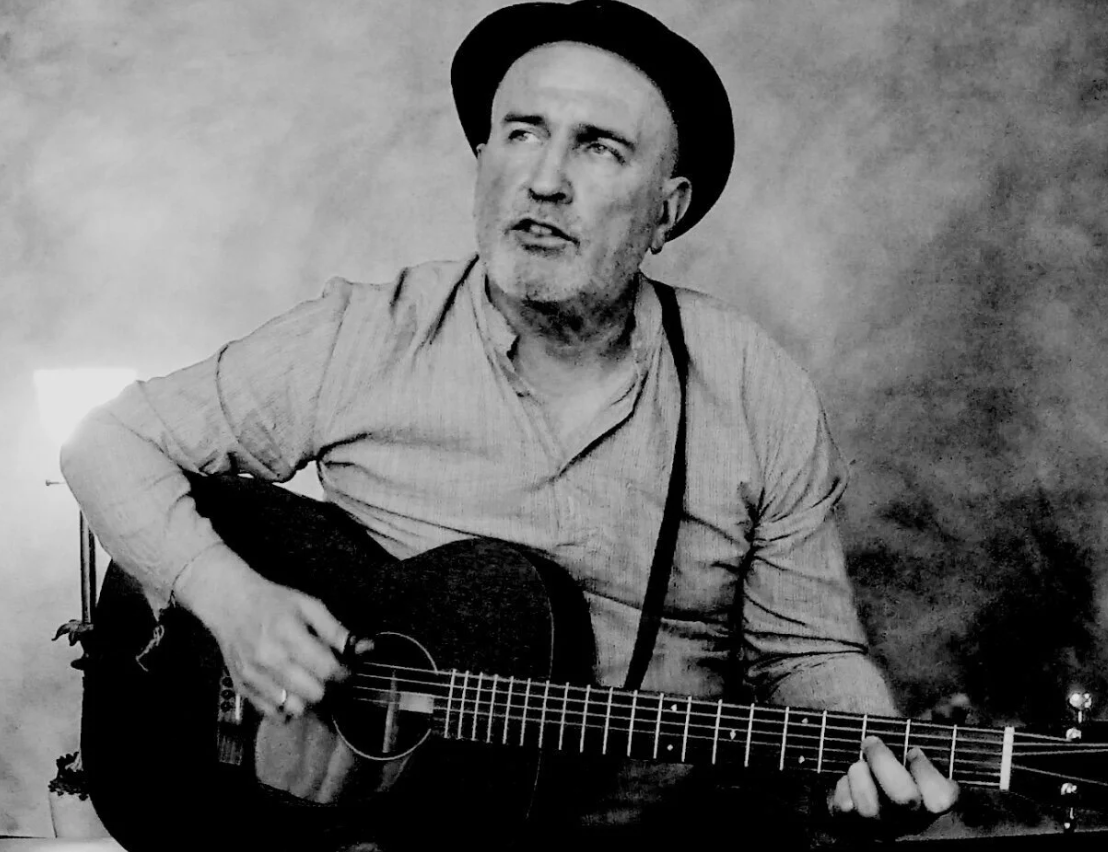
Chris Falson has worked at Warner Brothers, written hit gospel songs, and composed music for major films. He’s played for the Pope, led worship at Promise Keepers, and toured the world with his band. But the most meaningful moment of his career came from two homeless men with missing teeth who told him, “Don’t give up. Keep going.”
In a recent conversation on Biblical Money, Rabbi Rami Goldberg’s podcast exploring faith, finance, and business, Falson shared his unconventional journey from Australia to Hollywood, and why he believes being a Christian musician in the entertainment capital of the world is exactly where God wants him.
The Family Business
Falson’s path into music was almost inevitable. His father was a producer and composer, his mother an actress, his grandparents musicians. By age eight or nine, he was singing on commercials and jingles in Australia. “I never thought too much about it because it was just normal,” he said. “All the friends of my parents were musicians, and in Australia, some of them were celebrities.”
But Falson wasn’t a model student. He passed only one subject in high school: music. Years later, he discovered he was on the autism spectrum with learning difficulties. From 19 to 28, he made his living as a “side man,” playing guitar, bass, and keys for touring artists across Australia and Europe.
Then, at 27, everything changed. “My wife and I were just train wrecks ready to happen,” Falson recalled. “That lifestyle, it wasn’t going well.” He found faith in a way that rescued him from the stereotypical rock and roll life.
The difficulty? “As a professional musician coming into faith, into a church, I was struck by how bad the music was. I didn’t tell anybody I was a musician for several years. I didn’t want to go play in that band on stage. Oh my goodness, no.”
But he learned to pray, meditate, read Scripture. “Somehow for my personality or how God creates us, I was really designed for this,” he said.
The Songs That Changed Everything
Years later, working at a church and teaching musicians, Falson wrote some songs for his local congregation. Those songs took off in America and became, as he put it, “huge hits in gospel world.” That success allowed him to move to Los Angeles in 1993.
“I wanted to try, like any athlete,” Falson explained. “The golfer wants to play against Tiger Woods, the basketball player wants the NBA. I wanted to go to LA.”
Thirty-two years later, he’s still there. “It’s not a great place to live maybe in many ways,” he admitted. “But on the artistic side, you’re always in the NBA or the PGA. You’re always working with the best people.”
A Candle in a Dark Room
When Rabbi Goldberg asked how a person of faith navigates Hollywood, an industry that often seems hostile to religious values, Falson’s answer was immediate: “A candle shines brightest in a dark room.”
“There’s lots of us here that felt God draw us here,” he said. “It’d be like someone going to the Ukraine war or even to Israel, feeling called to be in a very troubled place. I’m on the mission field. That’s as simple as that. And the mission field happens to be in a morally very dark place.”
Falson works primarily in post-production, composing music after films are shot. And there’s a pattern he’s noticed: “Everybody who works with me has Googled me before they met me. At the very top of Google are all these Christian things I’ve done because I did Promise Keepers, I played for the Pope. So when I walk into a production meeting, everybody’s arms or their hearts are like this because they all say, ‘I hate Christians.'”
But Falson doesn’t preach. He lives differently. “Someone says you’re a Christian means nothing,” he argued. “It’s how you live your life. Are you living with grace? Are you loving people? Are you encouraging people?”
After a week or two, he’s friends with the crew. “I love being in those environments because I’m not the person they thought I was going to be.”
He does draw lines. He won’t work on horror films. “I have bad dreams as it is. I don’t need any help from a horror film.” He turned down a meeting with the Weinstein brothers after seeing two minutes of a horror franchise they wanted him to score. “I couldn’t even imagine sitting in front of that screen for days and weeks writing music for it.”
The Moment That Mattered Most
Before COVID hit, Falson played a concert at Midnight Mission in downtown Los Angeles, an organization that helps 100 homeless people graduate back into normal life each year. He brought a small gospel choir and played songs like “We Are Family.”
At the end, he sang one of his own songs, a meditation on Proverbs about searching for wisdom: “I went looking for wisdom, I cried out night and day, awaited by the city gates hoping she would pass my way… Oh, and then I found love, or should I say love found me.”
The room of homeless people caught the refrain and started chanting it. “I found love. I didn’t write it like that, and it just took off. They’re singing and singing and I just had to go, oh my goodness, this is amazing.”
But what happened next changed everything. Falson had gone through a brutal year. His production company had gone bankrupt. He’d lost most of his money. “As a dad, as a husband, you carry these things like I’m a failure. I didn’t do the right thing.”
As he packed up, two men approached, a white guy and a black guy, skinny with missing teeth. He could hear them conferring: “Should we tell him? I don’t know. You tell him.”
They walked up and said: “Hey man, don’t give up. Keep going.”
“To have two homeless people tell me that, it’s maybe the greatest thing anyone ever said in my life,” Falson said. “The King of England could have said it, it would have meant nothing. But those two people saying it…”
He’s played stadiums for hundreds of thousands. He’s had hit records and songs on TV shows and films. “But those moments are far more valuable. You don’t get paid money. You don’t get any reward. But the feedback from the audience is priceless.”
The Problem with “Clever” Christianity
Falson has strong opinions about the state of Christian entertainment. He’s not a fan of most Christian films coming out today. “I think they pander to the Christian audience, and I don’t think that’s why God put us on this earth, to pander to each other.”
Good theater, good teaching, good storytelling, he argues, is about questions, not answers. “The problem with a lot of successful Christian films and Christian music is that it’s not asking questions. It’s afraid to have somebody in their film that’s a little iffy or doesn’t believe, or the bad guy doesn’t get saved at the end.”
He sees the same problem in American church music. “Everything looks pretty, everything looks young, everything’s cool, and everything’s loud. You can disguise a lot of things when things are loud.”
What draws us to people in real life isn’t cleverness, Falson insists. “It’s because they loved us or they listened to us. And it’s the same in art.”
When he produces musicians, he works to strip away the polish and find authenticity. “They come in, they want to impress me. I get them to stop trying to sing. I say, imagine someone’s in the room now. Who would that be? Your mother, your sister, your friend? Think of someone who needs this song.”
“Gradually this realness comes out. Now this is what people want. We can fix flat notes. What we can’t fix is lack of integrity or honesty in your song.”
What AI Can’t Replace
Two weeks before his conversation with Rabbi Goldberg, an AI-generated country song hit number one on Spotify. Falson sees it as inevitable that AI will produce polished music. But he’s not worried.
“Imagine an AI worship band or an AI rabbi,” he said. “I just want human connection. I think most people eventually realize that’s what they need.”
“That’s the artist’s job. Our job is to keep fighting for those things.”
He’s working on a project now to democratize animation, building a studio to train storytellers around the world. The goal is to bring down the cost of quality animation from millions to something accessible. “If I could have a five-minute thing and all it is is my time and the software, that’s very exciting to me.”
But the technology isn’t the point. The story is the point. The human connection is the point. The broken heart that resonates with another broken heart is the point.
As Falson put it, quoting what Rabbi Goldberg shared from a Hasidic rabbi: “There’s nothing so whole as a broken heart.”
That’s why two homeless men telling a successful composer not to give up meant more than any platinum record. That’s why singing with terminally ill children matters more than stadium crowds. That’s why 32 years in Hollywood, surrounded by darkness, has been exactly where he needed to be.
“If we learn to listen to the divinity embedded in us, we’re going to be doing okay,” Falson said. “If we don’t, it’s not because of the tools. It’s because of our hearts.”
Watch the full episode here.