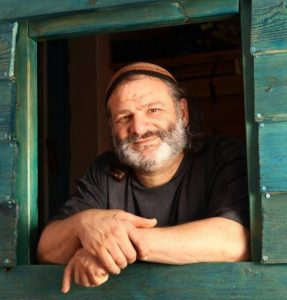
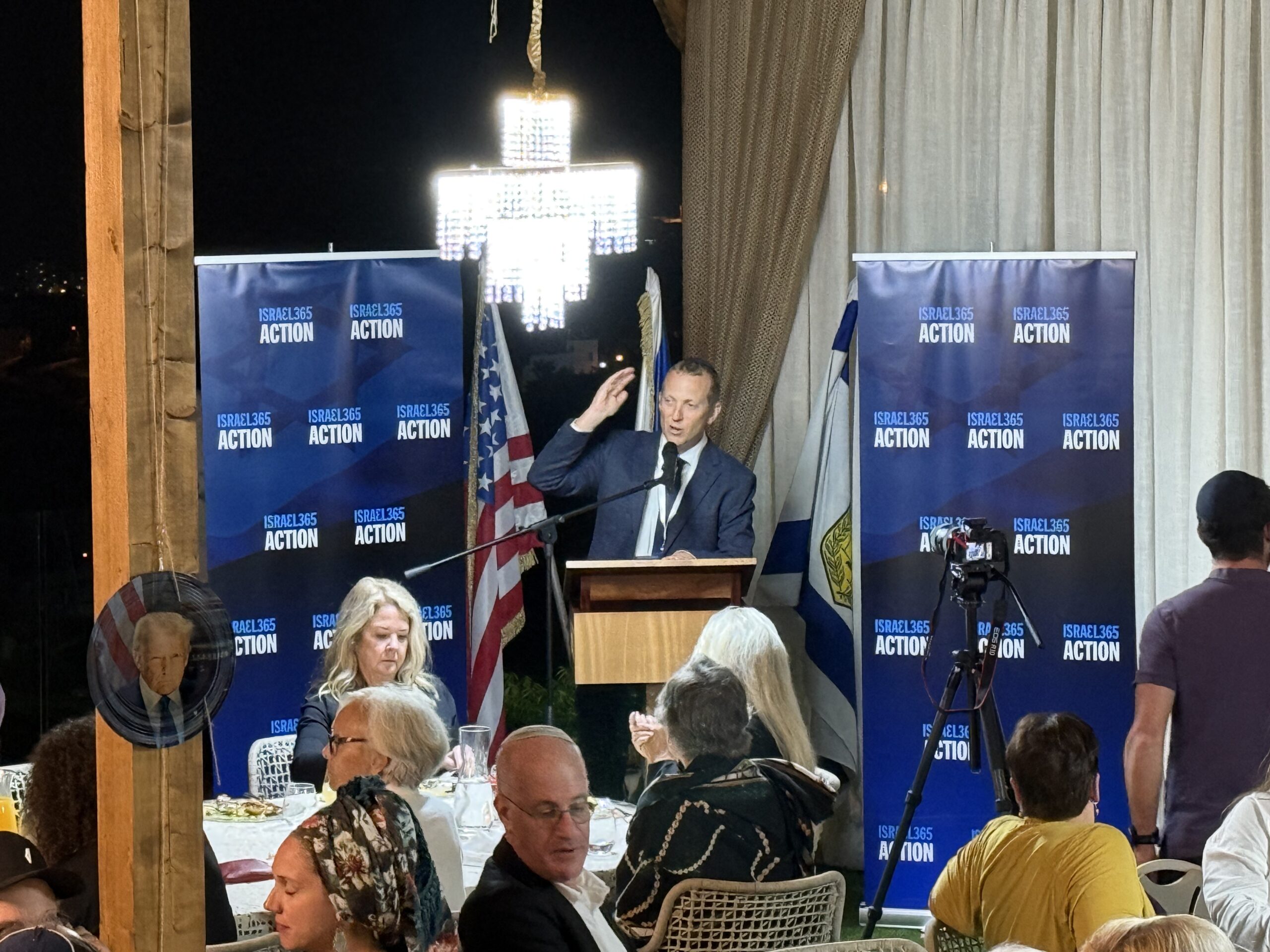
On October 8, while Israel was still burying its dead, a second shock set in. The massacre by Hamas terrorists was followed by something Rabbi Tuly Weisz, the head of Israel365, described as “more disturbing and surprising.” In his JNS TV interview, titled “Rabbi Warns A CRUCIAL Battle is Happening in The Christian World,” he said that what unfolded the next day exposed a deeper crisis.
“On October 8th,” he recalled, “it seemed like the world was really turning against us. We lost some of our best friends and our allies who the Jewish people invested decades in building relationships with… institutions and universities and professional associations, all abandoned us and kicked us when we were down.”
Weisz opened with an unambiguous assessment. “On October 7th, the world changed forever. A line was drawn between those who celebrated darkness and those who stood with light.” The shock, he said, was not only the brutality of Hamas but the reaction in the West. “All of the allies that we had are no longer with us,” he said. “The only ones who have been reliable are the evangelical Christian community.”
He rejected the idea that this alliance is transactional. “This is not just a friendship of convenience. This is a deep values-driven community that we have so much to build upon.” For years, he said, people questioned his focus on Christian outreach. “Nobody really understood why. Why are we doing that? Is it because of the donations? And it’s not. Is it because of tourism to Israel? It’s not. It’s because of the prophetic aspect and the real values-based relationship that Jews have with Christians that if we don’t invest in it, we’re going to lose in the next generation.”
Weisz calls his framework “Universal Zionism.” He acknowledged the tension in the term. “Zionism is a particular movement… the sovereignty of the Jewish people here in the land of Israel for the Jewish people,” he said. “Universal is, well, we believe that God is the God of the whole world, not just Jews.” The conclusion he draws is sweeping: “Universal Zionism reminds us that we’re here today not just to serve the Jewish people but really to serve all of humanity.”
He roots that idea in Scripture. “And you shall be to Me a kingdom of priests and a holy nation” (Exodus 19:6). The Sages understood that Israel’s covenant carries responsibility beyond itself. Weisz argues that after October 7, that outward responsibility can no longer be ignored. “We have to take our Zionism and turn it outwards and start doing outreach and getting people around the world to become Zionists like us.”
He described the current ideological struggle inside Christianity as decisive. “A lot of people are trying to split right now Christian Zionism and separate the Christians from Zionism,” he warned. Referencing prominent media voices hostile to Israel, he said, “There’s an effort to separate the Christian Zionist world.” The danger, in his view, lies in generational erosion. “They are reliable. They are with us. But their kids and their grandkids—the polling on that is very frightening.”
He was explicit about the Jewish community’s failure to cultivate its strongest allies. “We’ve invested a ton in our relationships with the liberal streams of Christianity… and we have done very little to invest and nurture the relationships on the more conservative or the right-wing.” That imbalance, he said, must end. “It’s on us to expand our mission and to go from religious Zionism to universal Zionism.”
Language is part of that battle. Weisz pointed to state-level legislation in the United States that requires the official use of “Judea and Samaria” instead of “West Bank.” “It’s mind-boggling in Tennessee that they’re taking such lengths to recognize the truth,” he said, praising efforts to align public language with biblical geography. He described initiatives to persuade Christian media to adopt accurate terminology and to oppose academic boycotts targeting Jewish communities in Judea and Samaria.
He also recalled the immediate political push for a Palestinian state after the massacre. “They really believed that the attack on October 7th proves that there needs to be a state for the Palestinians also in Judea and Samaria,” he said of senior American officials at the time. In response, his organization launched a campaign called “Keep God’s Land,” securing support from “hundreds of the most influential pastors and legislators.”
At the same time, Weisz addressed Jewish skepticism about Christian motives. “A lot of Jews say, ‘Well, don’t you know that all the Christians want to convert us?’” he said. His response was unequivocal. “We have nothing to be afraid of when working with our Christians. It’s not that they’re going to convert us… God forbid, it’s never going to happen. It strengthens our foundation, and it strengthens our faith in our Judaism.”
The practical expression of this alliance, he said, begins in Jewish homes. “We know that the best thing that we have in our life is the Shabbos,” he stated. “Most Christians have never seen a Jewish Shabbos, have never participated in a Shabbat dinner.” Israel365 is therefore encouraging Jewish families to invite Christian neighbors and colleagues to experience Shabbat. “Every Jewish person, every Jewish family has to go out of its way to do outreach and to bring non-Jews into the camp of Zionism.”
Weisz concluded with confidence rooted in redemption. “We know the end of the story. We know that we have a glorious future ahead of us,” he said. The State of Israel is described in the daily prayer as reishit tzemichat geulateinu, “the beginning of the flowering of our redemption.” Weisz argued that Israel is no longer at the beginning. “We’re much stronger than we were on October 6,” he said. The next stage, in his words, is when Zionism becomes “a source of blessing for the whole world.”
The battle after October 7 is not confined to Gaza. It is unfolding in churches, legislatures, media platforms, and Jewish living rooms. “Everyone has an important role to play in universal Zionism,” Weisz said. The outcome will determine not only who stands with Israel, but how Israel understands its own mission in history.