




The IDF says the slain commander ran Hamas’s apparatus for torturing and executing Gazans who opposed its rule
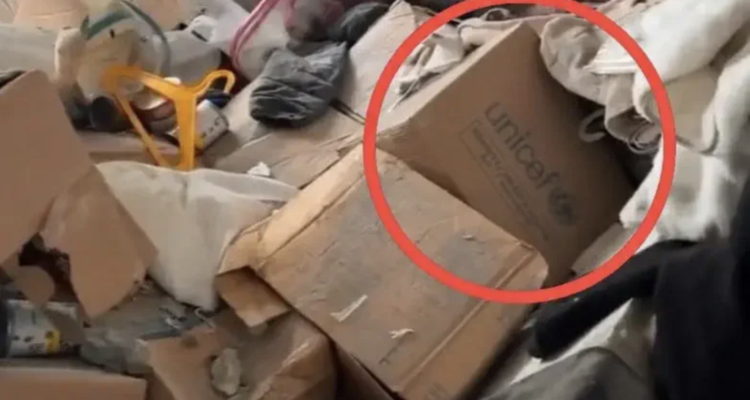
Stacks of UNICEF humanitarian aid boxes were found at the Gaza City home of Muhammad Abu al-Aouf, head of Hamas’s Internal Security Mechanism in northern Gaza, after Israel killed him in an airstrike, the IDF revealed on Wednesday.
🔻 هنا تم القضاء على الإرهابي محمد أبو العوف، المسؤول عن الأمن الداخلي لحماس في شمال قطاع غزة.
— Lieutenant Colonel Ella Waweya | إيلا واوية (@CaptainElla1) November 25, 2026
🔻 وفي المكان، عُثر على أكوام من صناديق المساعدات الإنسانية Unicef
🔻 وكان أبو العوف أحد المسؤولين عن قمع وتعذيب وإعدام سكان قطاع غزة الذين عارضوا حكم حماس.
🔻 وهذا يطرح تساؤلًا:… pic.twitter.com/9ZIkfl4HuC
Military footage released by the IDF showed dozens of cardboard boxes bearing the UNICEF logo stacked inside the residence, in the commander’s bedroom, according to JFeed. Lt. Col. Ella Waweya, the IDF’s Arabic-language spokesperson, said Abu al-Aouf was involved in the persecution, torture and execution of Palestinians who opposed Hamas rule.
“Why does humanitarian aid entering the Gaza Strip end up in the hands of terrorists who abuse and kill their own people?” Waweya asked.
The IDF and Shin Bet announced on Wednesday that they had killed Abu al-Aouf in an overnight strike in northern Gaza. Medics said the strike hit his apartment in the Beach refugee camp in western Gaza City. Abu al-Aouf, 47, also known as Abu Hamza, was killed before dawn along with his wife, Noura, and his daughters Yusra, 15, and Jana, 13, according to Palestinian reports. The IDF said he was sheltering in the building with his family. The Hamas-run Interior Ministry confirmed his death on Wednesday morning.
The IDF described Abu al-Aouf, a Hamas colonel, as a significant figure who “served as a key source of expertise in efforts to restrict the IDF’s counterterrorism operations in the Gaza Strip.” Israeli officials said his duties included planning attacks on Israeli civilians and soldiers and rebuilding Hamas’s military and security infrastructure.
The IDF and Shin Bet said Abu al-Aouf had been advancing attacks against Israeli troops and civilians and working to rebuild Hamas’s terrorist capabilities in violation of the ceasefire. Hamas uses its internal security apparatus to keep its grip on the Strip, the IDF and Shin Bet said, executing opponents and running torture facilities to crush protests against its rule.
The strike came one day after Israeli forces killed his commander, Naim Muhammad Ashour Abu Nahal, who led Hamas’s Internal Security Mechanism across the entire Gaza Strip. Abu Nahal was killed in an Israeli strike on Tuesday, November 24, and Israeli forces had captured his predecessor in September. “We commend the IDF and the Israel Security Agency [Shin Bet] for implementing our government’s offensive policy,” Netanyahu and Katz said in a joint statement after that strike. “No terrorist will escape the long arm of the State of Israel.” Early Thursday, the IDF and Shin Bet killed Khaled Abu Nada, the Hamas official in charge of economy and education, in a strike on Deir al-Balah. “We will continue to pursue our enemies and defend the security of Israel’s citizens,” Prime Minister Benjamin Netanyahu and Defense Minister Israel Katz said in a joint statement.
Israel has continued to strike Hamas officials throughout the ceasefire, insisting it will pursue them until the terrorist organization lays down its arms. Talks have not moved beyond the first phase of the agreement reached in October 2025.
The IDF did not say how the UNICEF supplies reached the commander’s home. UNICEF has not commented on the footage. The agency has said in the past that it tracks its shipments to warehouses and distribution points but cannot track its packaging once it is emptied, discarded or reused, and that misuse of aid by parties to the conflict is a deliberate attack on children’s lives.
A pattern of plunder
The discovery adds to a long record of evidence that Hamas diverts humanitarian aid meant for Gaza’s civilians. The IDF released internal Hamas documents during the war showing that the terrorist group stole roughly 25% of all humanitarian aid entering Gaza, profiting by hundreds of millions. Israeli intelligence found that Hamas declared itself the authority over aid distribution and commandeered large portions of the supplies.
In September 2024, Israel’s Channel 12 broadcast a recording of a Hamas terrorist discussing stolen humanitarian aid. “At this point, we have everything,” he said. “The warehouse is at full capacity.”
Even the United Nations has acknowledged the problem. In July, Ramiz Alakbarov, the UN’s deputy special coordinator for the Middle East peace process, issued a rare condemnation of Hamas. “I strongly condemn the recent obstruction of humanitarian operations in Gaza by the de facto authorities, which endangered humanitarian personnel, intimidated workers delivering lifesaving food assistance and disrupted life-saving humanitarian” operations, he said.
Israel’s Foreign Ministry responded that UNSCO had “finally acknowledged what Israel has been saying time and again. Hamas has been stealing humanitarian aid. Hamas must go.”
The US military has released its own evidence. CENTCOM published drone footage of what it called “suspected Hamas operatives looting an aid truck traveling as part of a humanitarian convoy delivering needed assistance from international partners to Gazans in northern Khan Yunis.” US officials said, “Hamas has been systematically stealing, looting & siphoning aid meant for suffering Palestinians in the Gaza Strip.”
Hamas has denied stealing aid, calling the American video a “baseless cover up.” In 2025, The New York Times quoted anonymous Israeli military officials who said the UN’s aid distribution system had been relatively reliable and less vulnerable to Hamas looting than other channels. The State Department disputed that report and accused traditional humanitarian groups of covering up “aid corruption.”
UNRWA: the UN agency Hamas built into
The UNICEF boxes surfaced against the backdrop of the most damning case of UN complicity with Hamas: the UN Relief and Works Agency for Palestine Refugees (UNRWA), which for decades ran the schools, clinics and aid networks of Gaza.
In January 2024, Israel accused 12 UNRWA staffers of taking part in the October 7 massacre, leading the United States and other major donors to suspend funding. Seven more cases followed. In August 2024, the UN’s own Office of Internal Oversight Services concluded that nine UNRWA employees “may have been involved” in the attack, and the agency fired them. “I have decided that in the case of these remaining nine staff members, they cannot work for UNRWA,” then-Commissioner-General Philippe Lazzarini said.
The investigations kept going, and the numbers kept growing. In June, USAID’s Office of Inspector General reported that it had referred 101 current or former UNRWA staff members to the State Department for suspension or debarment over their role in the October 7 massacre or their ties to Hamas. They included school principals, teachers, security guards, psychosocial counselors and medical workers.
The details read like a Hamas order of battle. According to USAID investigators, two deputy principals at one UNRWA school held senior positions in Hamas’s Izz ad-Din al-Qassam Brigades. Another deputy principal was a platoon commander in Hamas’s Nuseirat Battalion with communications duties on October 7. One UNRWA employee was a deputy company commander in Hamas’s Ain Jalut battalion, and another was a squad leader in the Khan Yunis Brigade. One UNRWA teacher delivered two anti-tank missiles to a designated location for use in the attack. A UNRWA school principal, Hafez Mousa Mohammed Mousa, was debarred after investigators found he coordinated communications among Hamas members on October 7.
Days later, UNRWA’s acting chief, Christian Saunders, fired 70 Gaza staff members with immediate effect over their ties to Hamas. The agency insisted the dismissals “do not constitute in any way a validation of the claims” against them, while UNRWA’s staff union called the firings “arbitrary” and demanded they be reversed.
The infiltration reached the agency’s own infrastructure. In February 2024, the IDF uncovered a Hamas tunnel running directly beneath UNRWA’s Gaza City headquarters, housing a Hamas intelligence data center powered by the agency’s electrical grid. Lazzarini said UNRWA did not know what was beneath its headquarters.
Hillel Neuer, executive director of the Geneva-based UN Watch, has spent years documenting the ties. His organization’s UNRWA Terror Network map identifies at least 400 Hamas-linked UNRWA employees, and UN Watch estimates that at least 1,500 more Hamas-affiliated staff work in Gaza alone.
Neuer points to the unions that represent UNRWA’s teachers. Suhail al-Hindi, longtime head of UNRWA’s teachers’ union in Gaza, sat on Hamas’s political bureau and was photographed with Yahya Sinwar. Fathi al-Sharif, head of UNRWA’s teachers’ union in Lebanon, was killed in an Israeli strike in 2024, after which Hamas announced he had been its leader in Lebanon. “It wasn’t underground,” Neuer said. “It was public. I’m not telling you he was Hamas. Hamas told you he was Hamas.”
“UNRWA has become an arm of Hamas,” Neuer told the JNS International Policy Summit in Jerusalem in June, where he called for the indictment of Lazzarini for crimes against humanity. “If we want accountability and if we want peace, governments must stop funding it.”
When UNRWA fired the 70 staffers, Neuer called the move “a drop in the bucket.” “UNRWA cannot be reformed,” he said. “It must be shut down.”
Israel’s Knesset has banned UNRWA from operating in Israeli territory, and in September the US-led Board of Peace overseeing Gaza’s reconstruction announced that UNRWA would have no role in the Strip. Hamas condemned the decision as “a complete alignment with the Zionist position.” UNRWA’s defenders point to a 2025 advisory opinion by the International Court of Justice, which found that Israel had not substantiated its claim that a significant part of UNRWA’s employees are members of Hamas or other terrorist groups.
The boxes in Abu al-Aouf’s home point to where at least some of that aid ended up. The man in charge of Hamas’s internal security in northern Gaza, whose job was hunting down Gazans who dissented, was sitting on supplies stamped with the logo of the UN children’s agency.

