




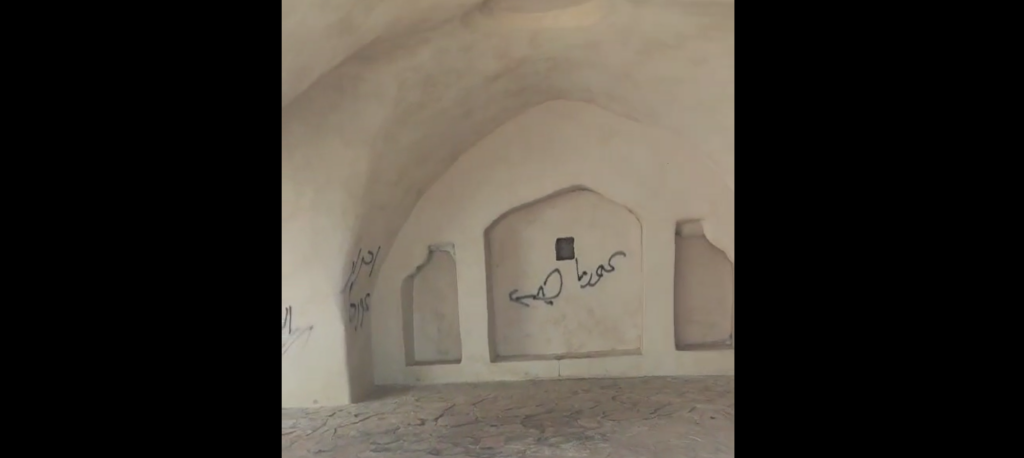
The Samaria tomb of Aaron’s son, who divided the Land of Israel among the tribes, has been attacked three times this year by residents of Awarta
Vandals graffitied “Hamas” on the tomb of Eleazar, son of Aaron the High Priest, in the Arab village of Awarta in Samaria. The attack took place on November 24. The vandals graffitied the Arabic word “Hamas” on the tomb alongside the emblem of the Popular Front for the Liberation of Palestine (PFLP).
The attack was exposed by the Judea and Samaria Situation Room (JSR), which blamed residents of Awarta and posted photos of the graffiti on its X account, @JSR_EN. Founded by the Yesha Council, JSR delivers verified updates on Judea and Samaria and counters misinformation for global media and decision-makers. The Yesha Council confirmed the vandalism to JNS on Wednesday. The JSR report, shared by the council, said the tomb compound had also been set on fire on the night of October 20-21. The graffiti is the second attack on the site in about a month, and the third on Awarta’s Jewish holy sites this year.
𝗗𝗲𝘀𝗲𝗰𝗿𝗮𝘁𝗶𝗼𝗻 𝗼𝗳 𝗛𝗼𝗹𝘆 𝗦𝗶𝘁𝗲𝘀: 𝗔𝗿𝗮𝗯𝘀 𝗙𝗿𝗼𝗺 𝗔𝘄𝗮𝗿𝘁𝗮 𝗶𝗻 𝗦𝗮𝗺𝗮𝗿𝗶𝗮 𝗩𝗮𝗻𝗱𝗮𝗹𝗶𝘇𝗲 𝘁𝗵𝗲 𝗧𝗼𝗺𝗯 𝗼𝗳 𝗘𝗹𝗲𝗮𝘇𝗮𝗿 𝘁𝗵𝗲 𝗛𝗶𝗴𝗵 𝗣𝗿𝗶𝗲𝘀𝘁
— JSR – The Judea & Samaria Situation Room (@JSR_EN) November 24, 2026
According to Jewish tradition, Eleazar, son of Aaron, is buried in the Arab village of… pic.twitter.com/v8N9Oo6MHw
Fire, flags and “a legendary day”
The October arson was filmed and celebrated. According to JSR, Arabs from Awarta set fire to the tomb on the night of October 20-21, and footage was posted on Arab social media with songs glorifying the act and threatening messages, including “What comes next will be even bigger, you scoundrels” and “Awarta, the Red Fortress.”
The IDF said troops searched for suspects, who had fled before they arrived. Israel Police officers and forensic investigators planned to enter the village under IDF escort to collect evidence and take witness statements. Samaria Regional Council head Yossi Dagan joined soldiers and volunteers in restoring the tomb that same night. Dagan condemned the perpetrators as “behaving like ISIS.” “These are our enemies. They choose darkness; they choose to burn,” he said. “We choose light; we choose life.”
The Palestinian Authority, which administers the area, did not comment on the attack. The PA’s WAFA news agency instead reported that settlers entered western Awarta and fired live ammunition at a home, causing no injuries.
According to the same JSR report, five months earlier the village targeted another tomb. On May 11, Arabs from Awarta vandalized the Tomb of the 70 Elders. A PFLP flag was raised over the compound, and the walls were graffitied with slogans glorifying the October 7 massacre, including the inscription “October 7 Is a Legendary Day.” Israeli security forces entered the village, removed the flag and erased the graffiti.
The attacks have a long history, and so does Awarta’s terror. In August 2025, Arabic inscriptions, including the name of the “Abu Ali Mustafa Brigades,” the military wing of the PFLP, were graffitied on the grave. In 2011, graffiti on the tomb called for the release of the Fogel family’s murderers. On the Sabbath eve of March 11, 2011, Amjad Awad, 19, and Hakim Awad, 18, both from Awarta, climbed over the fence of Itamar and murdered Udi and Ruth Fogel and three of their children, including a three-month-old baby. Both were affiliated with the PFLP. Hakim’s uncle, Jibril Awad, was a PFLP terrorist killed in a December 2003 clash with IDF soldiers. He had been involved in the 2002 attack on Itamar in which terrorists murdered a mother and three of her sons from the Shabo family. The emblem painted on Eleazar’s tomb this week belongs to the same organization.
A village of priests’ graves
Jewish tradition identifies Awarta as the burial place of Eleazar and Ithamar, sons of Aaron; Phinehas, son of Eleazar; and the 70 Elders of Israel, who assisted Moses and are considered one of the foundations of the Sanhedrin. Jewish travelers recorded these traditions as early as the Middle Ages. Eleazar is also revered in the Samaritan faith.
The Bible records Eleazar’s burial in the hills of Ephraim:
“And Eleazar the son of Aaron died; and they buried him in the hill of Phinehas his son, which was given him in the mount of Ephraim.” (Joshua 24:33)
Jewish visitors can reach the site only on organized visits coordinated with the IDF, a few nights a year.
The priest who divided the land
The vandals chose their target well, whether they knew it or not. Eleazar was the second High Priest of Israel. On Mount Hor, Moses removed Aaron’s priestly garments and placed them on his son, and Aaron died there (Numbers 20:28). Eleazar served Israel through the conquest of Canaan.
Eleazar also gave out the Land of Israel itself. Together with Joshua and the heads of the tribes, he cast lots to assign each tribe its portion (Joshua 14:1). The borders of Ephraim, Judah, Benjamin, and every other tribe were drawn under his supervision. The man who handed out the land is buried in it, and the people who now claim that land as theirs are burning his grave.
Before he became High Priest, Eleazar held a charge that speaks directly to this season:
“And the charge of Eleazar the son of Aaron the priest shall be the oil for the light, and the sweet incense, and the continual meal-offering, and the anointing oil, the charge of all the tabernacle, and of all that therein is, in the holy things, and in the furnishings thereof.” (Numbers 4:16)
Eleazar was the keeper of the oil for the Menorah. Next week, Jews around the world will light Hanukkah candles to celebrate the Hasmonean priests, Eleazar’s descendants, who drove the Greeks out of the Temple and found a single jar of pure oil to rekindle its light.
The Greeks defiled the Temple, and the Hasmoneans cleansed it. On the night of the arson, Dagan and the volunteers did the same at Eleazar’s tomb. “They choose darkness; they choose to burn,” Dagan said. “We choose light.”

“They had no defense”: Palestinian Authority quietly pays Rabbi Leo Dee over murder of his wife and daughters
Sarah Katz