


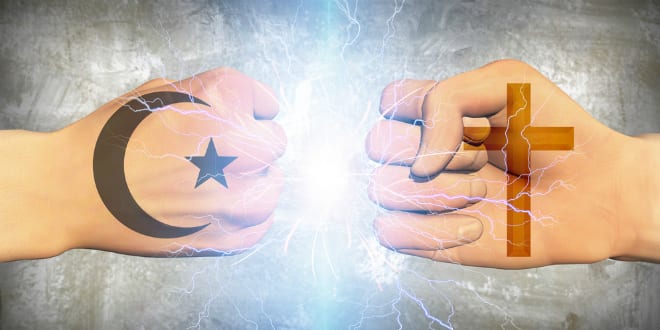
Ishmael is about to pass Esau as Islam is on track to overtake Christianity as the largest religion on earth. New projections from the Pew Research Center, released Wednesday, show Muslims passing Christians in number by 2035, ending Christianity’s long reign as the world’s most widely held faith. Buried in the same report is a figure that points the other way: the share of the world’s Jews living in the Land of Israel is projected to climb steadily, from 46% in 2020 to about 62% by 2070.
Pew estimates there were 2.27 billion Christians and 2.02 billion Muslims worldwide in 2020. By 2035, it projects there will be 2.57 billion Muslims and 2.52 billion Christians. If current trends hold, there will be more than 3.6 billion Muslims and just under 3 billion Christians by 2070.
The driver is birth rates. “It’s the babies,” Pew senior demographer Conrad Hackett told the Associated Press, explaining that conversion plays a far smaller role than fertility. Between 2020 and 2025, Muslim women averaged 3.1 children, compared with 2.0 for non-Muslim women, and the median Muslim was 24 years old, nine years younger than the median non-Muslim.
Pew stressed that both faiths are growing. “Both Christians and Muslims are going to continue to grow in number,” said Alan Cooperman, Pew’s director of religion research. The world’s population is projected to rise by 29% between 2020 and 2070; Christians are expected to grow by about 30% and Muslims by about 80%, making them the only two major groups keeping pace. Pew’s researchers emphasized that the figures are projections of current trends, not predictions.
The West empties its pews
The sharpest shifts come in the historically Christian West. Europe’s population is projected to shrink 17% by 2070, and its Christian population to fall by a third, from 505 million to 324 million. Over the same period, the Muslim share of Europe’s population is expected to more than double, from 6% to 13%.
The United States will lose its Christian majority within 40 years. Christians make up 62% of Americans today, according to Pew, and are projected to fall below half by 2065, declining from about 217 million in 2020 to 174 million in 2070. The religiously unaffiliated are projected to reach 41% of the US population. The number of Muslims in North America is projected to grow 236% between 2020 and 2070. Canada’s Christians are expected to fall below half the population by 2030.
Christianity’s center of gravity is moving south. By 2070, more than half the world’s Christians will live in sub-Saharan Africa, and the Democratic Republic of Congo will pass the United States as the country with the most Christians, with 299 million.
The blessing of Ishmael
In Jewish tradition, the two great civilizations that dominate the world in the final exile carry the names of two sons who were sent away from Abraham’s tent: Esav (Esau), whose descendants the Sages identify with Edom, Rome and the Christian West, and Yishmael (Ishmael), the father of the Arab nations and, through them, the Islamic world.
The Bible promised from the start that Ishmael would multiply. When Abraham pleaded for his firstborn son, God answered:
“And as for Ishmael, I have heard thee; behold, I have blessed him, and will make him fruitful, and will multiply him exceedingly; twelve princes shall he beget, and I will make him a great nation.” (Genesis 17:20)
The Pew demographers have reduced that verse to a single sentence: “It’s the babies.” Ishmael’s growth comes from the same source God named four thousand years ago: fruitfulness.
The same chapters that bless Ishmael describe his character. The angel told Hagar that her son would be “a wild ass of a man: his hand shall be against every man, and every man’s hand against him” (Genesis 16:12). That description has played out across the Islamic world for centuries, in wars against unbelievers and in wars within Ishmael’s own house.
Esau grows small
The prophet Obadiah, whose entire book is a prophecy against Edom, opens with a decree: “Behold, I make thee small among the nations; thou art greatly despised” (Obadiah 1:2). The Malbim reads Obadiah’s prophecy as a description of the end of days, at the time of the war of Gog and Magog.
The Pew report reads like a census of that decline in Esau’s historic heartland. Europe, the seat of Rome and the medieval church, is projected to lose a third of its Christians by 2070. America, which Rabbi Mendel Kessin identifies as the branch of Esau that carries the most promise, is projected to lose its Christian majority within 40 years. Christianity is surviving by moving south, into Africa, far from the old capitals of Edom.
The alliance and the last exile
The Bible bound Esau and Ishmael together in a single verse. After Esau saw that his father Isaac disapproved of Canaanite wives, “Esau went unto Ishmael, and took unto the wives that he had Mahalath the daughter of Ishmael Abraham’s son” (Genesis 28:9). The ancient Aramaic translation attributed to Jonathan ben Uzziel saw in that marriage an alliance that would return at the end of days. Rabbi Yechiel Weitzman, author of The Ishmaelite Exile, explains that tradition as a joint campaign by the children of Esau and the children of Ishmael against the Jewish people, a campaign the Sages taught would end with the two allies turning on each other.
The Zohar teaches that the Ishmaelite exile is the last and most severe. Ishmael received a reward for his circumcision: dominion over the Holy Land while it lay empty of its children, and the power to obstruct Israel’s return for as long as that merit lasts. Israel365 News has reported on that alliance playing out in the West this month, as socialists and Islamists rode the Democratic sweep of Congress together.
In the Pew numbers, Ishmael is ascending, Esau’s heartland is emptying, and the West is filling with the children of Ishmael. Europe’s Muslim share is projected to double. North America’s Muslim population is projected to more than triple.
Off the ladder
One figure in the Pew report runs against every other trend. While Ishmael multiplies and Esau shrinks, the children of Jacob are going home. The share of the world’s Jews living in the Land of Israel is projected to rise from under half today to nearly two-thirds by 2070.
The Torah portion read in synagogues around the world this Shabbat, Vayeitzei, holds the key to that number. Jacob, fleeing his brother Esau, lies down on a stone at Beit El and dreams:
“And he dreamed, and behold a ladder set up on the earth, and the top of it reached to heaven; and behold the angels of God ascending and descending on it.” (Genesis 28:12)
The Sages in the Midrash (Vayikra Rabbah 29:2) teach that these angels were the heavenly princes of the empires that would rule over Israel. Jacob watched the prince of Babylon climb seventy rungs and come down. Media climbed fifty-two rungs and came down. Greece climbed one hundred and eighty and came down. Then the prince of Edom climbed, and kept climbing, and Jacob was afraid that this one would never descend. God answered him with the words of the prophet Obadiah: “Though thou make thy nest as high as the eagle, and though thou set thy nest among the stars, I will bring thee down from thence” (Obadiah 1:4).
The ladder is the history of the nations. Empires rise and empires fall. Jacob stands apart from the ladder. He lies at its foot, on the stone, in the Land, and the verse says God stood over him there. The Hebrew name for this is Netzach Yisrael, the eternity of Israel, taken from the prophet Samuel’s declaration that “the Eternal One of Israel will not lie” (I Samuel 15:29). Babylon, Persia, Greece and Rome each had their climb and their fall. Israel remained at the foot of the ladder, in the place where God stands.
In that same dream, at the same moment, God gave Jacob the promise of return:
“And, behold, I am with thee, and will keep thee whithersoever thou goest, and will bring thee back into this land; for I will not leave thee, until I have done that which I have spoken to thee of.” (Genesis 28:15)
Pew’s demographers have drawn the ladder in numbers. Esau is coming down in his ancient heartland. Ishmael is climbing. And Jacob, who stood on neither rung, is doing exactly what God promised him at Beit El: coming back into this land, a few percentage points at a time, until the Jewish people are home.

