


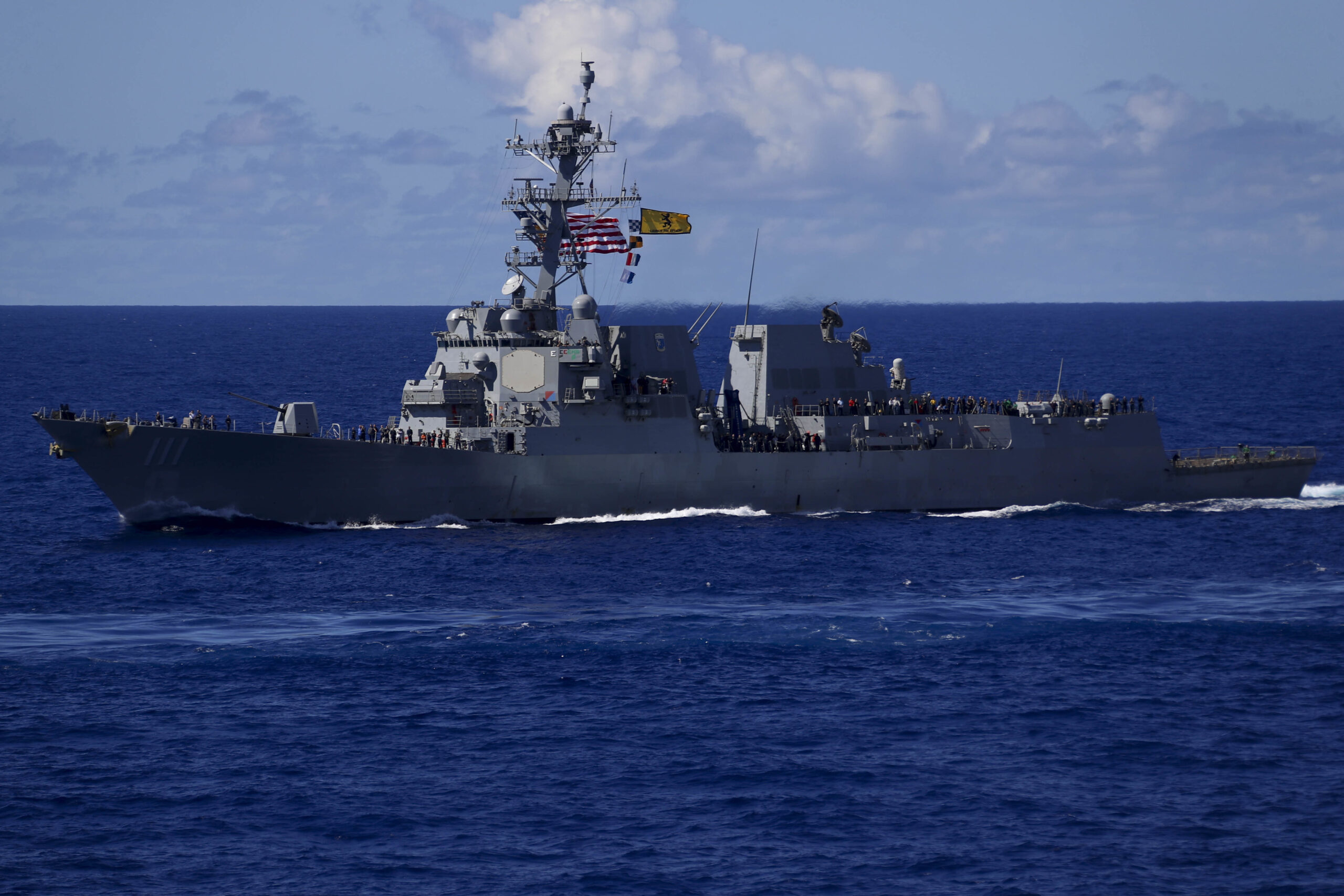
Iran’s embassy in South Africa posted photos of USS Spruance’s commander and executive officer on the day the destroyer came home. The threat follows Iranian plots against US officials that have driven cabinet members into military housing.
Iran’s embassy in South Africa issued a public threat against two US Navy officers on Friday, posting their photographs on social media under the words “We will find you” on the same day their ship returned to San Diego after nearly a year at war with Iran.
The post, published November 13 on the embassy’s X account, @IraninSA, identified Cmdr. Leigh R. Tate, commanding officer of the guided-missile destroyer USS Spruance, and Lt. Cmdr. Jeffrey E. York, the ship’s executive officer.
Iran's embassy is now issuing death threats pic.twitter.com/8KPIV8evZn
— Open Source Intel (@Osint613) November 16, 2026
The embassy had targeted the two officers before. On March 28, it accused them of ordering the Tomahawk missile launches that Iran says killed 168 children at an elementary school in Minab, in southern Iran. “Remember these two criminals,” the embassy wrote at the time.
That same Friday morning, a cheering crowd at Naval Base San Diego welcomed more than 300 sailors home from the Spruance. Hanna Weiss was waiting for her fiancée, Maria Melchor, a member of the crew. Weiss described how she followed news of the war while her partner was at sea. “I think being informed is important but also you want to sleep at night,” she said.
The Spruance, an Arleigh Burke-class destroyer, left San Diego on November 21, 2025, with the USS Abraham Lincoln Carrier Strike Group. Its deployment was extended during Operation Epic Fury, the American military campaign launched jointly with Israel against Iran on February 28. When the Lincoln turned for home late in the summer, the Spruance stayed in the Middle East. The carrier returned to San Diego more than a month before the destroyer. The Spruance came home after 357 days at sea, which the Navy described as the longest destroyer deployment since World War II. The ship sailed more than 88,000 nautical miles and earned a Presidential Unit Citation and the Combat Action Ribbon for its role in the war.
“This crew did experience some pretty intense combat,” Tate told KPBS, declining to give specifics for reasons of operational security.
Between February and August, the destroyer fired dozens of Tomahawk land-attack missiles at Iranian military targets. It shot down 12 drones and four anti-ship cruise missiles, and it took part in the American blockade of Iranian ports. In April, when the Iranian-flagged cargo ship Touska tried to run the blockade, the Spruance fired on it with its 5-inch MK 45 deck gun and disabled its engine. According to US Central Command, the Spruance waited for the Touska’s crew to evacuate the engine room before firing.
Tate said the Spruance was “instrumental in defending the carrier,” serving as alternate air defense commander for the strike group against threats that included “anti-ship cruise missiles, one-way attack waves.” He called command of the ship the “honor of a lifetime.” In a Navy statement, Tate said his sailors “represented their families, their ship and the United States Navy with distinction.” He told KPBS the crew can look forward to plenty of downtime between a post-deployment stand-down and the holiday season.
Behnam Ben Taleblu, senior director of the Iran program at the Foundation for Defense of Democracies, said the embassy’s posts should set off alarm bells at the White House, the Pentagon, and CENTCOM. He urged that any plot against the officers be “detected,” “disrupted,” and “defeated.” Ben Taleblu described the posts as part of an escalating pattern, pointing to Iranian threats after the US Navy shot down an Iranian airliner in 1988. He said Iran’s shadow war against the United States has moved into open conflict and public threats on social media.
The threat against the Spruance officers comes as Iran’s campaign against American officials has driven members of President Trump’s cabinet into military protection. In a separate post, the same embassy mocked Secretary of State Marco Rubio, Treasury Secretary Scott Bessent, Defense Secretary Pete Hegseth and others as “confined to military bunkers.” Bessent confirmed on CNBC that he moved onto a military base on the advice of the Secret Service. He called Iran a “dangerous cornered animal” and said the threats would not derail American economic pressure on Tehran. Rubio, Hegseth, and White House deputy chief of staff Stephen Miller have reportedly moved into military or protected housing.
Asked in a November 12 interview with Hugh Hewitt what would happen if Iran killed a senior American official, Trump answered: “They will not exist very long, any longer.”
The embassy’s post followed a week of developments in Iran’s campaign against Americans. On November 10, the FBI added Islamic Revolutionary Guard Corps operative Shahram Poursafi to its Most Wanted Terrorists list over an alleged plot to assassinate former senior US officials, including former National Security Adviser John Bolton. That same day, the Justice Department charged three men in connection with nearly 20 attacks or attempted attacks in Europe and the United States, including a plot against a British air base housing American forces.
A US intelligence memo dated October 23 warned that Iranian efforts to target American personnel abroad had substantially increased. On November 11, Mohsen Rezaei, secretary of Iran’s Supreme National Security Council and a former IRGC commander, told the Lebanese network Al Mayadeen that Iran could strike American bases in Europe and would not “limit ourselves to nearby bases” if attacked.
The Pentagon and the White House did not respond to requests for comment from Fox News Digital.

