


A hemorrhagic plague is spreading through Central Africa along the source of the Nile. Ezekiel named “pestilence and blood” as God’s weapons against Gog.
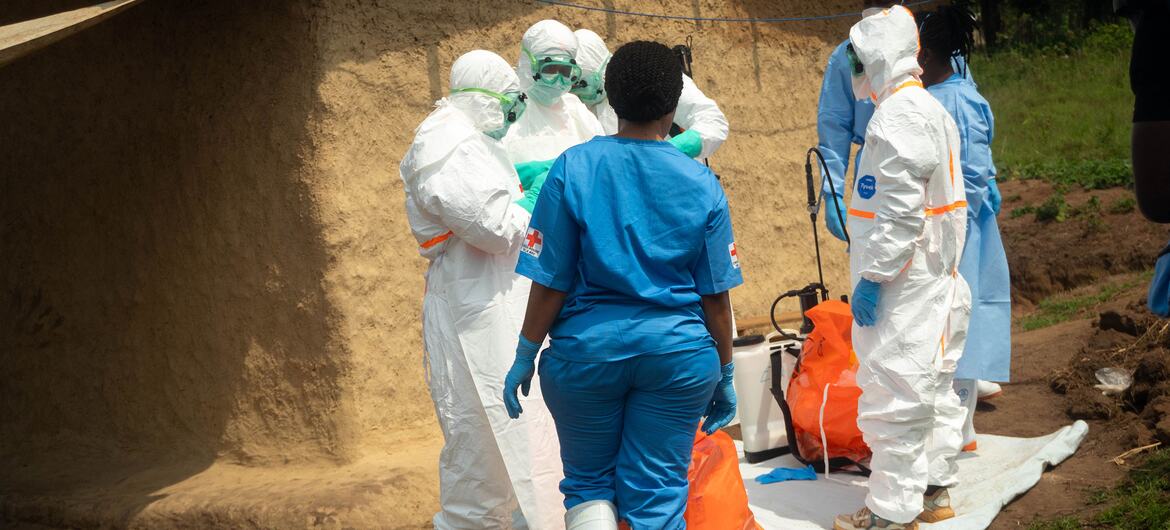
A hemorrhagic plague with no vaccine and no cure is raging along the headwaters of the Nile, and it has already killed more than 5,400 people. As of November 10, the Democratic Republic of the Congo had reported 11,114 confirmed cases and 5,433 deaths from Bundibugyo virus, a rare Ebola species that makes its victims bleed as it destroys the body from within. The CDC now ranks it as the second-largest Ebola outbreak in history. For readers of the Bible, the images coming out of the Congo recall the prophet Micah’s promise that the wonders of the Exodus would return before the final redemption.
Only the West African epidemic of 2014-2016 was larger. The current outbreak was declared on May 15 in Ituri province, in the northeastern corner of the DRC. Two days later, the World Health Organization declared a Public Health Emergency of International Concern. By July, health officials were calling it the fastest-growing Ebola outbreak on record. By August, it had passed the 3,317 cases of the 2018-2020 Kivu epidemic, the worst Ebola outbreak in the country’s history until this year. It has since grown to more than three times that size.
The virus has now reached 67 of the DRC’s 178 health zones in eight provinces. Ituri remains the epicenter, with 7,728 cases and 3,655 deaths, followed by North Kivu with 2,761 cases and 1,523 deaths. Nearly half of the confirmed patients have died. The DRC has been adding between 50 and 85 confirmed cases a day, and the European Centre for Disease Prevention and Control (ECDC) believes the true size of the outbreak is larger than the official count.
The disease has crossed borders. Uganda recorded 20 cases and two deaths before declaring its outbreak over in August. Kenya has confirmed nine cases and two deaths, and four of the nine were health workers. Nigeria confirmed an imported case in Abuja on October 20, after the patient had passed through Addis Ababa. She was evacuated to Switzerland for treatment. Infected aid workers and doctors have also been flown to Germany, France, the Netherlands and Britain. Most recently, on November 5, a British health worker was evacuated for treatment.
Bundibugyo is named after the district in western Uganda where it was first identified in 2007. That outbreak and one in the DRC in 2012 together infected fewer than 200 people. This year’s outbreak is the first time the virus has spread on a massive scale, and medicine has no answer for it. The Ervebo vaccine, which helped end the Kivu epidemic, was developed against a different Ebola species. Health officials began giving it to frontline workers in August and launched a clinical trial in Bunia on October 23, but no one knows whether it protects against Bundibugyo. Vaccines designed for this virus are still in early development.
The response has been crippled by violence. By July, health authorities had recorded at least a dozen attacks on treatment centers and response teams. Many were carried out by angry mobs, and response workers have been held captive in some health zones. Pierre Akilimali, who manages the Ebola response, said at a briefing in Bunia that families were angered by restrictions on traditional funerals, where relatives wash and prepare the bodies of the dead. Dr. Adelard Lufongola, the response’s operations manager, warned that burial teams “have been threatened and continue to be threatened in some cemeteries and within several communities.” Health workers in Ituri went on strike over unpaid salaries. In October, attacks on response teams in Tshopo province included the killing of a nurse. Armed conflict in Ituri has also cut off health teams from displacement camps sheltering tens of thousands of people, leaving the virus free to move through communities where no one is tracking it.
Africa's top public health agency said that the Ebola outbreak in Congo was still out of control six months after it was declared, citing problems including deadly attacks on health workers, unpaid staff and a lack of resources https://t.co/KYSuogDwzR pic.twitter.com/XAY9iD7Lmx
— Reuters (@Reuters) November 16, 2026
Israel has faced Ebola twice in twelve years, and both times the disease stopped at its borders. During the West African epidemic in 2014, Prime Minister Benjamin Netanyahu convened a special meeting of government, military and health officials to prepare for a possible outbreak. Israel tightened screening of travelers from Guinea, Liberia, and Sierra Leone. At the request of the World Health Organization and UN Secretary-General Ban Ki-moon, it sent three mobile emergency clinics to the stricken region. That September, a Nigerian tourist was rushed into isolation at Jerusalem’s Shaare Zedek hospital, and weeks later a hospital in northern Israel launched emergency protocols for a patient just back from Africa. Both tested negative.
This year the scares came closer together. In June, an Israeli who had returned from the Congo with a fever and headache was isolated at Rambam hospital in Haifa, and two days later a second traveler was hospitalized at Sheba Medical Center near Tel Aviv. A 24-year-old man returning from the Congo was then isolated at Soroka Medical Center in Beersheba, the third suspected case in a matter of months, and two more travelers from the Congo were later placed in isolation. The Interior Ministry temporarily barred entry to foreign nationals arriving from the Congo, Uganda, and South Sudan. Every test came back negative. Israel has never recorded a confirmed Ebola case.
Ituri borders Lake Albert, which feeds the White Nile, the river God struck at the beginning of the Exodus. That raises the question: does the Bible describe the plagues of Egypt returning before the final redemption?
The Bible answers explicitly. The prophet Micah described the redemption of the end of days as a return to the Exodus:
“As in the days of thy coming forth out of the land of Egypt will I show unto him marvellous things.” (Micah 7:15)
The Sages understood this literally. Midrash Tanchuma teaches that just as God struck the Egyptians with ten plagues, so too He will strike Israel’s enemies in the final redemption. Rabbeinu Bachya, the 13th-century Spanish commentator, taught that “in Egypt, God used only part of His strength.” Rabbi Yosef Berger, the rabbi of King David’s Tomb on Mount Zion, has explained that Jewish sources predict all of the plagues will reappear in the final redemption, in even more powerful forms.
The Midrash on the Song of Songs records the teaching of Rabbi Chiya bar Abba that close to the days of the Messiah, a dever gadol, a great plague, will come into the world, and the wicked will perish in it. Dever is the same Hebrew word for the fifth plague of Egypt, the pestilence that struck the Egyptians’ livestock while sparing the animals of Israel. Ebola is a disease that jumps from animals to people. Scientists believe fruit bats carry the virus and pass it to humans directly or through wild animals hunted for meat.
Disease has stalked Egypt and its rivers since the Exodus. The sixth plague, shechin (boils), afflicted “man and beast throughout the land of Egypt” (Exodus 9:9). Bubonic plague is a strong candidate for that plague, since its signature symptom is boil-like swellings that turn into black ulcers. In 2010, scientists traced plague back to ancient Egypt, where Egyptologists found the remains of Nile rats and fleas some 3,000 years old. When the Philistines were struck with a plague of boils after capturing the Ark of the Covenant, they sent it back with five golden mice and five golden swellings. Their priests warned them against repeating the mistake of Pharaoh:
“Wherefore then do ye harden your hearts, as the Egyptians and Pharaoh hardened their hearts? When He had wrought upon them, did they not let the people go, and they departed?” (I Samuel 6:6)
The prophet Ezekiel names both dever and blood in God’s war against Gog, the leader of the nations that attack Israel at the end of days:
“And I will plead against him with pestilence and with blood; and I will cause to rain upon him, and upon his hordes, and upon the many peoples that are with him, an overflowing shower, and great hailstones, fire, and brimstone.” (Ezekiel 38:22)
Ebola is a hemorrhagic fever. In its final stages, victims bleed from the gums, the eyes, and internal organs. The prophet Zechariah described the plague that will strike the nations that make war on Jerusalem in strikingly similar terms:
“And this shall be the plague wherewith the LORD will smite all the peoples that have warred against Jerusalem: their flesh shall consume away while they stand upon their feet, and their eyes shall consume away in their sockets, and their tongue shall consume away in their mouth.” (Zechariah 14:12)
The attacks on health workers and facilities are increasingly hindering efforts to contain an Ebola outbreak in eastern Democratic Republic of Congo that has killed more than 5,400 people, Africa's top public health agency said https://t.co/WA0qBhzhe8 pic.twitter.com/vlK0zRXmgU
— Reuters (@Reuters) November 13, 2026
Rabbi Rami Levy, an end-of-days lecturer from Jerusalem, has told Israel365 News that “the prophet described a disease that would accompany the War of Gog and Magog.” He has warned that the worst is still ahead. “There will certainly be another plague that destroys a significant part of the world population,” Rabbi Levy said. “But not until after the War of Gog and Magog, and specifically against the people who came out against the Jews.” He added that “the plague that comes after Gog and Magog will be even worse than the Bubonic Plague the world saw in the Middle Ages.” The rabbi explained that the process unfolds in steps: “God works in stages. He could have created the world in one moment, but he chose to do it in six days.”
The late Sephardi Chief Rabbi Mordechai Eliyahu predicted that the final war would be fought with disease. His son, Tzfat Chief Rabbi Shmuel Eliyahu, recalled that his father taught that “the plagues before Messiah will be even worse. God will throw some virus on them.” Rabbi Shmuel Eliyahu has taught that the epidemics in Egypt were sent to break Pharaoh’s stubbornness, and he insisted that a plague is a message from heaven: “we shouldn’t think that this was by chance, god forbid, or just something that fell down from the sky.” Rabbi Lazer Brody has cited the teaching of the Netziv, the 19th-century head of the Volozhin Yeshiva, that God “will go out and fight the other nations in the pre-Messiah war of Gog and Magog by way of a plague.”
The plagues of Egypt carried a second message. They struck Egypt and spared the Children of Israel in Goshen. After the splitting of the sea, God made that distinction a permanent promise:
“If thou wilt diligently hearken to the voice of the LORD thy God, and wilt do that which is right in His eyes, and wilt give ear to His commandments, and keep all His statutes, I will put none of the diseases upon thee, which I have put upon the Egyptians; for I am the LORD that healeth thee.” (Exodus 15:26)
Twelve years and two epidemics have brought Ebola to the doors of Israel’s hospitals again and again, and every suspected case has turned out negative.
The Bible also records the cure. Rabbi Shmuel Eliyahu has cited the tradition that the Angel of Death himself revealed to Moses the secret of stopping a plague. The Talmud (Shabbat 89a) identifies that secret as the ketoret, the Temple incense. When a plague broke out in the desert after the rebellion of Korach, Moses sent Aaron the High Priest into the camp with his fire pan:
“And Aaron took as Moses spoke, and ran into the midst of the assembly; and, behold, the plague was begun among the people; and he put on the incense, and made atonement for the people. And he stood between the dead and the living; and the plague was stayed.” (Numbers 17:12-13)
Rabbi Shmuel Eliyahu stressed that a decree from heaven can still be turned: “Repentance can sweeten the worst judgement.”
In Ituri this winter, burial teams in protective suits are digging graves under armed guard. Families are attacking the doctors sent to save them, and no vaccine exists to stop the dying. The virus has already crossed into five countries and travelled by airplane to four more. The Exodus began with blood in the Nile and ended with the death of the firstborn, and Micah promised the world would see those wonders again before the final redemption. The same Bible that foretold the plague also preserved the cure: a priest with incense standing between the dead and the living. For 11,000 confirmed patients and their families along the headwaters of the Nile, the prophecy has stopped sounding like ancient history.
