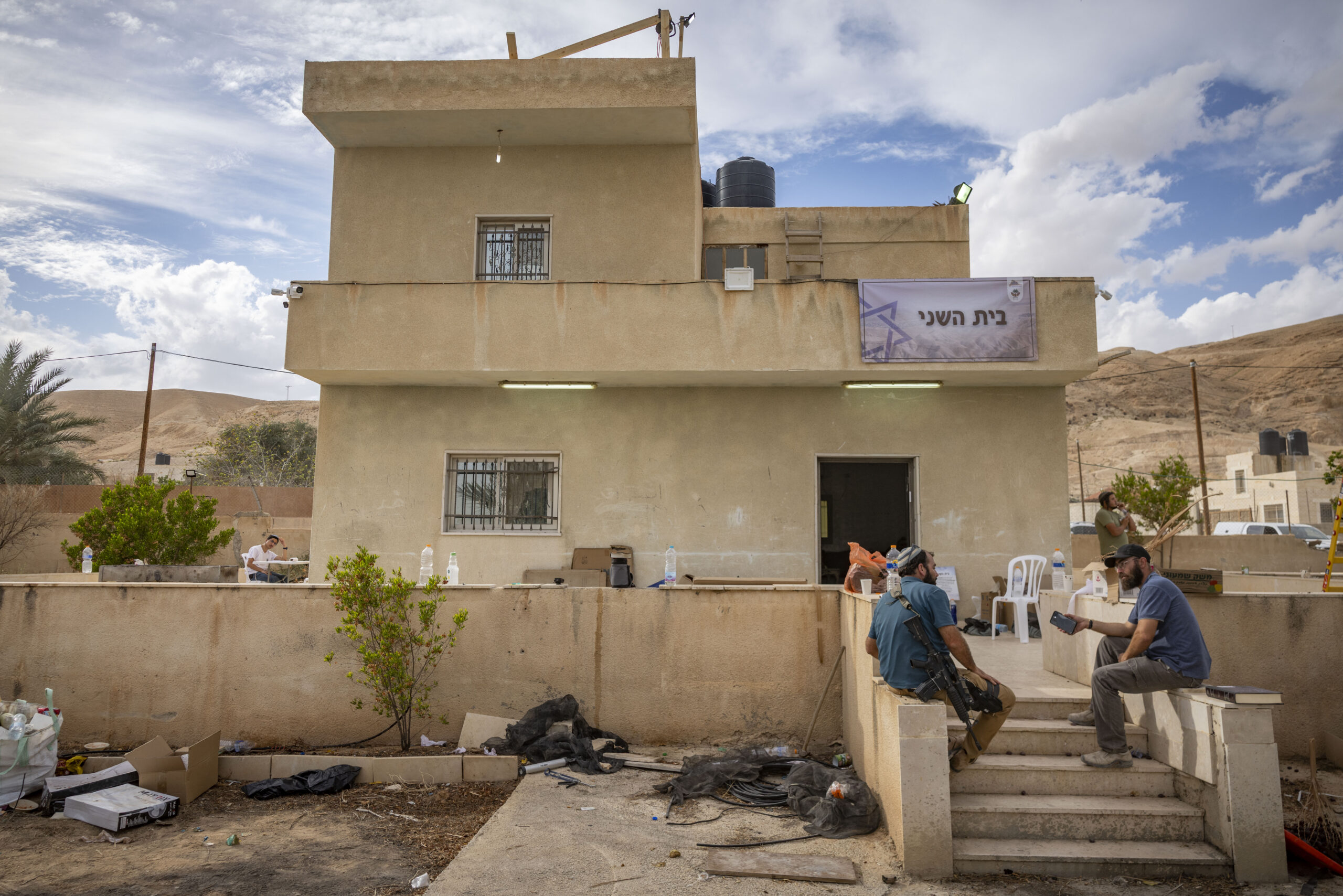
Eight Jewish families bought homes on the edge of the city of Joshua’s first victory. The world called it theft, the Palestinian Authority jailed the sellers, and Israel’s army called the move unauthorized.
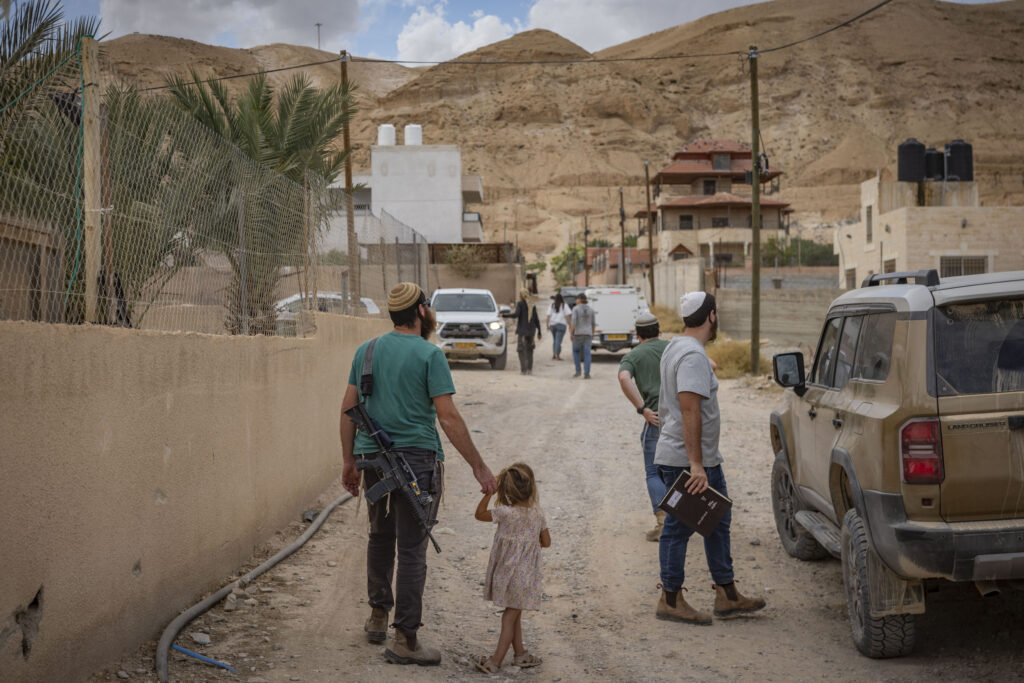
The children of the Gazit family guessed they were headed to Gaza, or perhaps another house in Hebron. Only when the families gathered at Mitzpe Yericho and were shown photos of their new homes did they learn the destination: Jericho. On November 4, eight Jewish families moved into houses on the city’s outskirts, in a neighborhood near the Hasmonean palaces named for the fruit Jericho is famous for, dates. Five days later, Palestinian Authority security forces arrested the Arab brokers who had sold them the homes. The same real estate deal produced a Jewish homecoming and an Arab prison sentence, and that contradiction runs to the heart of who is permitted to own land in the Land of Israel.
A secret purchase
The operation was organized by the Nachala movement together with the Binyamin Regional Council, which said the eight homes sit on state land in Area C, under full Israeli civil and security control. Nachala chairman Daniella Weiss framed the move in historic terms: “These homes in Jericho mark the end of the Oslo Accords.”
The secrecy had a specific purpose. Nachala’s chairman told Israel National News that the purchase was kept quiet to protect the Arab sellers from the Palestinian Authority’s death penalty for anyone who sells property to Jews. When word of the sale began to spread, the movement moved the families in early, fearing the PA would find out first.
Shmuel and Reshit Gazit, two of the neighborhood’s founders, described the move to Israel National News. They entered without confrontation, Shmuel said, and Arab neighbors welcomed them and brought them water. One of the houses is named after Yoel Moshe Solomon, the pioneer who tried and failed to buy land in Jericho before founding Petah Tikva. Binyamin Governor and Yesha Council chairman Yisrael Ganz put it plainly: “We have come home, and we are here to stay.”
Critics told a different story. Peace Now said the settlers assaulted Israeli activists and shot a Palestinian man in the leg, and the UN said residents fled. The IDF Spokesperson’s Unit announced that the families had moved in without coordinating with the military and without authorization. The organizers answered that every house was paid for in full and that ownership documents back the deals. Despite the army’s statement, it has diverted three platoons to guard the families, and no one has moved to evict them.
The arrests
On November 9, PA security forces spokesman Anwar Rajab told Palestinian radio that several suspects had been arrested in connection with the “takeover of land in the Ad-Duyuk area of Jericho.” According to the Saudi newspaper Asharq Al-Awsat, the detainees are brokers who facilitated the sale, and they have been remanded in custody for 15 days.
The PA went further. Its Land Authority suspended all land-registration transactions involving Palestinians who hold Israeli citizenship or residency, apparently on the assumption that Israeli Arabs had owned the properties. Lt.-Col. (res.) Maurice Hirsch of the Jerusalem Center for Security and Foreign Affairs pointed out the irony: the PA claims Israeli Arabs as Palestinians while stripping them of property rights because they are Israelis. In Area C, under Israeli administration, those same Israeli Arabs remain free to buy and register property.
Stolen or sold?
The international coverage settled on its verdict within hours. Al Jazeera’s headline announced that Israeli settlers had seized eight Palestinian homes in Jericho, displacing dozens. At the United Nations, Secretary-General António Guterres’s spokesman Stéphane Dujarric told reporters the settlers reportedly “used live ammunition” and forced families to flee. Peace Now warned that the purchase could turn Jericho into another Hebron. The story the world heard was a story of theft.
The Palestinian Authority’s own response tells a different one. Jericho Governor Hussein Hamayel told AFP that the sale documents were forged, and that the land belongs to the PA and cannot be sold. Days later, PA security forces arrested the brokers who sold it. A government does not jail men for selling property that was never sold. The arrests are the PA’s own admission that a sale took place, and that the crime, in its eyes, was selling to Jews.
The men now sitting in a PA cell face a law that carries life imprisonment with hard labor, under a legal system whose courts have sentenced land sellers to hang. Yet the arrests drew none of the condemnation that greeted the families’ arrival. The UN spokesman who relayed reports of settlers firing live ammunition had nothing to say about Palestinians jailed for selling their own homes. Peace Now, which warned of a “geopolitical disaster” when Jews moved in, raised no alarm over Arabs detained for the transaction that made it possible.
Daniel Luria, executive director of Ateret Cohanim, described this silence years ago, when the PA was torturing a man accused of the same crime. “This should be at the top of the list for humanitarian organizations,” he said. “Palestinians should be free to sell their land if they choose. The treatment of those accused is horrific.” The organizations that rushed to describe eight houses in Jericho as stolen have shown no interest in the men who are paying for having sold them.
A crime called treason
Under Palestinian law, selling land to a Jew is treason. The legal basis is Article 114 of the 1960 Jordanian Penal Code, which the PA still applies. In 2014, after a string of home sales to Jews in Jerusalem, Mahmoud Abbas raised the penalty to life imprisonment with hard labor for anyone selling land “to an enemy state or one of its subjects.” The PLO’s Revolutionary Penal Code of 1979 goes further, prescribing death for traitors and for anyone “transferring positions to the enemy.” PA courts have handed down death sentences under it, though Abbas has never authorized an execution. In practice, the law is enforced against sales to Jews and almost never against sales to Israeli Arabs.
The policy took shape in May 1997, when PA Justice Minister Freih Abu Medein announced that the PA would apply a Jordanian law carrying the death penalty for Arabs who sell land to Jews. Within weeks, land dealers Farid Bashiti and Harbi Abu Sara were murdered and a third, Rashid Salameh, disappeared. Abu Medein’s comment on Bashiti’s death: “Everybody now realizes the danger of selling land to a Jew.” In 2009, a PA military court in Hebron sentenced Anwar Brigith, 59, to death by hanging for selling land to Jews.
The most famous case involved an American. In October 2018, PA security forces abducted Issam Akel, a US citizen accused of helping sell an Old City property to Jews. “Palestinian Authority security forces abducted and incarcerated Akel, torturing him for several weeks,” Luria told Breaking Israel News. “The methods they used to torture him were brutal, straight out of the Middle Ages.” A Ramallah court sentenced Akel to life with hard labor. He went free only after US Ambassador David Friedman publicly demanded his release and Washington negotiated his transfer to America.
The persecution follows the accused into the grave. In November 2018, Ala’ Qirresh, a Muslim resident of Jerusalem accused of a role in selling land to Jews, died in a car accident, and other Arabs prevented his family from burying him. Jerusalem’s Ashkenazi Chief Rabbi Aryeh Stern approved his burial in a Jewish cemetery, calling him chasid umot ha’olam, a righteous gentile. Rabbi Stern also ruled that freeing an Arab imprisoned for selling land to Jews fulfills the commandment of pidyon shevuyim, the redemption of captives.
“There is no Israeli law preventing the sale of Jewish land to Arabs and Jews are certainly not tortured or killed for doing so,” Luria said. Some on the left went beyond silence. In 2016, B’Tselem field researcher Nasser Nawaja and Ta’ayush activist Ezra Nawi were recorded discussing how they turned would-be Arab sellers over to the PA, acknowledging that those they informed on were frequently killed. B’Tselem responded that reporting such sellers to the PA was “the only legitimate course of action.”
Israel’s own contradiction
The PA punishes the seller. For decades, Israel punished the buyer. Until February, a Jordanian law dating to 1953 remained in force in Judea and Samaria, barring Jews from buying land directly. Jews could purchase only through registered companies, and only after receiving a special transaction permit from the Civil Administration, while an Arab could buy the same house from another Arab with no permit at all. In February, the security cabinet repealed the law, a move Yisrael Ganz said ended “the disgraceful reality in which Arabs could buy land in Judea and Samaria while Jews were forbidden from doing so.” Jericho is the first major test of the new rules, and the old reflexes remain: the IDF still described the families’ move into homes they bought as unauthorized.
Hebron shows how the old rules worked. In 2007, Jewish-American businessman Morris Abraham and his family paid more than $1 million for Beit HaShalom, a four-story building between Hebron and Kiryat Arba. The seller, Faiz Rajabi, was filmed receiving and counting his money, then claimed the sale never happened once he learned the buyers were Jews. Defense Minister Ehud Barak sent forces to expel the families in December 2008. The Jerusalem District Court ruled the purchase legal in 2012, and the High Court confirmed it in 2014. The PA, meanwhile, summoned Rajabi to Jericho and held him for six months. In April 2012, on the eve of Passover, the IDF evicted Jewish families from Beit HaMachpela, another legally purchased Hebron building, while the PA arrested the man who arranged that sale, former PA intelligence officer Muhammad Abu Shahala. Both sides punished the same transaction: the PA jailed the Arab who sold, and Israel evicted the Jews who bought. That was the old pattern, in which Jews who bought homes from Arabs were removed by their own army, sometimes for years, until the courts vindicated them. In Jericho, for the first time, the army is guarding the buyers instead of evicting them.
The pattern held in Jerusalem as well. In 2004, the Greek Orthodox Church sold the Petra and Imperial hotels at Jaffa Gate to companies working with Ateret Cohanim. The Petra Hotel had been built in 1840 by a Jewish developer, Joseph Amzalek. The church fought the sale for 18 years, and every court, from the District Court in 2017 to the Supreme Court in 2019, rejected its claims, until a final ruling in June 2022 confirmed the purchase. The press still calls it a settler takeover.
Many of these homes were Jewish to begin with. In Silwan, known in Hebrew as Kfar HaShiloach, Yemenite Jews founded a village in 1882 that grew to some 144 families. Arab riots in the 1920s and 1930s decimated it, and the British evacuated the last 35 to 40 families in August 1938. A British letter from that month promised to cover their expenses “until the refugees are able to return.” They were never allowed back. Arabs moved into their homes and their synagogue, and no Jew lived there again until 2004.
For decades, the double standard ran the other way inside Jerusalem too. Under the Mukhtar Protocol, Arab clan elders could vouch that a parcel belonged to a resident of their village, and planning authorities accepted that testimony as proof of ownership, even for parcels registered in Israel’s Land Registry to other owners, Jewish and Arab. The protocol was canceled in June 2022 after a four-year campaign. Regavim’s Naomi Kahn explained why it lasted so long: “The State of Israel preferred to self-impose restrictions on its sovereignty in Jerusalem, hoping that undercutting its sovereignty would appease its critics.”
Jericho itself is a monument to that strategy. It was among the first cities handed to the PA under the 1994 Gaza-Jericho Agreement, the opening move of a process meant to end in the creation of an unprecedented Palestinian state inside Israel’s borders, militarized and ethnically cleansed of Jews, with its exclusively Muslim capital in Jerusalem, centered on Judaism’s holiest site, the Temple Mount. Three decades later, the Arab who sells a house in Jericho to a Jew faces life in prison, and the Jew who buys it is still told by his own army that moving in was unauthorized.
Bought at full price
The Bible records the boundaries and even the trees of the first plot of land a Jew ever bought in Israel, along with the exact price. Abraham could have accepted the Cave of Machpelah as a gift; Ephron the Hittite offered it to him for free. Why did the Bible insist on recording every shekel of the payment?
“And Abraham hearkened unto Ephron; and Abraham weighed to Ephron the silver, which he had named in the hearing of the children of Heth, four hundred shekels of silver, current money with the merchant.” (Genesis 23:16)
The Sages answered that question directly. The Midrash in Bereishit Rabbah (79:7) teaches that there are three places in the Land of Israel about which the nations of the world can never taunt the Jewish people by saying “you stole them”: the Cave of Machpelah in Hebron, which Abraham bought for 400 shekels of silver; Joseph’s Tomb in Shechem, where Jacob bought a field for a hundred kesitah (Genesis 33:19); and the Temple Mount, which King David bought from Araunah the Jebusite for 600 shekels of gold (I Chronicles 21:25). The Bible documented each sale so that no one could ever dispute the deed.
The irony is staggering. Those three sites, the three properties in the Land of Israel with the most explicit bill of sale in Scripture, are today the three most fiercely contested places in the country. Jews are restricted at the Cave of the Patriarchs, barred from Joseph’s Tomb except under military escort at night, and forbidden to pray on the Temple Mount. The Sages understood something the deed alone could not fix: a legal purchase has never been enough for those who deny that Jews belong in the land at all. Abraham paid in full, in front of witnesses, in coin accepted by every merchant. Four thousand years later, Arabs who sell homes to his descendants are hunted, jailed, and denied burial, and the world calls the purchase theft.
The gate of the Land
Jericho was the door through which the Jewish people first entered the Land of Israel. After forty years in the wilderness, the Israelites crossed the Jordan opposite the city, and it was the first to fall to Joshua. Before the battle, Joshua sent two spies into Jericho, and they found shelter with a local woman named Rahab, who hid them on her roof under stalks of flax and lied to the king’s men to save them. In return, the spies swore that she and her family would be spared when the city fell.
Joshua kept that oath.
“But Rahab the harlot, and her father’s household, and all that she had, did Joshua save alive; and she dwelt in the midst of Israel, unto this day; because she hid the messengers, whom Joshua sent to spy out Jericho.” (Joshua 6:25)
The Sages held Rahab in remarkable esteem. The Talmud (Megillah 14b) teaches that she joined the Jewish people, married Joshua, and became the ancestor of eight prophets who were also priests, among them the prophet Jeremiah. A resident of Jericho who risked her life for Israel’s return was welcomed into the nation and honored for all generations.
The parallel to this week’s events writes itself. The first Jewish entry into Jericho depended on a local who helped in secret and faced death from her own rulers for doing so. Three thousand years later, Nachala kept the Jericho purchase secret for the same reason: to protect the Arabs who made the sale possible from a regime that punishes cooperation with Jews as treason. The Bible’s answer to such people is clear. Joshua guarded Rahab’s household, and Rabbi Stern gave Ala’ Qirresh a Jewish burial when his own people denied him one. The brokers now sitting in a PA cell are this generation’s test of whether Israel stands by those who open the gate.
Eight families have now walked back through Joshua’s gate with a bill of sale in hand. The PA answered with handcuffs. For decades, Israel answered with eviction orders. This time the soldiers are standing guard at the door, and whether they stay will show if a Jew’s money is finally as good in Jericho as Abraham’s silver was in Hebron.