




As winter storms flood Gaza, Israel is trucking in shelter, blankets, and medicine. Hamas is collecting millions a day from the aid, diverting donations worldwide, and has a long record of turning reconstruction supplies into weapons.
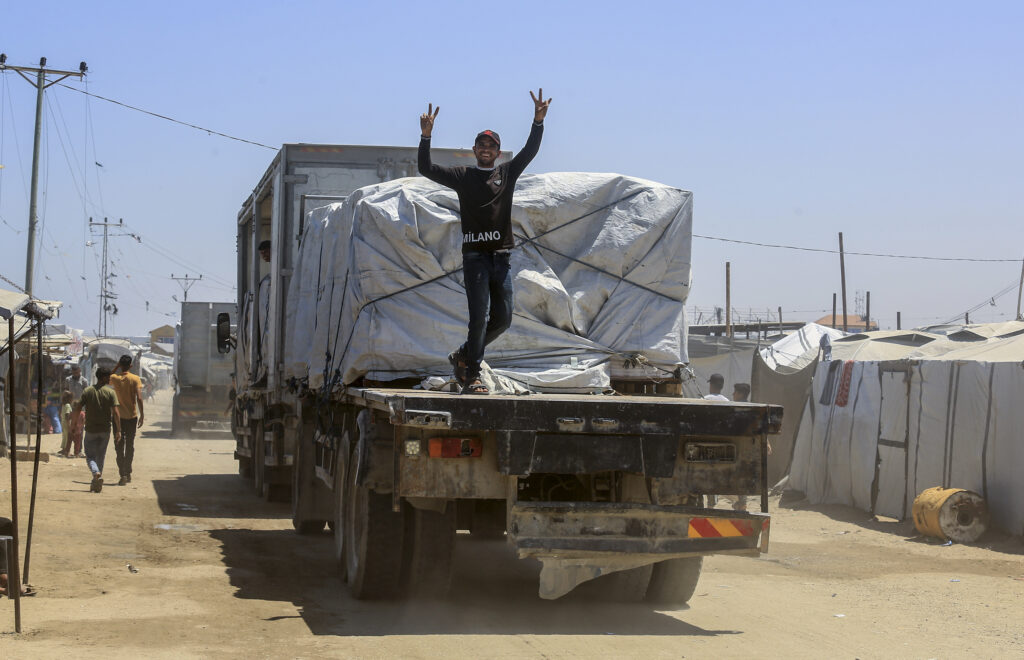
When the winter rains hit Gaza last week, they flooded tens of thousands of tents along the Mediterranean coast. The country that sent many of those tents is the same country Gaza’s rulers vowed to destroy on October 7. The IDF and COGAT announced on November 9 that more than 91,000 tents and over 8,200 trucks of winter supplies have entered the Strip since Israel launched its winter preparedness plan. The rain fell on Gaza’s civilians, while Hamas, according to Israel’s UN ambassador, collected roughly $2 million a day from the aid meant to shelter them.
Tents, blankets, and vaccines
According to the IDF, the winter plan was carried out in coordination with the US-backed Board of Peace, the United Nations, international aid organizations, and donor countries. Alongside the tents, the trucks carried tarpaulins, blankets, and winter clothing. Israel also approved 12 sewage vacuum trucks for the International Committee of the Red Cross, 7,500 vaccine doses for UNICEF, three mobile clinics for the International Medical Corps, and medications, medical equipment and fuel for Gaza’s hospitals.
The Board of Peace has nonetheless faulted Israel for delays and said it must do more, while also blaming Hamas for refusing to disarm. The IDF’s figures tell a different story about where the bottleneck lies. Israel has approved more than 850 requests covering tens of thousands of trucks of winter supplies, and roughly half have yet to be fulfilled by the UN and international organizations, partly because of logistical and budget problems that have nothing to do with Israel.
The IDF also disclosed a striking admission: the UN and international organizations have acknowledged that they cannot guarantee some of the equipment they want to bring into Gaza will not reach Hamas. Israel is therefore reviewing requests for sensitive equipment and looking for alternatives that meet civilian needs without rebuilding Hamas’s capabilities. “The IDF and COGAT will continue working to improve the humanitarian response and prepare the population for winter, while preventing these efforts from being exploited to rebuild the capabilities of terrorist organizations,” the military stated.
Hamas’s daily cut
On November 5, Israel’s Ambassador to the UN Danny Danon posted a video laying out the numbers. “Don’t let anyone lie to you: Israel allows humanitarian aid into Gaza,” he wrote. “Hamas is the one extorting money from aid trucks.”
In the video, Danon explained that Israel estimates Gaza’s needs at about 250 trucks a day. “But we actually allow more than 600 trucks to enter Gaza every day through the checkpoints,” he said, according to Israel National News. “In the last few weeks, we found out that Hamas is collecting $3,000 [that] they extort from the merchants in Gaza. You can make the calculation yourself. Two million dollars a day to the hands of the terrorist organization of Hamas.” The arithmetic holds: $3,000 on each of 600 trucks comes to $1.8 million a day. Danon said Gaza’s merchants have begun refusing to pay. “There will be no future for Gaza if Hamas will stay in the equation,” he said.
Danon’s figure sits at the low end of an earlier estimate. In October, Neomi Neumann, the former head of research for the Shin Bet, told the Kan public broadcaster that Hamas earns $2 million to $5 million a day by taxing goods entering Gaza and selling stolen humanitarian aid on the black market at exorbitant prices. “Everything that enters the Strip becomes a source of income for Hamas,” Neumann said. The group uses that money to create dependence and quietly enforce order over the population. Aid donated to feed Gaza’s civilians becomes the revenue stream that keeps their oppressors in power.
Donations diverted abroad
The theft begins long before the trucks reach the crossings. In October, US authorities charged Saleem al-Zaq, whom the Treasury identifies as a deputy battalion commander in Hamas’s military wing, with running a global fundraising network that solicited donations “purportedly to provide humanitarian aid to the people of Gaza.” The network raised more than $2 million between 2020 and 2026, $1.5 million of it after October 7. Two France-based fundraisers, Faouzi Barika and Amel Oualid, sent hundreds of thousands of dollars in cryptocurrency to al-Zaq, who passed it on to Hamas. Barika founded his charity, Association Baraka, just days after the October 7 massacre. France’s DGSI security service has since shut it down. Al-Zaq, who also photographed Hamas events led by Ismail Haniyeh and Yahya Sinwar, faces 20 years in a US prison if convicted, though he remains in Gaza.
The pattern repeats across Europe. In December 2025, Italian police arrested nine people accused of running charities that sent more than 7 million euros to Hamas, and police said more than 71 percent of the donations raised for Palestinians were diverted to Hamas or its affiliates. The US Treasury has repeatedly sanctioned Hamas’s network of what it calls sham charities, most recently in January and March of this year.
Cement for tunnels, pipes for rockets
Hamas has a long record of turning reconstruction into rearmament. After the 2014 war, the UN, the Palestinian Authority, and Israel created the Gaza Reconstruction Mechanism to bring in cement and building materials for civilian homes. During that war, IDF soldiers had already found sacks of UNRWA building materials used to construct Hamas tunnels. In April 2016, Israel halted private cement shipments into Gaza after COGAT accused a senior official in Gaza’s Hamas-run Economy Ministry, Imad al-Baz, of taking construction materials intended for civilian reconstruction. Israel’s Gaza Reconstruction Mechanism unit states plainly that Hamas often tries to steal the cement entering Gaza to build terror tunnels instead of rebuilding homes. The result was the vast underground network that Hamas used to launch the October 7 invasion and to hide Israeli hostages.
Hamas even turned Gaza’s water system into ammunition. In May 2021, Hamas’s military wing released a video showing its men digging up water pipes and turning them into rockets to fire at Israeli cities, at a time when Gazans were already suffering water shortages. Islamic Jihad leader Ziyad al-Nakhala boasted the same week that the weapons used against Israel were “water pipes that engineers of the resistance turned into the rockets.” The Telegraph later reported that the European Union had spent almost 100 million euros over a decade building water pipelines in territory controlled by Hamas.
The genocide lie
The aid figures also demolish the central accusation against Israel. For three years, Israel has been accused before international courts and in the world’s media of committing genocide in Gaza. No nation bent on destroying a people trucks in 91,000 tents to keep them dry, approves vaccines for their children and sewage trucks for their streets, and lets in more than twice the food and goods its own experts estimate they need. Israel does all of this while Hamas, the organization that started the war, steals the aid, taxes it, and sells it back to the people it claims to defend. The accusation of genocide is aimed at the one party in this war that is feeding the other side’s civilians.
Bread for the enemy
The Bible commands something that runs against every human instinct in wartime.
“If thine enemy be hungry, give him bread to eat, and if he be thirsty, give him water to drink; for thou wilt heap coals of fire upon his head, and the LORD will reward thee.” (Proverbs 25:21-22)
Why would the Bible require a nation to feed the people who seek its destruction?
The prophet Elisha put the command into practice. When an Aramean army came to seize him, God struck the soldiers with blindness, and Elisha led them straight into Samaria, the capital of Israel. The king of Israel asked whether he should strike them down. Elisha told him to set bread and water before them instead, and the king prepared a great feast and sent them home. The Bible records the result: “And the bands of Aram came no more into the land of Israel” (II Kings 6:23). Feeding the enemy, in that case, ended the raids.
The Sages placed a sharp boundary around that kindness. Commenting on King Saul, who spared Agag, king of Amalek, against God’s command, the Midrash in Kohelet Rabbah (7:16) warns that whoever is merciful to the cruel will end up being cruel to the merciful. Saul’s misplaced compassion cost Israel dearly. Israel has spent three years walking the line between those two teachings: feeding the hungry civilians of Gaza as Proverbs commands, while refusing to let that mercy become fuel for the cruel. Every truck inspected at the crossing, every request for dual-use equipment reviewed, every demand that Hamas disarm, is an attempt to fulfill the first teaching without violating the second.
Elisha’s bread worked because the Arameans went home. Hamas takes the bread, sells it to its own people, and uses the profits to prepare the next attack. Israel keeps sending the tents anyway. The rain is falling on Gaza, and the only party in this war that has sent the people shelter is the one the world accuses of trying to destroy them.


