




Fifty-nine years after the Six-Day War derailed Rev. Martin Luther King Jr.’s plan to lead thousands of Black Americans on a pilgrimage to the Holy Land, hundreds of African American and African pastors arrived in Israel this week to make the journey he never made.
The delegation of approximately 500 pastors and Christian leaders, organized by Israel’s Foreign Ministry and led by the Black Christian Leaders Council on Israel Relations, arrived on Thursday. It will be joined by 75 Christian leaders from ten African countries, a group of American rabbis marking the Jewish-Christian partnership, and religious influencers with millions of followers, according to the Foreign Ministry. The eight-day trip includes biblical sites across the country and the site of the Nova music festival massacre.
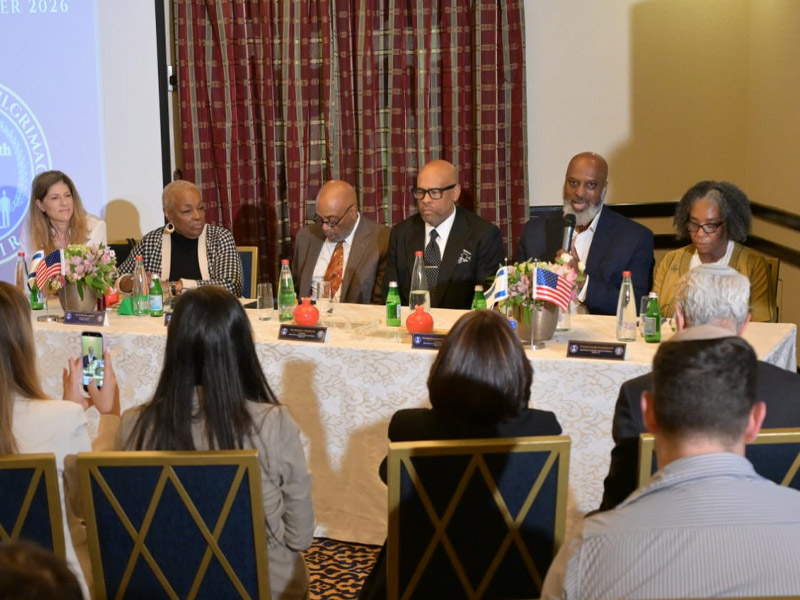
“There were no mass pilgrimages” in King’s day, Pastor Dumisani Washington, who is leading the delegation, said at a press conference in Jerusalem on Wednesday. “We as Black Americans recognize that Black Americans were about to start something that no one else was doing.”
“We felt a burden in our heart,” Washington said. “We see the rising antisemitism on the right and on the left.”
Pastor Michael A. Stevens Sr. described a “mountain of support rising from the Black church.”
“If anyone should stand with our Jewish brothers and sisters, it ought to be African-Americans, it ought to be Africans,” Stevens said.
At the press conference, the delegation’s leaders presented certificates of recognition to three Israelis whose lives were shattered by the war: Hila Abir, whose brother Lotan was murdered at the Nova festival; Elkana Bohbot, who survived 738 days in Hamas captivity; and Daniel Lischinsky, whose son Yaron was murdered in the terror attack in Washington, DC, alongside his partner Sarah Milgrim. Both worked at the Israeli Embassy. Each also received a commemorative pomegranate containing a video telling the story of Lotan, Yaron or Elkana.
The State of Israel’s official account on X welcomed the delegation. “At a time when it proves most costly, these brave leaders came to see Israel for themselves, led by their faith, a deep commitment to the truth, and in service of Black – Jewish community building, a special tradition built by generations of solidarity,” the post read.
Ambassador Tammy Ben-Haim welcomed the pastors on behalf of the Foreign Ministry, which called the trip “a first-of-its-kind visit.” On Monday, Foreign Minister Gideon Sa’ar will address the delegation at a special event. The pastors will also join Jerusalem’s Sigd celebrations and gather for a group photo on Martin Luther King Street.
The pilgrimage arrives days after the US midterm elections, in which Democrats took control of both the House and the Senate, and Abdul El-Sayed, a vocal opponent of Israel, won a Senate seat in Michigan. Two days before the vote, Bishop J. Drew Sheard, a leading figure in the Church of God in Christ, the largest predominantly Black Pentecostal denomination in the United States, hosted El-Sayed at his Detroit church, JNS reported.
“The whole world is dying in lack of knowledge of its biblical foundation and relationship with Israel,” Washington told JNS.
Stevens told the Times of Israel that despite rising antisemitism among people of color, “I still think we are the lowest-hanging fruit to educate and to learn.” He said one goal of the mission is to spread the message that “we cannot have antisemitism in our culture, period.”
“The African-American Church is still the most influential institution in all of America, in fact, at least in the Black community,” Stevens said.
Stevens also said Israel “could be more attentive to the fact that a lot of the loss of lives that we see looks like us. Whether it’s in Gaza, whether it’s Ethiopians and racism.”
The Pilgrimage That Never Was
King’s only visit to Jerusalem came in March 1959, when he and his wife, Coretta, toured the eastern half of the city, along with Bethlehem, Hebron, Shechem (Nablus), and Jericho, all then under Jordanian rule. The Jordanian border sealed him off from Israeli West Jerusalem. On Easter Sunday, back at his Dexter Avenue Baptist Church in Montgomery, Alabama, he described what he saw.
“This city has been divided,” King said. “So this was a strange feeling to go to the ancient city of God and see the tragedies of man’s hate and his evil, which causes him to fight and live in conflict.”
He closed that sermon with a prophecy of his own. “Know that God has the universe in His hands,” King said. “And because of that, segregation will die one day. Because of that, all of the lands of Africa will be free one day.”
Eight years later, on May 15, 1967, King announced that he would lead a mass pilgrimage to the Holy Land that November, with a gathering on the Mount of Olives and a second in the Galilee two days later.
“I count this a rare privilege in my ministry to lead this Pilgrimage,” King wrote in the announcement.
King planned to bring “hundreds, possibly thousands” of Black Americans, according to the council, which says the plans were laid out in private correspondence between King, Prime Minister Levi Eshkol and former prime minister David Ben-Gurion between January and May 1967.
Three weeks later, the Six-Day War broke out. Facing pressure to take sides on the war, King postponed the trip in September 1967 and said he would come the following year. He was assassinated in Memphis on April 4, 1968.
That same month, King responded to Adolph Held, president of the Jewish Labor Committee, who had written to him about press reports of a conference attended by King’s Southern Christian Leadership Conference, at which resolutions condemning Zionism were considered. King replied that had he been present for that debate, “I would have made it crystal clear that I could not have supported any resolution calling for Black separatism or calling for a condemnation of Israel and an unqualified endorsement of the policy of the Arab powers.”
“Israel’s right to exist as a state is incontestable,” King wrote.
Weeks later, on October 27, 1967, King spoke at a gathering at the Cambridge, Massachusetts home of Harvard instructor Martin Peretz. When a Black student there attacked Zionists, King cut him off, according to sociologist Seymour Martin Lipset, who was in the room. “Don’t talk like that,” King said. “When people criticize Zionists, they mean Jews. You’re talking anti-Semitism.”
On March 25, 1968, less than two weeks before his murder, King was the honored guest at the convention of the Conservative movement’s Rabbinical Assembly. He was introduced by his friend Rabbi Abraham Joshua Heschel, who had marched beside him at Selma three years earlier. “Where in America today do we hear a voice like the voice of the prophets of Israel?” Heschel asked the rabbis. “Martin Luther King is a sign that God has not forsaken the United States of America.”
“Peace for Israel means security, and we must stand with all our might to protect its right to exist, its territorial integrity,” King said. “I see Israel as one of the great outposts of democracy in the world, and a marvelous example of what can be done, how desert land can be transformed into an oasis of brotherhood and democracy. Peace for Israel means security and that security must be a reality.”
“Our Hineni Moment”
The Black Christian Leaders Council on Israel Relations was launched on June 25 at the National Press Club in Washington. Its founders include Washington, founder of the Institute for Black Solidarity with Israel; Stevens, the first African American outreach director for Christians United for Israel; Pastor Roger Cheeks of the International Fellowship of Christians and Jews; Pastor Valerie Washington; and Pastors Reginald and Brandy Gibson of Birmingham, Alabama.
Stevens said the council grew out of a December 2025 trip to Israel with 1,100 pastors organized by Friends of Zion founder Mike Evans. Only 40 of the pastors were Black.
Washington called the council’s founding a hineni moment, from the Hebrew word Abraham used when God called him, meaning “here I am.”
“We’re not new to this; we’re true to this,” Stevens said. He described the council’s goal as being “a firewall” and “a very visible friend” to the Jewish community, and its rapid-response network, Shoulder to Shoulder, as Black pastors ready to be “boots on the ground” whenever an antisemitic attack strikes a Jewish community.
The pilgrimage includes a group of Ethiopian pastors who plan to apologize to Israel’s Ethiopian Jewish community for its mistreatment over the centuries, at an event timed to the Sigd, the Ethiopian Jewish festival that falls during the trip.
“In honor of that pilgrimage that never happened, we are going to begin by God’s grace,” Washington said in June. “By next year it won’t be 500, it’ll be 5,000.”
Africa at Israel’s Side
Washington traces the relationship back three thousand years. The first Africa-Israel summit, he said, “was when the Queen of Sheba traveled from Ethiopia to Jerusalem, 3,000 years ago, stood in Jerusalem and told the world God loves Israel forever.”
The Bible records her words in Solomon’s court:
Blessed be the LORD thy God, who delighted in thee, to set thee on the throne of Israel; because the LORD loved Israel for ever, therefore made He thee king, to do justice and righteousness. (I Kings 10:9)
The Hebrew is b’ahavat Hashem et Yisrael l’olam, “because the LORD loved Israel forever.” A foreign queen became one of the first voices in the Bible to declare God’s eternal love for Israel before the nations.
Four centuries later, an African saved the life of a prophet. When the princes of Judah threw Jeremiah into a pit of mud to die during the Babylonian siege, the only man in the palace who acted was Ebed-melech the Kushi, the Cushite or Ethiopian. He went to King Zedekiah, gathered thirty men, lowered worn rags and ropes into the pit, and pulled Jeremiah out (Jeremiah 38:7-13). God sent Jeremiah back to him with a personal promise:
For I will surely deliver thee, and thou shalt not fall by the sword, but thy life shall be for a prey unto thee; because thou hast put thy trust in Me, saith the LORD. (Jeremiah 39:18)
Ebed-melech brought ropes. That is what Stevens means by “boots on the ground.”
The prophet Zephaniah foresaw the return of Israel’s exiles from the far side of Africa: “From beyond the rivers of Ethiopia shall they bring My suppliants, even the daughter of My dispersed, as Mine offering” (Zephaniah 3:10). Ethiopia’s Jews, who kept their faith for millennia and came home to Israel in modern airlifts, still celebrate the Sigd each year as a day of longing for Jerusalem. This year, African pastors will stand with them on that day.
From the Mountaintop
On April 3, 1968, the night before he was murdered, King told a Memphis church that he had been to the mountaintop. “I’ve looked over, and I’ve seen the Promised Land. I may not get there with you. But I want you to know tonight, that we, as a people, will get to the promised land,” he said.
He was speaking in the words of Moses on Mount Nebo, to whom God showed the land of Israel and said, “I have caused thee to see it with thine eyes, but thou shalt not go over thither” (Deuteronomy 34:4). Moses died on the mountain. Joshua led the next generation across the Jordan.
King never stood on the Mount of Olives with his pilgrims. Fifty-nine years later, the next generation of Black pastors crossed over to finish his business, and they arrived in Jerusalem with a message the Queen of Sheba delivered three thousand years before them: the LORD loves Israel forever.
