

Netanyahu’s Likud won the most seats in Israel’s election, but neither he nor his rival can form a government yet. With 76.8 percent of ballots counted, Likud has 27 seats and Gadi Eisenkot’s Yashar has 20. Netanyahu’s bloc has 54 seats, and Eisenkot’s has 47, both short of the 61 needed for a majority. The Arab parties won a record 19 seats, enough to decide the outcome, and turnout hit 77.7 percent, the highest since 1999. Final results are due November 4.
Both men promised on election night to form the next government. Each would have to break a campaign promise to do it. President Trump claimed credit for Netanyahu’s recovery, saying that after his endorsement “the whole tide turned.”
The results
| List | 2026 (partial count) | 2022 (closest predecessor) |
|---|---|---|
| Likud | 27 | 32 |
| Otzma Yehudit | 7 | 14 (joint Religious Zionism list) |
| Religious Zionism | 6 | counted above |
| Shas | 7 | 11 |
| United Torah Judaism | 7 | 7 |
| Netanyahu bloc | 54 | 64 |
| Yashar | 20 | 12 (National Unity) |
| B’Yachad | 11 | 24 (Yesh Atid) |
| Democrats | 8 | 4 (Labor) |
| Yisrael Beytenu | 8 | 6 |
| Opposition bloc | 47 | 46 |
| Joint List | 13 | 5 (Hadash-Ta’al) |
| Ra’am | 6 | 5 |
| Arab parties | 19 | 10 |
Likud fell from 32 seats to 27, and Netanyahu’s bloc fell from 64 to 54. Eisenkot, a former IDF chief of staff, founded Yashar (“Straight”) in September 2025. Naftali Bennett and Yair Lapid ran together as B’Yachad (“Together”). Two right-leaning lists, Yoaz Hendel’s Reservists and Ofer Winter’s People of Israel, missed the 3.25 percent threshold and lost about 4.3 percent of the vote between them.
The count is not final. More than half a million “double envelope” ballots from soldiers, diplomats and others voting away from home are counted last, and Globes reported they could cost the Arab parties seats. Exit polls on Tuesday night showed the blocs tied or the opposition ahead. Channel 14 was the only network to forecast a Netanyahu win.
Record turnout
Of 7.33 million eligible voters, 77.7 percent voted, up from 70.6 percent in 2022. Soldiers voted at 79.9 percent. Channel 12 estimated Arab turnout at about 80 percent, a record, though no official breakdown exists yet. Long lines formed through the day, and turnout at 4 p.m. already set a record at 55.7 percent.
The Arab parties hold the balance
The Joint List won 13 seats and Mansour Abbas’s Ra’am won six, up from 10 combined in 2022. Abbas credited the surge to Ben-Gvir, Smotrich, and a government that neglected Arab citizens.
The arithmetic is simple. Eisenkot’s 47 seats plus 19 Arab seats make 66. But Bennett, Lapid and Liberman ruled out governing with either Arab party, and Eisenkot pledged a “Zionist government.” Yair Golan, leader of the Democrats, is the only opposition leader who broke ranks. “We must stop being afraid,” he said.
The Arab parties have their own terms. Joint List chairman Yousef Jabareen demanded movement toward a Palestinian state, which Yashar’s platform rejects. Abbas said he wants to join Eisenkot’s bloc while keeping lines open to both sides, and conceded that “currently there aren’t numbers for a government.” Ra’am is rooted in the Southern Branch of the Islamic Movement, which is inspired by the Muslim Brotherhood, and in July Abbas refused to say on Kan radio that Hamas is a terrorist organization.
Netanyahu drew a hard line: it is “forbidden to endanger Israel and form a government that rests on anti-Zionist Arab parties.”
Inside the right-wing bloc
Itamar Ben-Gvir’s Otzma Yehudit won seven seats, and Bezalel Smotrich’s Religious Zionism won six. Together they hold 13, down from 14 in 2022. Shas fell from 11 seats to seven, and Aryeh Deri canceled his election-night speech. United Torah Judaism held at seven. The Haredi parties forced this election by walking away from the coalition over the military draft exemption, and they returned to the race inside Netanyahu’s bloc.
Ben-Gvir warned Netanyahu against a unity government with Eisenkot, calling it “a terrible mistake.” Smotrich vowed that “Jewish settlements will rise in Gaza.”
Two speeches
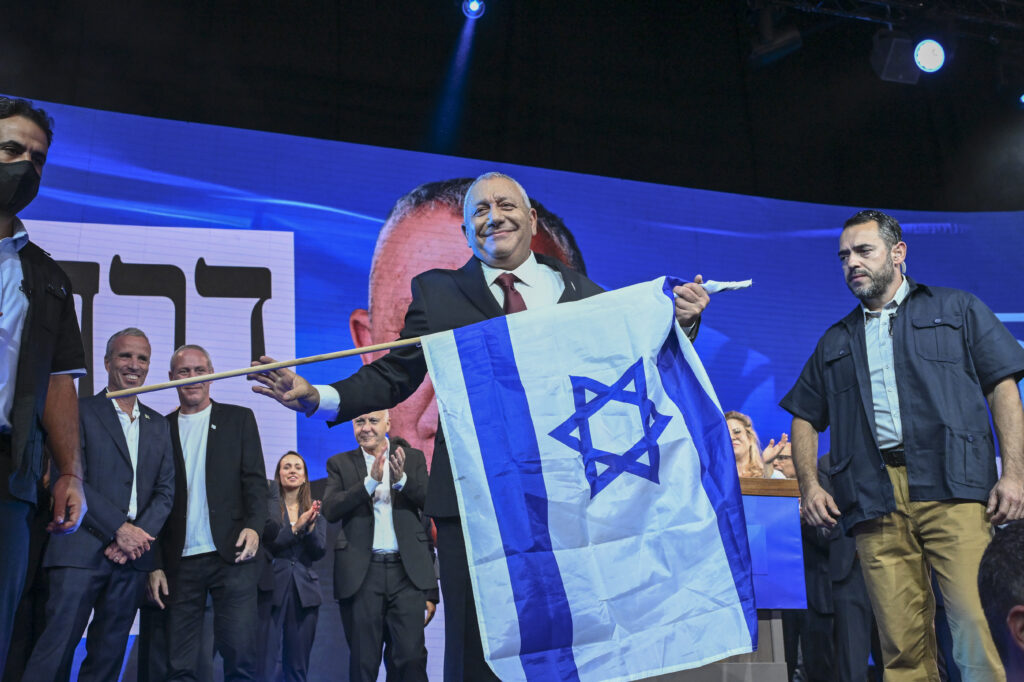
Eisenkot spoke first, while exit polls still favored his bloc. “The public has chosen change,” he said, and he called on Netanyahu to leave political life. He promised a Zionist government with national service for all, a state commission of inquiry into October 7 and the dismantling of Hamas. He has vowed never to serve under Netanyahu, even in a rotation: “I’ll resign an hour later.”
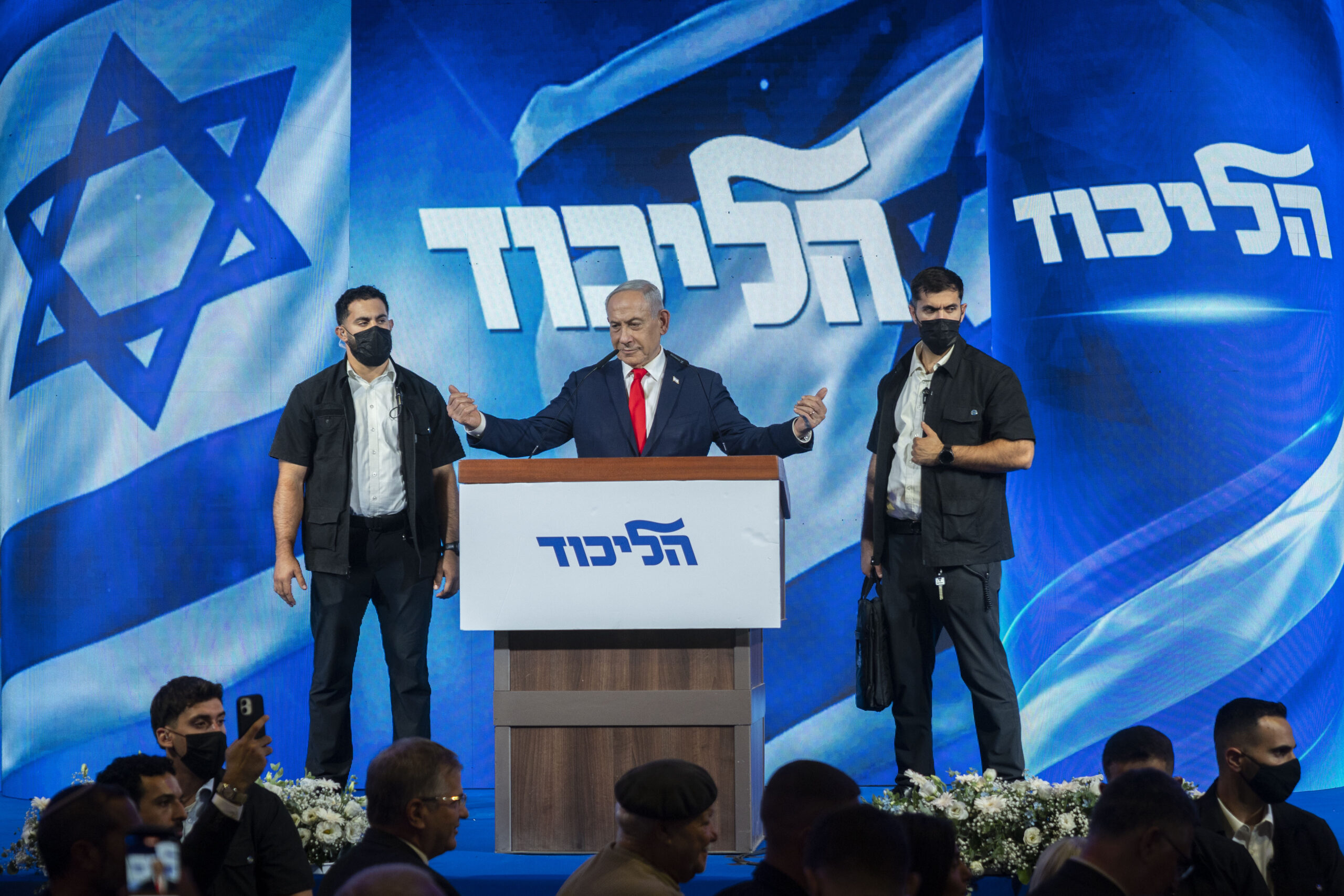
Netanyahu waited until after 3 a.m. and stopped short of declaring victory. He pointed to Likud’s place as the largest party, said the right holds a majority among Jewish voters, and listed his government’s record, including the killings of Sinwar, Nasrallah, and Khamenei. A week earlier he set out four principles for his next government, the first being “There is not, and there will not be, a Palestinian state. Period.”
Election day: arrests, claims and violence
Police arrested three men from Bedouin communities in the south on suspicion of bribing voters to back Ra’am. Ra’am called the arrests a sham. Netanyahu told Likud voters, “They are trying to steal the election from us,” and Yashar accused him of laying the groundwork to dispute the result. The Central Elections Committee found no evidence of systematic tampering. Police also detained a man with a knife near Golan in Tel Aviv. His party called it an attempted stabbing, and police said it was not.
Trump and Iran
Trump endorsed Netanyahu on October 18 with his “Complete and Total Endorsement” and renewed it on the eve of the vote. Walla News reported, citing American sources, that Trump wants the next government to exclude Ben-Gvir and Smotrich, and the Jerusalem Post reported that Trump-aligned figures favor a unity government with Eisenkot, with Netanyahu serving first. Ben-Gvir accused Netanyahu of secretly promising such a deal. Netanyahu called the charge a “trick.”
Israel and the United States launched their joint war on Iran on February 28. CNN reported that Netanyahu pushed for a strike before the vote and Trump refused. Eisenkot warned the heads of the IDF, Mossad and Shin Bet to resist pressure, calling Netanyahu a “caretaker prime minister, without a mandate.” Netanyahu stays in office as caretaker until a new government is sworn in, and the Times of Israel reported that Washington told Gulf states it may launch a short, intensive campaign against Iran after the November 3 U.S. midterms.
Five roads to a government
The first is Netanyahu’s: he needs seven more seats. Liberman’s eight would give him 62, but Liberman called on Likud members to rebel against Netanyahu.
The second is the opposition plus the Arab parties, 66 seats, which breaks the promises Bennett, Lapid, Liberman, and Eisenkot made.
The third is a minority government, which Eisenkot says he would lead with outside Arab support. It needs only a confidence vote, not 61 seats.
The fourth is a unity or rotation government. Eisenkot refuses to serve under Netanyahu, and Ben-Gvir opposes the deal. In 2020, the COVID emergency pushed Gantz into a rotation with Netanyahu, and JNS analyst Alex Traiman argues that Iran could play the same role now.
The fifth is another election, Israel’s seventh since 2019.
What happens next
Official results are due November 4. President Isaac Herzog then consults every party and picks a candidate, who is not necessarily the leader of the largest party. That candidate has 28 days to build a coalition, plus a possible 14-day extension. A second candidate then gets 28 days. If both fail, any 61 lawmakers can nominate a candidate within 21 days, who gets 14 days. If every attempt fails, Israel votes again about 90 days later with Netanyahu as caretaker. The shekel weakened, and Tel Aviv stocks fell on Wednesday.
For now, Netanyahu leads the largest party by seven seats and a bloc that outnumbers Eisenkot’s by the same margin. The opposition can reach a majority only through the Arab parties its own leaders swore off during the campaign. Whichever side blinks first will decide who governs Israel.

