


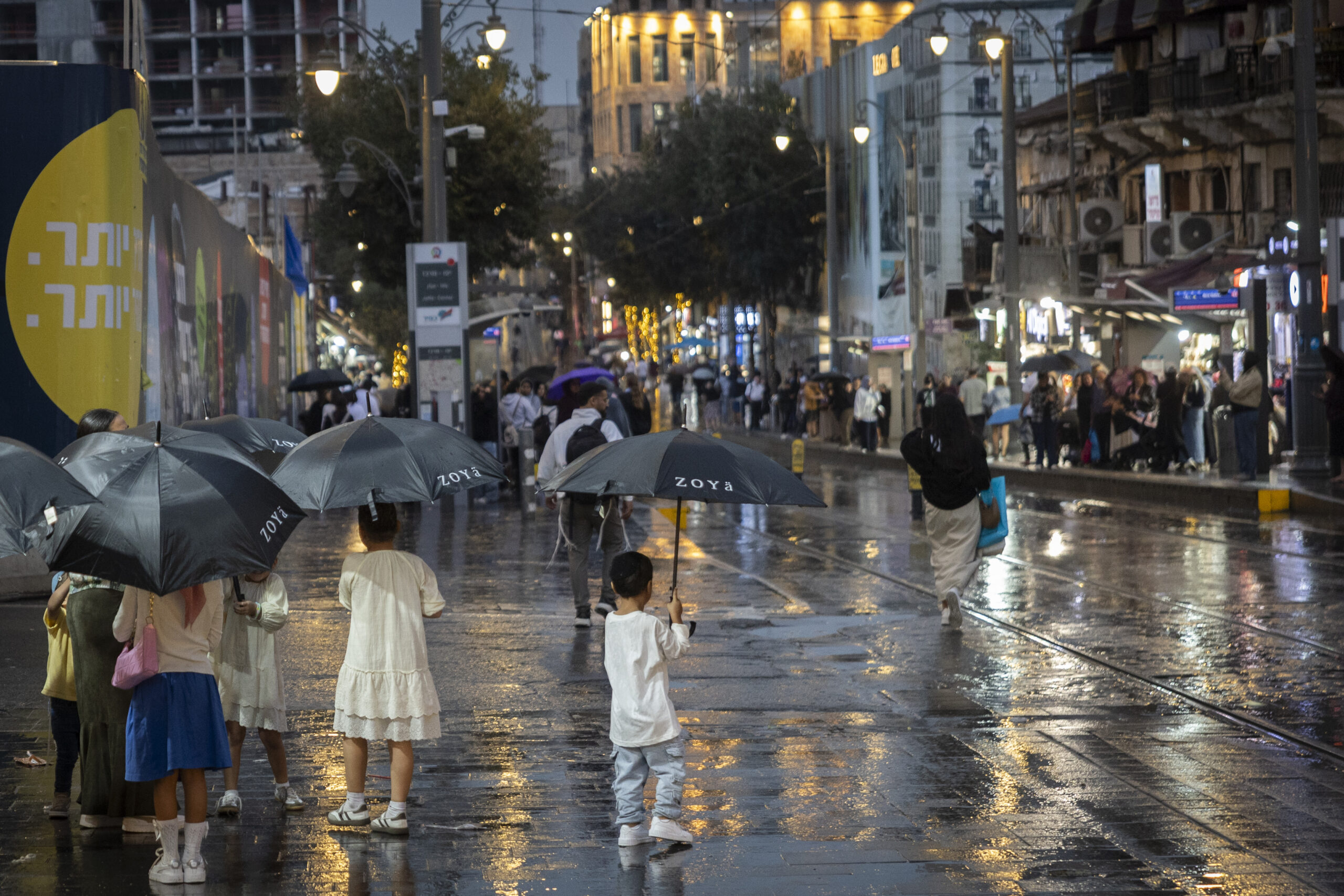
Israelis who went to the polls on Tuesday to choose their next government walked out of the voting booths into the first heavy storm of the season, which broke as the Hebrew calendar turned to 17 Cheshvan, the date on which, according to Jewish tradition, the rains of Noah’s Flood began to fall. Significantly, the Bible also describes a storm on the day Israel chose its first king, when the prophet Samuel called down thunder and rain on the nation as a warning.
The Israel Meteorological Service had warned of a prolonged and potentially exceptional flash-flood event, with a second wave of heavy rain forecast for Wednesday, 17 Cheshvan itself. The nation chose its leaders and the heavens opened, on the same day. Tuesday’s thunder, hail and flash floods cut off the main road into Eilat, sent torrents through the dry riverbeds of the Negev and dropped hail on Beit Shean.
But the rain did nothing to keep voters home. The Central Elections Committee reported a turnout of 77.7 percent, the highest since 1999, with more than 5.69 million Israelis casting ballots. Channel 12 reported that turnout in the Arab sector reached about 80 percent. When flooding blocked the only road out of Eilat, the Elections Committee adapted, allowing tourists stranded in the city to vote at any polling station there rather than at their predetermined location.
Israelis have voted in a storm before. The record turnout of 87 percent was set in the elections for the First Knesset in January 1949, held on an especially stormy winter day. This was also the first time in 38 years that Israelis voted on the date originally set by law, at the natural end of a full Knesset term.
The results left the country suspended. Channel 12’s updated exit poll gave Prime Minister Benjamin Netanyahu’s bloc 52 seats against 49 for the bloc led by former IDF Chief of Staff Gadi Eisenkot. Channel 13 and Kan 11 had the two blocs tied at 51 seats each, with Likud the largest party at 27 seats. Channel 14 gave Netanyahu’s bloc 60 seats. Arab parties were projected to win between 17 and 19 seats, an unprecedented number. Neither side reached the 61 seats needed to form a government.

Both men claimed victory. “The initial exit poll results indicate a complete lack of confidence in Netanyahu and the October 7 government among the Zionist majority and the majority of Israeli citizens,” Eisenkot wrote on X. Netanyahu took the stage after 3 a.m. and said the right-wing bloc had won a decisive majority among the Zionist public, announcing his intention to form a right-wing government. Official results will be published on November 4.
In a prophetic warning given as thunder rolled over Gilgal that seemed to presage yesterday’s election day storm, Samuel attached a warning to his storm that binds every Israeli government to this day.
Samuel’s thunderstorm
The story begins when the elders of Israel came to Samuel in Ramah and demanded a king “to judge us like all the nations” (I Samuel 8:5). Samuel was deeply troubled, and God’s answer to him was blunt: the people had rejected God Himself as their King. Samuel warned the nation what a king would take from them, and the people insisted anyway. Saul was anointed, and after his victory over the Ammonites, the nation gathered at Gilgal to renew the kingship.
There, before the assembled people, Samuel delivered the terms on which the new government would stand or fall:
“If ye will fear the LORD, and serve Him, and hearken unto His voice, and not rebel against the commandment of the LORD, and both ye and also the king that reigneth over you be followers of the LORD your God—; but if ye will not hearken unto the voice of the LORD, but rebel against the commandment of the LORD, then shall the hand of the LORD be against you, as it was against your fathers.” (I Samuel 12:14-15)
The condition falls on the people as much as on the king. The nation’s fate rests on its relationship with God, and the man on the throne rises or falls with it.
Then Samuel gave the people a sign they could see with their own eyes. “Is it not wheat harvest to-day? I will call unto the LORD, that He may send thunder and rain; and ye shall know and see that your wickedness is great, which ye have done in the sight of the LORD, in asking you a king” (I Samuel 12:17). The next verse records what happened: “So Samuel called unto the LORD; and the LORD sent thunder and rain that day; and all the people greatly feared the LORD and Samuel” (I Samuel 12:18).
The wheat harvest falls in early summer, when rain in the Land of Israel does more harm than good. The Mishnah (Taanit 1:7) rules that rain falling after the month of Nisan has ended is a sign of curse, and cites this very verse as its proof. Samuel’s storm was a rebuke because it came out of season.
The terrified people begged Samuel to pray for them. His reply contains both comfort and the sharpest warning in the chapter: “Only fear the LORD, and serve Him in truth with all your heart; for consider how great things He hath done for you. But if ye shall still do wickedly, ye shall be swept away, both ye and your king” (I Samuel 12:24-25).
Rain in its season
Tuesday’s storm was the mirror image of Samuel’s. Samuel’s thunder struck in the wrong season as a rebuke. This week’s rain arrived exactly on schedule, as the yoreh, the first rain of autumn, which the Bible promises as a blessing to a nation that keeps faith with God.
Jews recite that promise twice every day in the second paragraph of the Shema: “I will give the rain of your land in its season, the former rain and the latter rain, that thou mayest gather in thy corn, and thy wine, and thine oil” (Deuteronomy 11:14). Rashi explains that the yoreh is the rain that falls in Marcheshvan. The same passage warns that the blessing depends on the nation’s loyalty: “Take heed to yourselves, lest your heart be deceived, and ye turn aside, and serve other gods, and worship them; and the anger of the LORD be kindled against you, and He shut up the heaven, so that there shall be no rain” (Deuteronomy 11:16-17).
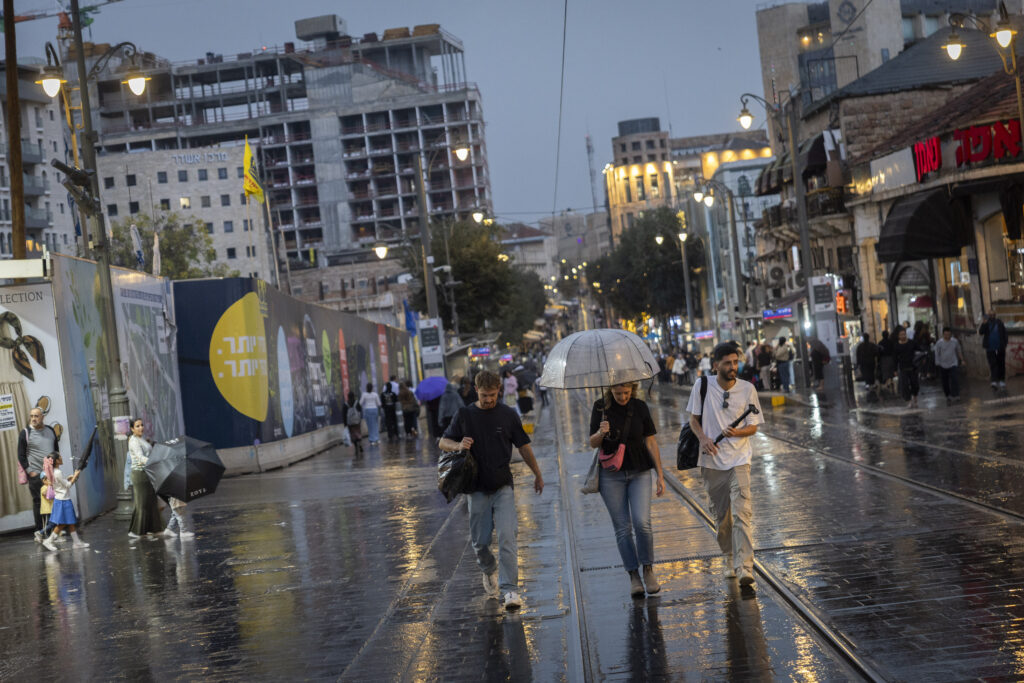
Jews in the Land of Israel began asking for that rain on 7 Cheshvan, which fell this year on October 18, just ten days before the election. Beginning on that day, the Amidah prayer recited three times daily adds the request v’ten tal u’matar livracha, “give dew and rain for a blessing.” The Mishnah (Taanit 1:3) sets the date fifteen days after Sukkot, so that the last of the pilgrims who came up to Jerusalem for the festival could reach their homes at the Euphrates River before the roads turned to mud. Ten days after the nation began asking, the heavens answered, on Election Day.
Rain in the Land of Israel is a product of the nation’s relationship with God, and the Bible built that into the land itself. Moses contrasted it with Egypt, where farmers watered their fields from the Nile by foot, the way one waters a vegetable garden:
“But the land, whither ye go over to possess it, is a land of hills and valleys, and drinketh water as the rain of heaven cometh down; a land which the LORD thy God careth for; the eyes of the LORD thy God are always upon it, from the beginning of the year even unto the end of the year.” (Deuteronomy 11:11-12)
Egypt depends on a river. Israel depends on God. The Talmud (Taanit 7b) states that rain is withheld only because of the sins of the people. The connection goes back to the first days of creation. Rashi on Genesis 2:5 explains that God held back the rain until Adam was created, because there was no one to recognize the need for it. When Adam prayed, the rain fell, and everything grew. From the beginning, rain in God’s world has come in answer to man turning to Him.
The Bible addresses this promise to the entire nation as one body. Rain in the Land of Israel is a public verdict, delivered to everyone at once. The Talmud (Taanit 2a) teaches that God holds three keys that He never hands to any messenger: the key of childbirth, the key of the resurrection of the dead, and the key of rain. The Sages held the day of rain in such esteem that the Talmud (Taanit 7a) declares it greater than the day of the resurrection of the dead.
The Bible makes the same claim about the men who govern. “The king’s heart is in the hand of the LORD as the watercourses: He turneth it whithersoever He will” (Proverbs 21:1). The Hebrew phrase is palgei mayim, streams of water, the same channels that filled with floodwater across the Negev on Tuesday. The prophet Daniel ties the seasons and the rulers together in a single breath: “And He changeth the times and the seasons; He removeth kings, and setteth up kings” (Daniel 2:21).
The Bible’s law of kingship states the principle outright: “Thou shalt in any wise set him king over thee, whom the LORD thy God shall choose” (Deuteronomy 17:15). The people set the king in place. God makes the choice. Israelis cast 5.69 million ballots on Tuesday, and the coalition that emerges from them will govern only as long as the nation’s relationship with the One who sends the rain holds.
The seventeenth of Cheshvan
The Bible dates the Flood with precision: “In the six hundredth year of Noah’s life, in the second month, on the seventeenth day of the month, on the same day were all the fountains of the great deep broken up, and the windows of heaven were opened” (Genesis 7:11).
The Talmud (Rosh Hashanah 11b) records a dispute over which month the Bible calls “the second month.” Rabbi Yehoshua counts from Nisan, placing the Flood in Iyar. Rabbi Eliezer counts from Tishrei, the month of creation, placing it in Marcheshvan. Rashi brings both opinions, and Rabbi Eliezer’s reading has become the one most widely taught. By that count, the Flood began on 17 Cheshvan, which this year falls on Wednesday, October 28, the day after the election.
The Talmud adds that Cheshvan is the season when the springs of the earth begin to dwindle. God overturned the natural order to bring the Flood, opening the fountains of the deep at the very time they should have been receding.
The Bible names the sin that brought the waters: “And the earth was corrupt before God, and the earth was filled with violence” (Genesis 6:11). The Hebrew word for violence is chamas. Rashi explains that it refers to robbery, and comments on Genesis 6:13 that the decree against that generation was sealed only because of robbery, though they were guilty of far worse sins.
The corruption of the Flood generation started at the top. The Bible describes the bnei ha’elohim, translated as “the sons of God,” who took whatever women they chose (Genesis 6:2). Rashi explains that the term refers to the sons of princes and judges, the ruling class of that generation. The men charged with upholding justice led the way in destroying it.
The election that closed on the eve of 17 Cheshvan was fought in the shadow of a war against Hamas, the terrorist organization whose name, an Arabic acronym, sounds exactly like the Bible’s word for the violence that brought the Flood. Accountability for the massacre of October 7, 2023, was the central issue of the campaign, and both candidates for prime minister invoked it on election night.
Rashi offers one more detail that turns the Flood narrative into a lesson for the present. When the waters first began, the Bible calls them geshem, ordinary rain (Genesis 7:12). Only later does it call them mabul, a flood. Rashi explains that God first brought the rain down gently, with mercy, so that if the generation repented, the same waters would become rains of blessing. The rain of judgment and the rain of blessing are the same water. The response of the people decides which one falls.
Both ye and your king
The coming weeks will be consumed by coalition arithmetic, as party leaders count seats and bargain for ministries. Samuel’s message at Gilgal cuts beneath all of it. A government in Israel derives its mandate from the voters and its future from God. The prophet told the nation that its king would stand or fall together with the people, and he called down thunder and rain on the day of the coronation so that no one would forget it.
On Tuesday, the thunder came again, in its proper season, on the day the nation went to the polls and on the eve of the date the Flood began. Since Shemini Atzeret, Jews have praised God in every Amidah as the One who causes the wind to blow and the rain to fall, and since 7 Cheshvan, they have asked Him outright for dew and rain. The answer arrived on Election Day.
The rain of Cheshvan is a blessing, and the same water that fills the wells can sweep away a generation. Samuel stated the terms plainly three thousand years ago, and they remain in force for whoever forms the next government in Jerusalem: “If ye shall still do wickedly, ye shall be swept away, both ye and your king.”

