Israelis go to the polls on Tuesday, October 27, to elect the 26th Knesset, Israel’s parliament. The system is very different from the American one. Israelis never vote for a prime minister, a local representative, or an individual candidate. They vote for a party, and the math that follows decides who governs.
One country, one district, one vote
Israel has no electoral districts. The whole country votes as a single constituency, and each voter casts one ballot for one party list. The 120 Knesset seats are assigned proportionally to each party, provided that the party meets the 3.25% electoral threshold.
Each party submits a ranked list of candidates before the election. If a party wins 10 seats, the top 10 names on its list enter the Knesset. Voters have no say over the order. Parties set their lists through primaries, as Likud did in August, or through the party leader’s choice.
Who votes, and where
All Israeli citizens 18 and older who are listed in the voter registry can vote. About 6.8 million Israelis are eligible this year. Every eligible resident is assigned to a particular polling station near their registered address and must vote there using an Israeli ID card, passport, or driver’s license.
In most locations, polling stations operate from 7:00 a.m. until 10:00 p.m. In small communities, hospitals, and prisons, the hours are 8:00 a.m. to 8:00 p.m. Election day is a legally mandated national holiday.
Israel has no absentee ballots for ordinary citizens living or traveling abroad. Only state envoys vote overseas. This year, 101 polling stations across 99 diplomatic missions served around 4,800 eligible voters. Soldiers vote early at their bases. Voting began October 21 at military polling stations on IDF bases and outposts. Votes in special polling stations, such as those for soldiers, are cast in double envelopes and counted at the Knesset.
Inside the booth
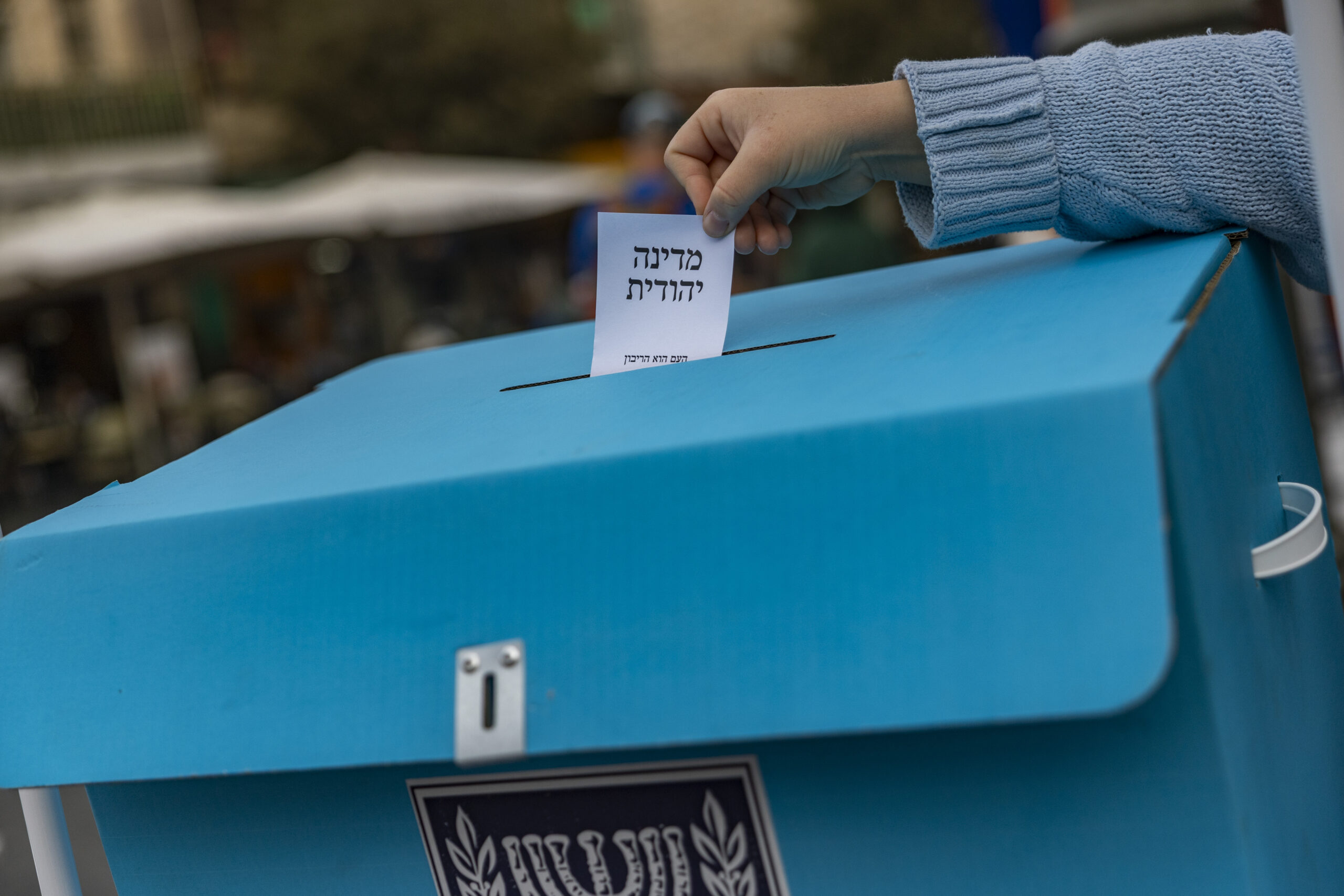
The Israeli ballot is unlike anything in an American polling place. Behind a screen sits a tray of paper slips, called petakim (ballot slips), one stack for each party. Each slip carries the party’s name and its assigned Hebrew letters, known as otiyot. Many parties are known by their letters as much as by their names. The voter takes one slip, places it in an envelope, and drops the envelope into the ballot box. A voter can also write in a party’s letters on a blank slip.
This year, voters face a long tray. The Times of Israel counts 37 parties running for the Knesset‘s 120 seats.
The threshold: where votes disappear
A party needs 3.25% of valid votes to enter the Knesset, roughly equivalent to four seats. A party that falls short gets nothing. Votes cast for parties that fail to cross the threshold are discarded and not included in the distribution of seats.
The stakes are enormous. In the November 2022 election, almost 420,000 votes were wasted on parties that failed to pass the threshold, equal to 8.8 percent of all valid votes and the equivalent of 10 Knesset seats. Israel’s growing electorate could push the threshold close to 200,000 votes this year. For that reason, several smaller parties are hovering around the threshold, meaning shifts of a few tenths of a percentage point could determine whether roughly four lawmakers enter the Knesset.
Surplus-vote agreements
Seats rarely divide evenly, so leftover votes matter. Before the election, pairs of parties sign surplus-vote agreements. These deals do not merge parties, which run independently and must each cross the 3.25% threshold for the deal to take effect, but pool leftover votes in the allocation of the Knesset‘s final seats, potentially helping one gain an additional seat. The deadline for this year’s agreements was October 16.
Election night
When polls close at 10 p.m., the three main television channels release exit polls. These are projections and have missed by several seats in past elections. Polling station committees then begin counting the votes, a process that usually lasts two to three hours, and results are posted throughout the night on the Central Elections Committee website. The soldiers’ and other double-envelope ballots are counted afterward, and they can shift a seat or two. The final results are published in Reshumot, Israel’s official gazette, roughly a week later.
The election is run by the Central Elections Committee, headed by Supreme Court Justice Noam Sohlberg. On election day, the committee chair and presidium can stop voting at polling stations if there is suspicion of irregularities, and can extend voting hours at particular stations.
61: the only number that matters
No party has ever won a majority on its own in Israel’s history. The real contest begins after the count, when parties assemble a coalition of at least 61 of the 120 seats.
Once official results are in, the President consults with every party that entered the Knesset. Each party recommends a candidate for prime minister. The President then assigns the task of forming a government to the lawmaker he judges most likely to succeed, usually the one with the most recommendations. That candidate has 28 days to build a coalition, with a possible extension of up to 14 more days. If he fails, the President can hand the mandate to another lawmaker, or a majority of the Knesset can petition for a candidate of its own. If no one succeeds, Israel goes back to the polls.
A new government takes office only after it wins a confidence vote in the Knesset. Until then, the outgoing government continues to serve.
What to watch
Watch the threshold. The race between the two largest parties will grab headlines, but the parties hovering near 3.25% will decide which bloc reaches 61. A single small party falling just short can erase four seats from one side and hand the government to the other.