


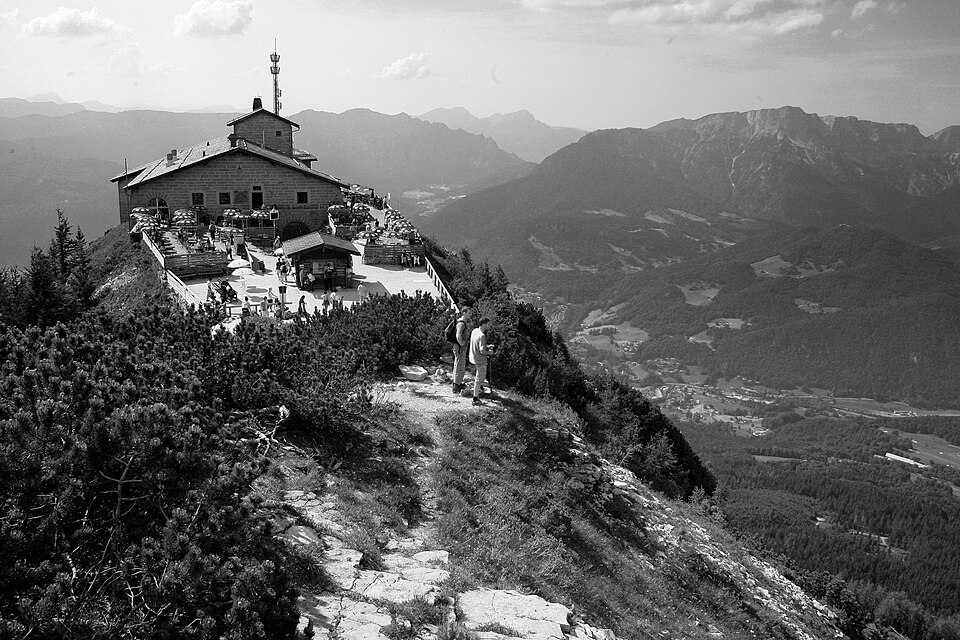
The fire that gutted Hitler’s Eagle’s Nest has reopened an ancient question for Germany and for the Jewish people: how to obey the Bible’s command to blot out the memory of Amalek while never forgetting what it did.
The Kehlsteinhaus, the granite retreat perched 6,000 feet above the Bavarian Alps that the Nazi Party built as a birthday present for Adolf Hitler, burned through the night on Friday as snow fell on the mountaintop. By Saturday afternoon, the building that Allied bombers never touched stood gutted and too unstable to enter, and German police had a 33-year-old man in custody. Bavaria has already vowed to rebuild the site as a place of remembrance, reviving an ancient question for the Jewish people. The Bible commands Israel to blot out the memory of Amalek, the nation Jewish tradition sees reborn in Haman, in Hitler and in Hamas, and in the same breath commands never to forget what Amalek did.
‘Completely ablaze’
Authorities were alerted on Friday night when a smoke detector triggered the fire alarm at the building, known in English as the Eagle’s Nest, on the Kehlstein peak above Obersalzberg near Berchtesgaden. When firefighters arrived, they found the building “completely ablaze,” according to police.
Some 200 firefighters battled the blaze. Reaching the site at 1,834 meters was itself a struggle. Police spokeswoman Lisa Maier said crews could work there only with “heavy breathing apparatus,” and police said fire trucks had trouble reaching the summit “due to the local conditions.” No one was inside, and no injuries were reported.
The building was still burning at dawn on Saturday. Fire chief Michael Brandl told a press conference that “the last elements of the inferno were being put out during the afternoon.” Firefighters have not gone inside. “No one has entered the building because of fears it could collapse,” Brandl said. A police spokesperson told Bild that the building “could probably not be saved.”
The fire flared up again overnight into Sunday. “It was burning up to room height again,” a police officer said, adding that reignition from smoldering embers is common after a major blaze. Firefighters returned and put out the flames. The restaurant was closed on Friday, and the building is largely destroyed. The local tourism association estimates the damage in the millions of euros.
The suspect
Police said a suspect “came into the focus of investigators” shortly after the fire broke out, and that there were no indications anyone else was involved. According to Bild, officers detained a motorcyclist they encountered on their way to the scene.
Prosecutors said the suspect is a 33-year-old German citizen with ties to the Berchtesgaden area who does not currently live there. He was arrested on suspicion of arson. An initial psychiatric assessment concluded that he is mentally ill, and he was sent to a psychiatric facility. Prosecutors said they have not established a motive and will examine whether the arson was politically motivated, given the building’s history.
Hitler’s birthday present
The Nazi Party built the Kehlsteinhaus between 1937 and 1938 as a gift for Hitler’s 50th birthday and as a monument to his rule. Built of stone and granite with sweeping views of the Alps, it was designed to impress foreign diplomats and served as a guest house for senior Nazi officials.
According to the Berchtesgaden tourism association, Hitler visited several times, but the retreat “remained of little significance” politically and was used mainly by senior Nazi officials for leisure and private celebrations.
The building escaped Allied bombing and survived the war intact. Since 1952 it has housed an exhibition on its Nazi history and operated as a restaurant and beer garden, drawing tourists up the mountain road. Its own website describes it as “one of the few undamaged monuments of the Hitler era” and says it “stands for the insanity of the regime.”
Bavarian Interior Minister Joachim Herrmann said the site will be restored. “We’re not going to leave a ruin there,” he told reporters in Berchtesgaden. “It is important that we continue to do the work of remembrance.” He said its future form will be decided together with local officials, historians and preservationists.
Blotting out the memory of Amalek
The question of what to do with the monuments of the Third Reich touches one of the Bible’s most striking commandments. Amalek, the nation that ambushed the weakest of the Israelites as they left Egypt, became in Jewish tradition the archetype of the enemy who seeks to destroy the Jewish people for no reason other than its existence. The Bible commands two things about Amalek at once: to erase its memory and never to forget what it did. “Remember what Amalek did unto thee by the way as ye came forth out of Egypt… therefore it shall be, when the Lord thy God hath given thee rest from all thine enemies round about, in the land which the Lord thy God giveth thee for an inheritance to possess it, that thou shalt blot out the remembrance of Amalek from under heaven; thou shalt not forget” (Deuteronomy 25:17-19).
Jewish tradition traces Amalek’s line through history. When King Saul spared Agag, king of Amalek, in defiance of God’s command (1 Samuel 15), he lost his throne, and the Bible later identifies Haman, the would-be exterminator in the Purim story, as “Haman the Agagite.” The lesson the Sages drew is that Amalek’s spirit, left alive, returns in later enemies of the Jews.
Jewish sources have long linked that spirit to Germany. The Talmud (Megillah 6b) mentions “Germamya of Edom,” a kingdom whose armies, it warns, could destroy the world if unleashed. The Vilna Gaon understood the word as referring to Germany, a land he associated with the descendants of Amalek. Citing that tradition, Rabbi Yosef Chaim Sonnenfeld, the leader of Jerusalem’s old Orthodox community, reportedly refused to go out and greet the visiting German Kaiser Wilhelm II in 1898.
An essay by an Aish rabbi describes Amalek’s worldview as the denial of any divine order: “Amalek’s entire philosophy is that there is no design or providence in the world.” Writer Daniella Levy has described Amalek as the embodiment of “survival of the fittest,” the antithesis of a Torah that commands compassion for the weak, the same stragglers Amalek attacked in the desert. Nazism raised that worldview into a state ideology, casting the Jews as the inventors of conscience and the enemies of a racial “natural order.”
After the Holocaust, the identification became explicit. Rabbi Moshe Soloveitchik taught that Amalek is “more a concept than a nation,” and that any person or nation that hates the Jewish people without cause takes on the status of Amalek. His son, Rabbi Joseph B. Soloveitchik, the leading figure of American Modern Orthodoxy, transmitted the teaching and regarded the Nazis as Amalek, a view that became widely accepted in the Jewish world. Rabbi Ephraim Oshry, the Kovno ghetto survivor whose wartime rulings became a classic of Jewish law, identified Hitler with Amalek. Like Amalek, which attacked Israel at its own peril, the Nazis pursued the Jews even at the expense of their own war: in 1944, with the front collapsing, Germany kept trains running to deport the Jews of Hungary to Auschwitz. Julius Streicher, the Nazi propagandist, appeared to understand the connection himself. On the gallows at Nuremberg on October 16, 1946, he shouted “Purim-Fest 1946!” Ten Nazi leaders were hanged that day, and many Jews noted the parallel to the ten sons of Haman hanged in the Book of Esther (Esther 9:13-14). A widely cited observation holds that the names of Haman’s sons in the Megillah, the scroll of Esther, are written with three undersized letters, tav, shin and zayin, whose numerical value points to the Hebrew year 5707, which began in the autumn of 1946.
Today, following Rabbi Moshe Feinstein, many authorities hold that the commandment is fulfilled by remembering Amalek and uprooting its cruelty and arrogance toward God.
The teaching that “each generation has its own ideological Amalek,” as Rabbi Shraga Simmons of Aish put it, took on new urgency on October 7, 2023. Like Amalek, which fell on the weak and the stragglers at the rear of the camp, Hamas terrorists struck families in their homes and young people at a music festival on a Jewish holiday. Simmons called the atrocities “straight out of the Nazi playbook” and named Iran, the patron of Hamas, Hezbollah and the Houthis, as “this modern-day Amalek.” Weeks after the massacre, Prime Minister Benjamin Netanyahu invoked the commandment directly as Israeli troops entered Gaza: “You must remember what Amalek has done to you.” Three years later, Hamas has sent word through the United Nations that it is ready to carry out another October 7.
The Jewish answer to Amalek has never been to preserve its shrines. It has been to remember the crime, to remember the victims, and to outlive the destroyer, a balance Germany is now debating on a mountaintop in Bavaria.


