


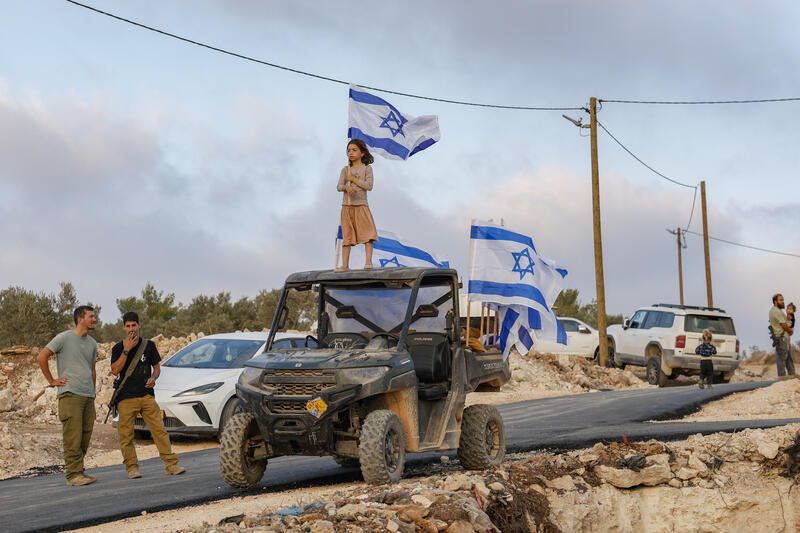
Two new communities and ten new farms rise in the Hebron Hills after Palestinian terrorists murdered two IDF soldiers. The Sages taught that the Land of Israel is acquired through suffering, and its blossoming heralds the end of days.
Palestinian terrorists murdered two Israeli soldiers at a checkpoint outside Hebron on Friday morning. By Friday afternoon, Finance Minister Bezalel Smotrich was standing beside a bulldozer at the scene, and by Friday evening the government had approved four new Jewish farms in the southern Hebron Hills. On Saturday night, the regional council added two new communities and six more farms. The terrorists came to destroy, and Israel’s answer, delivered within hours, was to plant.
The attack
Staff Sgt. Ron Yonatan Roytman and Sgt. Yuval Shai Svilem were killed on October 23 when two Palestinian gunmen opened fire at Yehuda Junction on Route 35, just north of Hebron. Three other soldiers were wounded. Israeli forces killed both terrorists. Hamas, Palestinian Islamic Jihad and the Popular Front for the Liberation of Palestine praised the attack and called for more confrontations with soldiers and settlers.
Prime Minister Benjamin Netanyahu ordered a closure of Hebron and Halhul and told the IDF to prepare a lockdown of all of Judea and Samaria. Defense Minister Israel Katz said some 2,000 residents of the terrorists’ neighborhood were evacuated and would not return “until we’ve finished dealing with all the Hamas issues in Hebron.” The IDF reported about 40 arrests, including operatives of Hamas and Islamic Jihad.
Netanyahu also hinted that the response would reach well beyond Hebron. “There is a very big surprise for the Palestinian Authority as well,” he told i24News.
The attack at Yehuda Junction was the latest in a string of Palestinian terror attacks in Judea and Samaria. On September 7, a terrorist stabbed and wounded an Israeli at the Maoz Yehuda farm in the southern Hebron Hills before troops killed him. On September 20, the eve of Yom Kippur, a terrorist shot dead Netanel Shukrun, a 30-year-old father of six from Alei Zahav, as Israelis immersed in a spring near Neve Tzuf. Security forces also arrested two Palestinians charged with plotting to assassinate National Security Minister Itamar Ben Gvir. The IDF said the Yehuda Junction terrorists, both 27-year-old residents of Hebron, were stopped before they could reach civilians, and Israel’s public broadcaster Kan reported that one of them is believed to have been affiliated with Hamas. Days earlier, Defense Minister Katz had warned that Iran and its proxies were trying to carry out terror attacks to influence the outcome of Tuesday’s election. The Shin Bet foiled 532 terror attempts in July alone, nearly all of them in Judea and Samaria.”
Demolish and build
Smotrich, who serves as a minister in the Defense Ministry with responsibility for civilian affairs in Judea and Samaria, arrived at the scene hours after the shooting to oversee Civil Administration teams demolishing dozens of illegal structures on Hebron’s outskirts.
“We are already here with heavy machinery on the ground, sending an unequivocal message to our enemies: Whoever messes with us will pay a very painful price,” Smotrich said. “By Shabbat, we will demolish quite a few structures here, and it will be clear that terrorism targeting Israeli citizens bears a very heavy price. This is just the beginning.”
He said he had agreed with Netanyahu and Katz to map the area and other locations across Judea and Samaria to expand the operation. “Jewish blood is not cheap,” he said.
In the same visit, Smotrich announced that four new farms in the southern Hebron Hills had been approved that day. He described the two moves in a single Biblical phrase: “We are continuing both to do good and to turn away from evil.”
This phrase (sur me’ra va’aseh tov) appears twice in Psalms, emphasizing the connection between morality and being permitted to live in the land of Israel:
“Depart from evil, and do good; and dwell for evermore” (Psalms 34:15; 37:27).
Smotrich’s phrase at the attack site reversed the order, and the reversal fits Friday’s events. Tearing down the illegal structures beside the junction removed the evil. The farms on the hills are the good.
On Saturday night, the Har Hebron Regional Council announced eight more sites, backed by the Defense Ministry’s Settlement Administration and the Amana settlement movement. The new communities are Magad, between Negohot and Eshkolot, and Nofei Gulot, between Otniel and Afeka. The six farms are Mitzpe Tzur near Telem, close to the site of the attack; Noi, between Karmei Yehuda and Adora; Lev Amit, between the new community of Makeda and Adora; Eshel, near the planned community of Magad; Lema’an Achai, between Otniel and Shima; and Mitzpe Or, between Carmel and a nature reserve in the Judean Desert.
“Terrorism seeks to destroy lives, spread fear, and undermine our hold on our homeland, but our historic and Zionist response is being written on the ground. We will not retreat or give in,” said council head Eliram Azulai. “Out of the immense pain and grief over the loss of our heroic soldiers, we choose life and deepen our roots. The establishment of two communities and six farms sends a clear message: We are here to stay, build, and grow.”
A Zionist response
Israel has answered terror with construction for decades. In 2019, after 17-year-old Rina Shnerb was killed by a bomb near Dolev, Netanyahu ordered a new neighborhood of some 300 homes in the town. “We will deepen our roots and strike at our enemies,” he said. That same month, after yeshiva student and soldier Dvir Sorek was stabbed to death in Gush Etzion, Netanyahu visited Beit El and said, “We know that the Land of Israel is bought in agony.”
In 2023, after terrorists murdered four Israelis near Eli, Netanyahu approved 1,000 new homes in the town. “Our answer to terror is to strike it hard and to build our country,” he said. The same year, after a ramming attack in Jerusalem’s Ramot neighborhood killed two young brothers and a newlywed, the cabinet legalized nine communities in Judea and Samaria. In 2024, after a shooting near Ma’ale Adumim, the government moved to advance more than 3,000 housing units in Ma’ale Adumim, Efrat and Kedar. Yesha Council chairman Shlomo Ne’eman called it a “Zionist response” to terror.
The current government has made the principle into policy. Smotrich said in July that 104 new communities have been approved during its tenure, along with more than 160 agricultural outposts. “We are leading an historic revolution in Judea and Samaria that will prevent the creation of a terror state in the very heart of Israel,” he said. The state he was referring to is the two-state solution’s core demand: the creation of an unprecedented Palestinian state inside Israel’s borders, militarized and ethnically cleansed of Jews, with its exclusively Muslim capital in Jerusalem, centered on Judaism’s holiest site, the Temple Mount.
Europe burns
The contrast with what is happening in Europe this month is stark. Cost-of-living protests across France, Italy and other countries have turned into some of the worst rioting the continent has seen in decades. In France, the government estimated 550,000 people took to the streets on October 17. Some 2,000 shops were vandalized or looted, more than 600 police officers, gendarmes and firefighters were injured, and more than 2,000 people were arrested. Rioters set fire to the historic city hall of Limoges, a listed national monument, and vandalized the Monument à la République in Paris. Italy deployed soldiers to Milan after rioters looted stores around the city’s cathedral.
Palestinian flags and keffiyehs were a recurring sight. In Marseille, marchers chanted “Intifada,” according to Bruno Benjamin, head of the local branch of CRIF, the umbrella body of French Jewry. “The looting, the violence, and the attacks on law enforcement are neither social demands nor acts of resistance,” Benjamin said. “They are acts of delinquency that must be punished with the utmost severity.” In Paris, intruders ransacked the Ohalei Yaakov synagogue, and Jewish-owned shops burned in Marseille. French Jewish security officials said they found no evidence that Jewish sites had been singled out. Synagogues, city halls, monuments and shops of every kind went up together.
The builder and the wild man
The pattern raises a question as old as the Bible: why do the sons of Isaac answer violence by building, while those who rage against them answer everything by burning?
The Bible draws this line in the first family of the Jewish people. Before Ishmael was born, an angel described his nature to his mother, Hagar:
“And he shall be a wild ass of a man: his hand shall be against every man, and every man’s hand against him; and he shall dwell in the face of all his brethren” (Genesis 16:12).
The Hebrew is pere adam, a wild ass of a man. Rashi explains that Ishmael would love the wilderness and the hunt, and that “his hand against every man” means he would be a bandit. The verse says nothing about a particular target. Ishmael’s hand is against every man. A mob that burns a synagogue, a city hall and a corner shop in the same night, without distinguishing between them, is acting out that verse precisely.
Isaac’s story runs in the opposite direction. When the Philistines filled in the wells his father Abraham had dug, Isaac did not burn their fields. He dug the wells again (Genesis 26:18). And Abraham himself, in the very chapter where Ishmael is sent away and grows into an archer in the wilderness, plants. “And Abraham planted a tamarisk-tree in Beer-sheba, and called there on the name of the Lord, the Everlasting God” (Genesis 21:33). The Hebrew word for that tree is eshel. One of the six farms announced on Saturday night bears that name.
A sign of redemption
The Sages saw farms on these particular mountains as more than a policy. In the Talmud (Sanhedrin 98a), Rabbi Abba teaches that there is no clearer sign of the coming redemption, the ketz hamegulah or “revealed end,” than a single verse in Ezekiel:
“But ye, O mountains of Israel, ye shall shoot forth your branches, and yield your fruit to My people Israel; for they are at hand to come” (Ezekiel 36:8).
Rashi explains that when the Land of Israel gives its fruit generously, the end is near. For nearly two thousand years, the hills of Judea yielded little to anyone. Today, Jewish farmers are planting orchards and vineyards on the same slopes where Caleb took his inheritance and where Abraham bought the Cave of Machpelah, the first piece of the Land a Jew ever purchased.
The Sages also understood the price. “The Holy One, Blessed be He, gave Israel three precious gifts, and all of them were given only through suffering,” the Talmud teaches (Berakhot 5a). Those gifts are the Torah, the Land of Israel and the World to Come. When Netanyahu said in Beit El that the Land “is bought in agony,” he was quoting the Sages, whether or not he said so.
The prophet Amos promised how the story ends: “And I will plant them upon their land, and they shall no more be plucked up out of their land which I have given them, saith the Lord thy God” (Amos 9:15).
Ron Roytman and Yuval Svilem gave their lives guarding the road to Hebron. Within a day of their deaths, the State of Israel had approved ten new farms and two new communities on the hills that road runs through. Europe’s rioters are burning their own cities to the ground. The terrorists who murdered two soldiers left behind a pile of rubble. Israel’s response to both is to plant, and the prophets promised that what Israel plants on these mountains will never again be uprooted.

