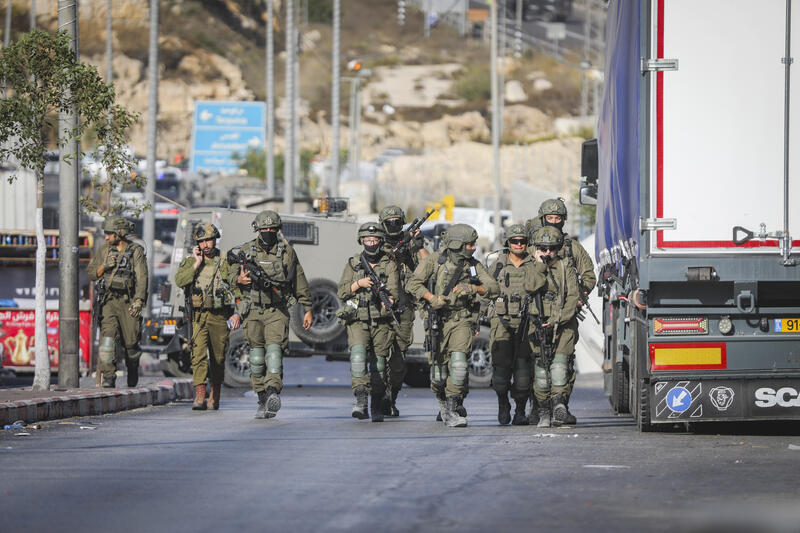
Two Hamas-linked terrorists opened fire on Israelis at Tzomet Yehuda (Judah Junction) on Route 35 near Hebron on Friday morning, wounding five people, two of them critically, and pinning down soldiers and medics in a gunfight that raged for more than 20 minutes. Both terrorists were killed by IDF troops. The attack came four days before Israelis go to the polls, and ten days after Prime Minister Benjamin Netanyahu and Defense Minister Israel Katz publicly warned that Israel’s enemies would try to strike before the vote.
Magen David Adom said two of the victims were critically wounded and three sustained light to moderate injuries. The terrorists arrived in a vehicle with yellow license plates, got out, and opened fire on people at the junction. The IDF Spokesperson identified the site as Yehuda Junction, also known as HaOkefim Junction near Beit Einun, in the Yehuda Brigade sector. Arab media refer to the area as the Farsh al-Hawa checkpoint. The Hebrew news site Walla reported that the attack appears to have targeted a reservists’ battalion, and investigators are examining whether the terrorists set an ambush for the soldiers, opened fire, and then tried to escape.
Both terrorists were 27-year-old residents of Hebron, and Israel’s public broadcaster Kan 11 reported that one of them is believed to have been affiliated with Hamas. They were armed with an M16 rifle and a pistol. According to the IDF, they were shot dead by the deputy commander of the Home Front Command’s Ari Battalion and a company commander who rushed to the scene.
Footage from the scene captured the length of the battle. Ofer Ohana, a medic well known in the area, was heard shouting that the wounded could not be evacuated because there had been “active gunfire for more than 20 minutes!” In separate footage, a medic called out to soldiers to take cover beside the ambulance, telling them it was bulletproof.
One of the soldiers who returned fire described the moment a round found him. “I felt something hit my helmet. I lowered my head,” he told Israel National News. He said his unit took cover behind a concrete barrier as soon as the shooting began, and that the soldier beside him began to panic, so he worked to calm him while they kept firing. He also used his personal cellphone to call in additional forces.
IDF Chief of Staff Lt. Gen. Eyal Zamir said the troops’ swift action “prevented an even more serious attack.” Zamir said a large quantity of ammunition was found in the terrorists’ vehicle, intended for a larger-scale attack, and ordered preparations to deploy additional forces to Central Command if needed.
Responders told the Associated Press that two men in their 20s suffered gunshot wounds to their lower limbs. Shaare Zedek Medical Center said two victims arrived at its trauma unit in moderate condition, conscious and stable. Hadassah said one victim was brought to Hadassah Ein Kerem in mild condition and fully conscious.
The IDF launched a manhunt for any additional terrorists who may have been involved. Highway 35 was closed in both directions, and the military imposed closures on several nearby Arab towns, including a full closure on Hebron.
Closure through the election
Netanyahu, running for a new term in Tuesday’s election, called off all political meetings for Friday. He and Katz instructed Zamir to cordon off Hebron and impose a closure across Judea and Samaria at least until after the vote. Netanyahu praised the soldiers who stopped the attack and said security forces were carrying out extensive waves of arrests. Addressing Hamas and its sponsors, he vowed that Israel would pursue them everywhere and at all times, warning, “You have nowhere to hide.”
Gadi Eisenkot, the former army chief and Netanyahu’s top rival, praised the troops’ response and said he prayed, like all Israelis, for the full and speedy recovery of the wounded.
National Security Minister Itamar Ben Gvir went to the scene and called the attack a painful reminder of the price of the conceptzia (the “concept”), the Hebrew term for the mistaken security assumptions blamed for Israel’s failure to anticipate the October 7 massacre. He warned that Israel must act before an October 7 erupts in Judea and Samaria, where he said the next war will break out, and called for the Palestinian Authority to “be dismantled and demilitarized.” The Palestinian Authority was created under the 1993 Oslo Accords as the vehicle for the two-state solution: the creation of an unprecedented Palestinian state inside Israel’s borders, militarized and ethnically cleansed of Jews, with its exclusively Muslim capital in Jerusalem, centered on Judaism’s holiest site, the Temple Mount. Three decades of that land-for-peace experiment produced three intifadas, waves of suicide bombings, rocket fire from Gaza, and the war against Hamas.
An attack foretold
Israel’s leaders saw this coming. Earlier this month, Katz warned that Israel had identified attempts by Iran and its proxies to carry out terror attacks aimed at influencing the election results, and vowed that anyone attacking Israel would pay the heaviest price. Netanyahu told his cabinet on October 13 that Hamas, precisely because it has been so weakened, would try to challenge Israel with its remaining forces ahead of the vote.
The IDF raised its alert level twice over the past month, first around October 7 and again this week. On Monday, following a security assessment by Zamir, leave was suspended across all military units beginning Thursday. Zamir said the IDF’s mission was to ensure democratic elections could take place “on schedule and safely,” and that the military was on its highest level of alert. The IDF also reinforced Judea and Samaria with an additional regular brigade for the election period.
The numbers
Friday’s attack broke a period of relative quiet. Data from the Shin Bet (Israel Security Agency) and the Foreign Ministry, analyzed by the Jerusalem Post‘s Seth Frantzman this week, show a 70% decline in major terror attacks between 2024 and 2025 and nearly a 60% decline from 2025 to 2026. Overall attacks, including stone throwing, fell 20% this year according to data through August. By the Post’s count, there were 218 major attacks in 2024 and 62 in 2025, with 5,663 terrorist incidents overall in 2024 compared to 4,744 in 2025.
The threat remains constant. According to the Foreign Ministry, nine major terror attacks took place in July, four in Judea and Samaria and five inside Israel, while the Shin Bet foiled 532 attempted attacks that month, 528 of them in Judea and Samaria. In August alone, there were 288 other attacks, including 254 stone-throwing incidents and 12 Molotov cocktail attacks.
The 2024 figures show the full scale of the war on the roads of Judea and Samaria. Rescuers Without Borders recorded at least 6,343 attacks on Israeli Jews in Judea and Samaria that year, figures cross-checked against official security data. They included 3,668 rock-throwings, 843 Molotov cocktails, 671 attempts to blind drivers with laser pointers, 526 explosive charges, 364 arsons, and 179 shootings. The Shin Bet foiled 1,040 major attacks in Judea, Samaria, and Jerusalem that year, most involving firearms (689) and explosive devices (326). Since the start of the war in October 2023, the IDF reports confiscating more than 3,800 weapons in the region and detaining roughly 45,000 wanted individuals for questioning. Israeli figures show at least 49 Israelis, civilians and security personnel, have been killed in Palestinian attacks or during military operations in the region over the same period.
How the Washington Post told the story
The Washington Post‘s report on the attack, published from Associated Press wire copy, built its account around blaming the IDF. The headline read “Israel’s military says it killed 2 men who had launched an attack in the occupied West Bank,” making Israeli soldiers the subject of the story and two dead “men” its central fact. The words “terror” and “terrorist” appear nowhere in the text. The gunmen who ambushed a junction and kept up a firefight for more than 20 minutes while medics were pinned behind their ambulances appear only as “men,” and their attack reaches readers secondhand, through what “Israel’s military says.” The five wounded Israelis, two of them in critical condition, come after the IDF’s killing of the attackers.
The Post also called the incident “the deadly shooting,” though every Israeli victim survived and the only dead were the two terrorists, which means the one word conveying lethality pointed readers back to the deaths caused by Israeli soldiers. The Post’s readers never learned that the attackers were Hamas-linked, that their car was loaded with ammunition for a larger massacre, or that Israel’s leaders had warned of exactly this attack ten days earlier. Every Israeli outlet that covered the attack reported those facts.
This is a developing story.