


The Israel Defense Forces has appointed the first commander of a new Space Division, formally declaring space an active battlefield and placing Israel among the handful of nations organizing their militaries to fight beyond the atmosphere. Defense Minister Israel Katz welcomed the move on Tuesday, calling it the beginning of “blue-and-white Star Wars.” The Bible described this battlefield long before Israel launched its first satellite: in the Song of Deborah, the stars fought from their courses against Israel’s enemies, and one star, Meroz, was cursed for refusing to join the battle.
The new commander, Brig. Gen. “Shin,” identified only by the first letter of his name in Hebrew, was selected on Monday night at a senior appointments meeting chaired by IDF Chief of Staff Lt. Gen. Eyal Zamir. Two lieutenant colonels, identified as “N.” and “S.,” will be promoted to colonel to head departments within the new division. The Space Division will sit within the IDF’s Planning Directorate as part of the military’s multiyear Hoshen program, where, according to the military, it will “lead force buildup and operations, consolidate knowledge and training,” and develop space as a dedicated military profession.
The IDF explained the decision bluntly. The military said it has identified space as an active combat domain, one that will expand as a military arena in the coming years and that carries national significance. Over the past year, the IDF approved a series of space projects covering both sensors that operate from space toward Earth and space warfare itself. The IDF has disclosed few details about those projects, including their operational status, the resources behind them, or when they will be ready. The appointments also remain subject to Katz’s approval, though there is no indication he opposes them.
Katz framed the division as part of a larger policy to turn Israel into “a security space power.” He said the goal is for Israel to rank among the world’s leading countries in space security, and that the ability to “monitor, defend and attack from space any target across vast areas” would strengthen Israel’s standing in the region and around the world. Katz added that the investment would also boost Israeli industry and the civilian space sector.
Until now, space operations belonged to the Israeli Air Force, whose official name is the Air and Space Arm. The Air Force handled satellite launches and ballistic missile defense, while Israel’s spy satellites, once in orbit, have been operated by Unit 9900, Military Intelligence’s visual intelligence unit. The IDF has not yet specified which of those responsibilities will move to the new division.
The new division is the latest step in a buildup that began nearly four years ago. In January 2023, Air Force commander Maj. Gen. Tomer Bar ordered the creation of a Space Directorate under a lieutenant colonel, Israel Hayom reported at the time. The Air Force had added “space” to its official name almost two decades earlier, but its leadership had invested elsewhere. Satellite development remained with the Defense Ministry’s research and development directorate, known by its Hebrew acronym MAFAT, which has run its own space program for about 40 years. The Air Force directorate was formally established in February 2024, during the war with Hamas, to consolidate all missions beyond the Earth’s atmosphere. Its commander, identified as Lt. Col. N., acknowledged that the timing “may not be standard, but precisely at this time, we saw fit to establish the directorate.” He described how close the new battlefield is: “Space may seem far away, but it’s only about 100 kilometers from here.”
Iran Reaches for Orbit
Iran is a central part of the military’s reasoning. The IDF said the Islamic Republic has been building “capabilities to strike satellites,” which it described as a threat to Israeli satellites and those of other countries. In March, during the recent war with Iran, the IDF struck and destroyed an Iranian space facility in Tehran used for military space programs, including work on the Chamran-1 satellite.
Israel’s enemies have also targeted its space infrastructure on the ground. On March 9, 2026, a Hezbollah missile struck and damaged a satellite station in the Ella Valley.
Israel has already fought in space. In November 2023, weeks after the October 7 massacre, the Arrow 3 system intercepted a ballistic missile fired by the Houthis in Yemen toward Eilat. The interception took place outside the Earth’s atmosphere, and defense analysts described it as the first combat in space in history.
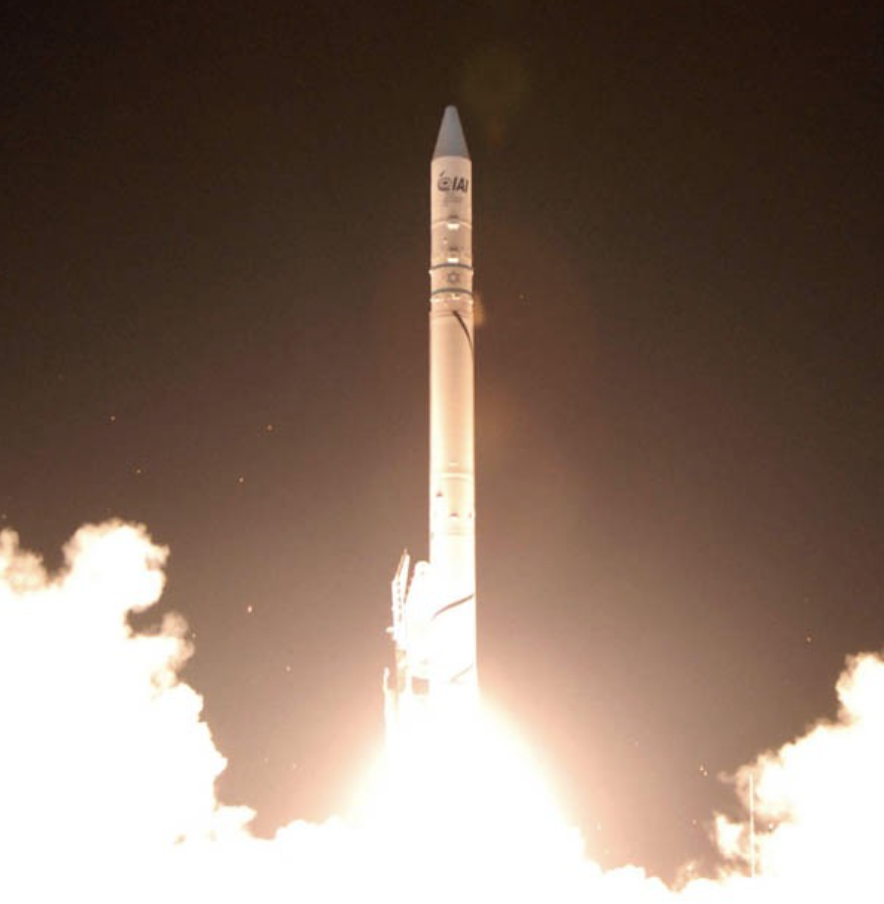
Israel’s presence above the Earth reaches back nearly four decades. The country launched its first satellite, Ofek-1, in 1988, joining a small club of nations capable of placing a satellite in orbit with their own rockets. The most recent in the series, Ofek-19, launched from Palmachim Air Base on September 2, 2025.
Israel joins the United States, Russia, China and India, all of which have explored warfare in space, including the targeting of rival satellites. The militarization of space began with the Soviet launch of Sputnik in 1957, and the 1967 Outer Space Treaty banned weapons of mass destruction in orbit.
Zamir’s appointments included two other notable new commands. Brig. Gen. “Yud” will head a new Robotics Division within the Depth Corps, a first step toward the unmanned systems and artificial intelligence branch Zamir announced last month. Lt. Col. “Resh” will be promoted to colonel to command the 500th Armored Brigade, which was shut down in 2003 and is now being reopened.
The Army of Heaven
While it seems anachronistic, the new Space Division has its roots in the Bible. Israelis call their military Tzahal, an acronym for Tzva HaHaganah LeYisrael, the Israel Defense Forces. The root word, tzava, means army. The Bible uses that exact word for the stars from the first chapter of creation.
“And the heaven and the earth were finished, and all the host of them.” (Genesis 2:1)
The Hebrew word translated as “host” is tzeva’am, “their army.” In the language of the Bible, the stars are tzeva hashamayim, the army of heaven, arrayed in ranks and positions like soldiers. The prophet Isaiah describes God mustering them like a commander taking roll call:
“Lift up your eyes on high, and see: who hath created these? He that bringeth out their host by number, He calleth them all by name; by the greatness of His might, and for that He is strong in power, not one faileth.” (Isaiah 40:26)
That is the source of one of the most frequent names for God in the Bible, Hashem Tzeva’ot, translated as “the LORD of Hosts.” It means, literally, the God of armies, Commander of the forces of heaven and earth alike.
The Bible records a battle in which those heavenly forces fought for Israel. When the Canaanite general Sisera came against Israel with 900 iron chariots, the most advanced military technology of his day, the prophetess Deborah and the commander Barak led the Israelite tribes to victory at the Kishon River. In the song Deborah sang afterward, she described a war fought on the ground and in the heavens at once:
“They fought from heaven, the stars in their courses fought against Sisera. The brook Kishon swept them away, that ancient brook, the brook Kishon. O my soul, tread them down with strength. Then did the horsehoofs stamp by reason of the prancings, the prancings of their mighty ones. ‘Curse ye Meroz,’ said the angel of the LORD, ‘curse ye bitterly the inhabitants thereof, because they came not to the help of the LORD, to the help of the LORD against the mighty.'” (Judges 5:20-23)
In the middle of her victory song, Deborah stops to deliver a curse. Meroz appears nowhere else in the Bible, and the verse names only its crime: when the battle came, Meroz stayed out of it.
The Talmud (Moed Katan 16a) records that Barak placed Meroz under a ban, sounding 400 shofarot, ram’s horns, to proclaim it. The Talmud then cites the opinion that Meroz was a kochav, a star or planet, and Rashi brings this explanation in his commentary on the verse. The reading flows from the text itself. The curse follows immediately after the stars fight from their courses, and it falls on “the inhabitants thereof.” Later commentators, including Rabbi Pinchas Eliyahu Horowitz in Sefer HaBrit, read the verse as a source for life on other worlds, a subject Israel365 News explored when Steven Spielberg’s film Disclosure Day raised the question of contact with aliens.
The stars did not merely shine over the battlefield. They participated in it. Every star in the army of heaven was called to fight Sisera, and the one that failed to take its position was cursed as bitterly as any Israelite town that stayed home.
The Bible also warns any enemy who believes the heavens offer protection. The prophet Obadiah addresses Edom, the nation descended from Esau, which grew arrogant over its mountain strongholds:
“Though thou make thy nest as high as the eagle, and though thou set it among the stars, I will bring thee down from thence, saith the LORD.” (Obadiah 1:4)
Iran is building weapons to destroy satellites. The Houthis have fired ballistic missiles that left the atmosphere on their way to Eilat. Israel answered the first threat by destroying Iran’s military space facility in Tehran, and the second by intercepting a missile in space.
Israel is now sending its own soldiers to take up positions among the stars. The army of Israel and the army of heaven share a name in Hebrew, and with the appointment of Brig. Gen. “Shin,” they share a battlefield. Deborah’s song records how that war is won: Israel fights on the ground, the stars fight from their courses, and the curse of Meroz falls on any power, on earth or in heaven, that stands aside.
