

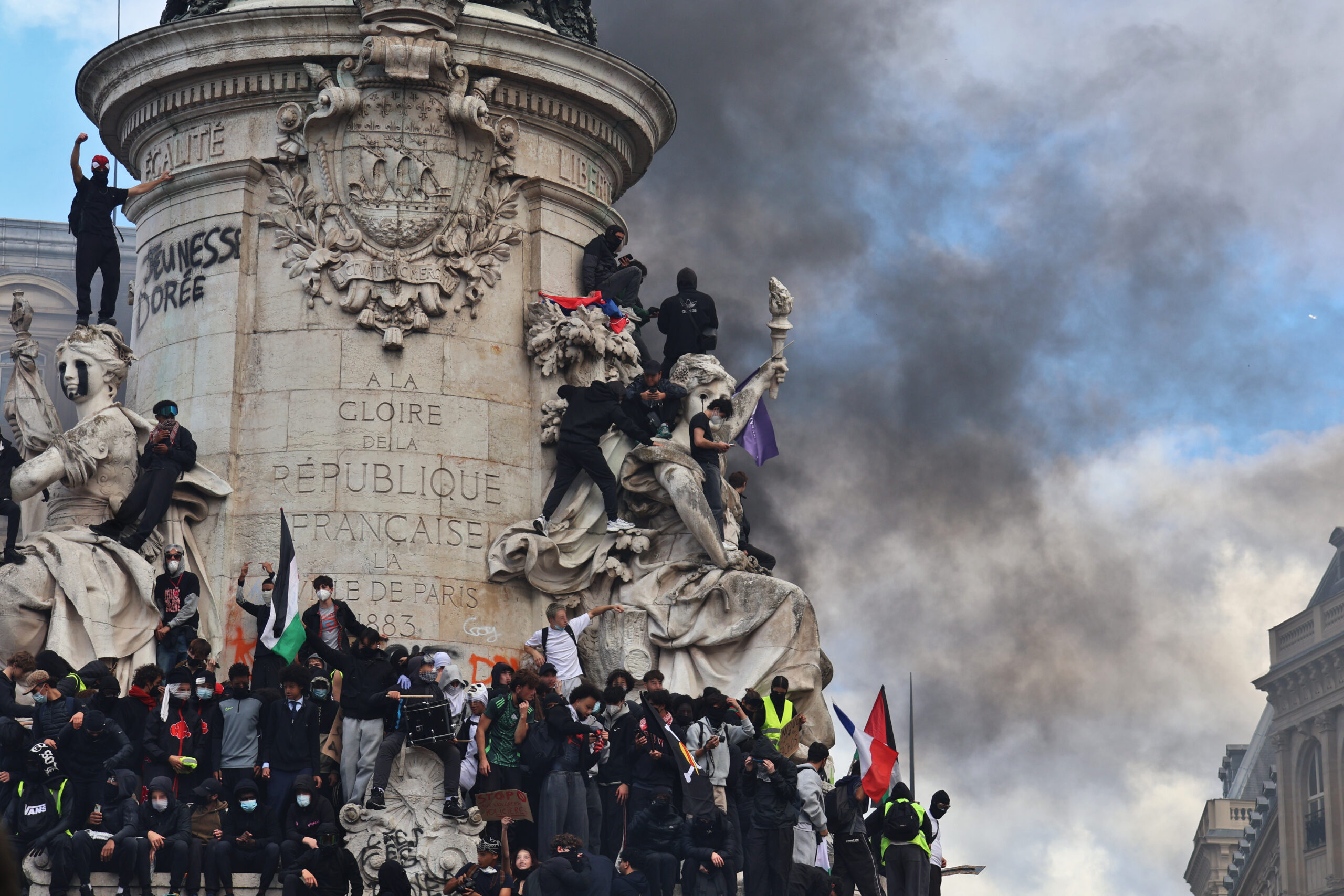
A synagogue in Paris was ransacked, and Jewish-owned shops in Marseille were set ablaze over the weekend as cost-of-living protests across France erupted into the country’s worst riots in decades, marked by Palestinian flags and chants of “Intifada.” Vandals broke into the temporary sanctuary of the Ohalei Yaakov congregation on Rue Burnouf in Paris’s 19th arrondissement overnight Saturday, scattering prayer books and tefillin (phylacteries) across the floor and searching the rabbi’s office. In Marseille, home to one of Europe’s largest Jewish communities, the head of the local Jewish umbrella organization called for a state of emergency and the deployment of the army.
The weekend of October 17–18 brought some of the worst urban violence France has seen in decades. The Interior Ministry reported nearly 2,400 arrests on Saturday alone and almost 1,000 police officers and gendarmes injured, seven seriously. Paris police made a record 855 arrests in the capital. Rioters burned the 143-year-old town hall in Limoges, broke into Marseille’s city hall and defaced it, torched the tourist office in Lyon, and invaded the prefect’s residence in Bordeaux. France’s Retail and Trade Federation estimated that around 1,500 businesses were damaged, with losses in the hundreds of millions of euros.
The unrest began in late September with high school students in the working-class suburbs north of Paris protesting teacher shortages and crumbling classrooms. On Saturday, the student movement merged with union marches and the Yellow Vests against fuel prices and inflation. The Interior Ministry counted 550,000 marchers nationwide; the CGT union put the figure at 800,000.
🇫🇷✡️ BREAKING: Ohalei Yaakov Shul in Paris’ 19th arrondissement was vandalized amid the widespread protesting and unrest across France, attacks on police stations and looting. pic.twitter.com/NlIzuVWNfk
— Belaaz News (@TheBelaaz) October 18, 2026
The flag that kept appearing
The demands were economic, but the imagery told a different story. The Jewish Telegraphic Agency reported that Palestinian flags and keffiyehs were a recurring motif in most of the violent protests, vandalism, and looting. On Paris’s Boulevard des Capucines, “Free Gaza” was scrawled across a shop’s security shutter. In Lyon, “Free Palestine” graffiti appeared beside smashed storefronts. On Sunday, an AFP photographer captured a man in a keffiyeh hurling a bicycle onto a street fire in Paris.
In Marseille, Bruno Benjamin, president of the Marseille-Provence branch of CRIF, the umbrella body of French Jewish institutions, reported that many marchers carried Palestinian flags and chanted “Intifada,” the Arabic word for “uprising” and the name given to the two waves of Palestinian terror that began in 1987 and 2000, which included suicide bombings, shootings and stabbings.
“What we’re seeing today in the streets of Marseille is intolerable,” Benjamin said. “The looting, the violence, and the attacks on law enforcement are neither social demands nor acts of resistance. They are acts of delinquency that must be punished with the utmost severity.”
He added: “Israel has shown its determination in the face of terrorism. France, too, must enforce its authority against those who defy its laws. The Republic cannot tremble before rioters.”
Benjamin told JNS that France needs to “declare a state of emergency, send in the army, massively increase law enforcement personnel and arrest these rioters and vandals by every means.”
The same pattern surfaced across the Alps. In Milan, a cost-of-living march featuring Palestinian symbols degenerated into looting, and police cleared the cathedral square with tear gas.
“Stop gassing us, we are not Jews”
A masked rioter in Paris held up a handwritten sign on Saturday that read “Stop gassing us, we are not Jews.”
The rioter stood in front of a pile of burning bicycles, his face wrapped in cloth, holding a cardboard sign that read: “Arrêtez de nous gazer, nous sommes pas des Juifs.” The slogan protested police tear gas by casting gassing as something reserved for Jews, a direct reference to the Nazi gas chambers. The Combat Antisemitism Movement posted the image to its X account. French Jewish outlet Israj reported it alongside the keffiyehs and Palestinian flags worn by many rioters. Germany’s Jüdische Allgemeine, reporting on a video of the scene circulated by a French Jewish news channel, called it undisguised Jew-hatred using social protest as its cover.
🇫🇷 France, Oct 17, 2026:
— Combat Antisemitism Movement (@CombatASemitism) October 19, 2026
"Stop gassing us, we are not Jews."
Streets on fire. And a rioter joking that gas is for Jews.
It starts with the Jews. It ends with everyone else. pic.twitter.com/eC4CVasBEe
Targeted or caught in the fire
The question of whether Jews were singled out has divided observers. Appearing on CNews, French journalist Paul Amar said the rioters “came prepared,” had the addresses of Jewish shop owners, and that on one street in Marseille “all businesses owned by Jews were set on fire” while Muslim-owned shops were left alone.
The SPCJ, the Jewish community’s security service founded in 1980 after the Rue Copernic synagogue bombing, confirmed that Jewish-owned businesses in Marseille were among those damaged but said it had found no evidence they were chosen because their owners were Jewish. Marseille police said the looting there had “no connection” to anti-Jewish hatred. A member of the Ohalei Yaakov committee said the synagogue break-in pointed primarily to attempted theft, though nothing appeared to be missing.
Sacha Roytman Dratwa, CEO of the Combat Antisemitism Movement, placed the weekend in a longer frame. He said the events “are not comparable to the Holocaust,” but warned that “by Kristallnacht, the warning signs had been visible for years. The world had already lost precious time. Europe cannot afford to keep making excuses until it is too late. What starts with the Jews never ends with the Jews.”
The numbers behind that warning are stark. France’s Interior Ministry recorded 1,320 antisemitic acts in 2025. Jews make up less than one percent of the French population and were the targets of 53 percent of all anti-religious incidents.
The political fallout
President Emmanuel Macron addressed the nation Sunday night. “Tonight, we all feel anger and shame,” he said, blaming “agitators from ultra-left fringe groups, joined by numerous delinquents” for “unbridled violence in our cities.” He vowed: “Those who have destroyed must pay.” Interior Minister Laurent Nuñez offered his resignation and admitted a “loss of control” in some cities; Macron refused it. Justice Minister Gérald Darmanin said the government “undoubtedly failed this weekend.” Prime Minister Sébastien Lecornu ordered partial curfews for Monday night.
President Trump weighed in on social media: “France is burning! The immigration of people from an entirely different world, people with hatred in their hearts, has shattered that once great country.” Vice President JD Vance suggested France had “imported the third world.” Far-left leader Jean-Luc Mélenchon accused the authorities of inflaming tensions. Marine Le Pen, frontrunner in next year’s presidential race, said the government was “running on fumes.”
The banners say bread, fuel, and teachers. The chants say “Intifada.” The cardboard sign in Paris says the quiet part out loud. Hatred of Jews has always borrowed the clothing of whatever grievance is fashionable that season: the treasury in Shushan, the economy in Weimar Germany, Gaza in Paris. The disguise changes. The target stays the same.
French Jews are reading the signs the same way. More than 4,000 have moved to Israel so far this year, the highest pace in a decade. The police may still be weighing whether a shop in Marseille burned by accident or by design. The banner in the street says bread. The flag beside it says intifada. The sign in the rioter’s hands says gas the Jews. The Jews of France have learned to read all three.

