By David Nekrutman
Jewish educator David Nekrutman explains how Jews and Christians read the same word, “Matriarch,” differently, leading to two very different ways of reading Genesis. He is asking readers to take part in a survey on how they study the Bible and relate to Sarah, Rebecca, Rachel, and Leah.
Sometimes the most meaningful bridge between Jews and Christians is not a reaction to headlines or geopolitical strife, but an intentional, shared encounter with the Scriptures that connect us.
For more than two and a half decades, I have taught the Bible to Christian audiences through a Hebraic lens. Over the years, I have come to appreciate a foundational truth that continues to shape my work: one of the most transformative ways to build relationships between Jews and Christians is to open the sacred texts together.
Too often, our conversations only gain momentum when Israel is in crisis. War, antisemitism, political turmoil, and the physical safety of the Jewish people rightly draw the focus and concern of Christians who stand with Israel. These conversations are vital. Yet I am convinced that our relationship becomes far more durable when it is anchored not solely in moments of shared grief or external threats, but in the living words of Scripture.
When Jews and Christians open the Bible side by side, it transcends a mere academic exercise. It becomes an encounter that can sanctify our shared spaces—a time to deepen our understanding of God, examine our lives, and uncover layers of meaning that might otherwise remain obscured.
How do we foster that kind of encounter?
Through years of teaching and learning from my own missteps, I have adopted a simple rule with profound implications: Never assume your audience knows what you know, and never assume you fully know the lens they bring to the text.
When Familiar Words Carry Different Meanings
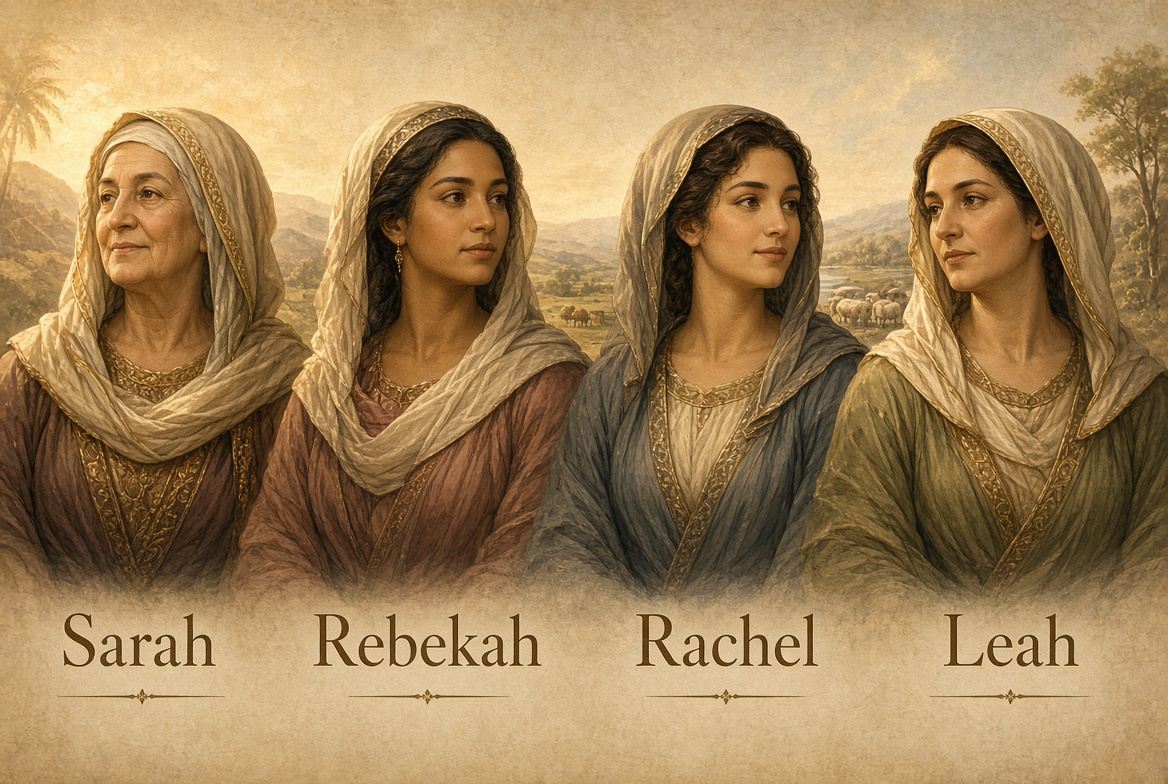
Recently, while preparing a lesson on Sarah’s dialogue in Genesis 16, I spoke about the biblical Matriarchs. In Jewish tradition, the four Matriarchs—Imahot in Hebrew—are Sarah, Rebecca, Rachel, and Leah. They stand beside Abraham, Isaac, and Jacob as the foundational ancestors in the narratives of Genesis.
Yet the Hebrew Bible itself never uses Imahot as a formal, collective title for these four figures. That designation emerged later within rabbinic tradition, becoming an enduring part of how Jewish memory organizes the story of Israel.
To a Jewish listener, the term Matriarch immediately calls to mind those four women. But when I used the expression in a broader gathering of Christians, someone named Esther.
At first, I caught myself. My initial impulse was to view the answer as a mistake through the Jewish framework I inhabited. But upon reflection, I realized the person was using “matriarch” more broadly: to describe a woman of extraordinary faith, grit, and spiritual stature whose courage had profoundly shaped their walk with God. Esther, after all, risked her life to save her people, inspiring countless generations.
The response was not an error; it was an invitation to recognize that different faith communities bring distinct lenses and vocabularies to the very same stories.
Sarah: Matriarch in Genesis, Exemplar in the New Testament
This dynamic becomes even clearer when we look closely at Sarah herself.
In Genesis 16:2, Sarah addresses Abraham out of the pain of her barrenness and proposing that he father a child with her Egyptian servant, Hagar. Her words spark a series of decisions that profoundly alter every life involved.
“See now, The Eternal has restrained me from having children; come now to my handmaid perhaps I will be built-up through her.”.
Why does the Torah place Sarah’s raw, vulnerable dialogue before us at this exact juncture? What does it reveal about her longing, her pain, and her effort to wrestle with God’s unfulfilled covenantal promise to Abraham?
These questions invite us into the human core of Genesis—where heroes of faith are never presented as flawless archetypes, but as real people enduring profound uncertainty, waiting, and grief. Rabbinic commentary explores the subtleties of Sarah’s Hebrew phrasing, debating her motivations, her agency, and the complexities within the household.
At the very same time, Christian readers approach Sarah with an additional layer of theological memory shaped by the New Testament:
- Faith in the Impossible: In Hebrews 11:11, Sarah is celebrated in the great “hall of faith,” recognized for considering God faithful to fulfill His promise, which empowered her to conceive Isaac well past the natural age of childbearing.
- Hope, Dignity, and Holy Conduct: In 1 Peter 3:5–6, Sarah is held up as a model of holy women of the past whose inner beauty was defined by trust in God and respectful devotion—holding Abraham in high honor without being paralyzed by fear.
- The Living Word of Promise: In Romans 4:19 and Romans 9:9, Paul highlights Sarah’s barren womb as the place where human capability ended and divine power began.
When Jews and Christians, in the sacred space of Jewish-Christian relations, to discuss Sarah together, the portrait expands. Neither reading invalidates the other. Rather, when brought into honest conversation, they illuminate both the messy realities of the Genesis narrative and the enduring theological weight of God’s faithfulness across generations.
The Responsibility of Mutual Translation
Teaching across traditions requires us to articulate the frameworks we take for granted.
A concept rooted in rabbinic literature may be entirely novel to a Christian reader. Conversely, the ways the New Testament interprets figures like Sarah or Abraham may not be immediately familiar to a Jewish thinker. Neither group should be expected to intuitively possess the other’s interpretive heritage.
This does not mean watering down our traditions or homogenizing our distinct identities. To the contrary: explaining the origins of our perspectives invites our partners into the depth of our traditions.
When we introduce Sarah not merely as a character on a page, but as a bridge across Genesis, rabbinic commentary, and apostolic reflection, teaching shifts from a one-way lecture into genuine mutual discovery. The goal is not to force uniformity of interpretation, but to foster intellectual humility, sharpen our questions, and rediscover the living power of Scripture.
Beyond Crisis Toward Common Ground
I remain profoundly grateful for the Christian friends and communities who consistently stand in solidarity with the Jewish people, especially during dark and vulnerable seasons in Israel’s modern history. Their friendship in times of crisis is an irreplaceable blessing.
Yet if our relationship only activates during crisis, we miss the fullness of what we are called to build.
We can gather around the biblical text not merely to react to current events, but to study, listen, and grow together. Before we can invite each other into the depth of our perspectives, we must be willing to listen first, understand the frameworks our partners bring, and provide the context that welcomes genuine dialogue.
Join the Conversation: A Brief Reader Survey
Engaging Scripture across traditions is not a one-way lecture; it is an ongoing, shared exploration. To help me better understand the perspectives, traditions, and questions you bring to these foundational narratives, I would love to hear your personal reflections.
Take a moment to read through the poll below and send your answers to david@theisaiahprojects.com.
Which Matriarch Speaks to Your Soul?
Sarah. Rebecca. Rachel. Leah.
Four women. Four extraordinary stories. Four lives woven into the foundations of our faith. But how do we relate to them today? Do we see them as spiritual role models, complex human beings, or women whose struggles still speak to our own?
Please let me know your thoughts on two questions by sending an email with your answers to david@theisaiahprojects.com:
1. Which of the four Matriarchs has had the greatest influence on your life, if any?
- Sarah
- Rebecca
- Rachel
- Leah
- More than one equally
- None of them
- I don’t know enough about them to answer
2. How do you primarily view the Matriarchs?
- Spiritual role models
- Historical figures
- Complex human beings whose stories reveal life’s struggles
- Examples of both admirable and questionable behavior
- Ancestors who shape my religious or cultural identity
- Characters whose stories I know but rarely think about
There are no right or wrong answers. I’m interested in how people of faith actually encounter these women—not just as names on a page, but as human beings whose stories invite us to reflect on faith, family, choices, and the complexities of life.