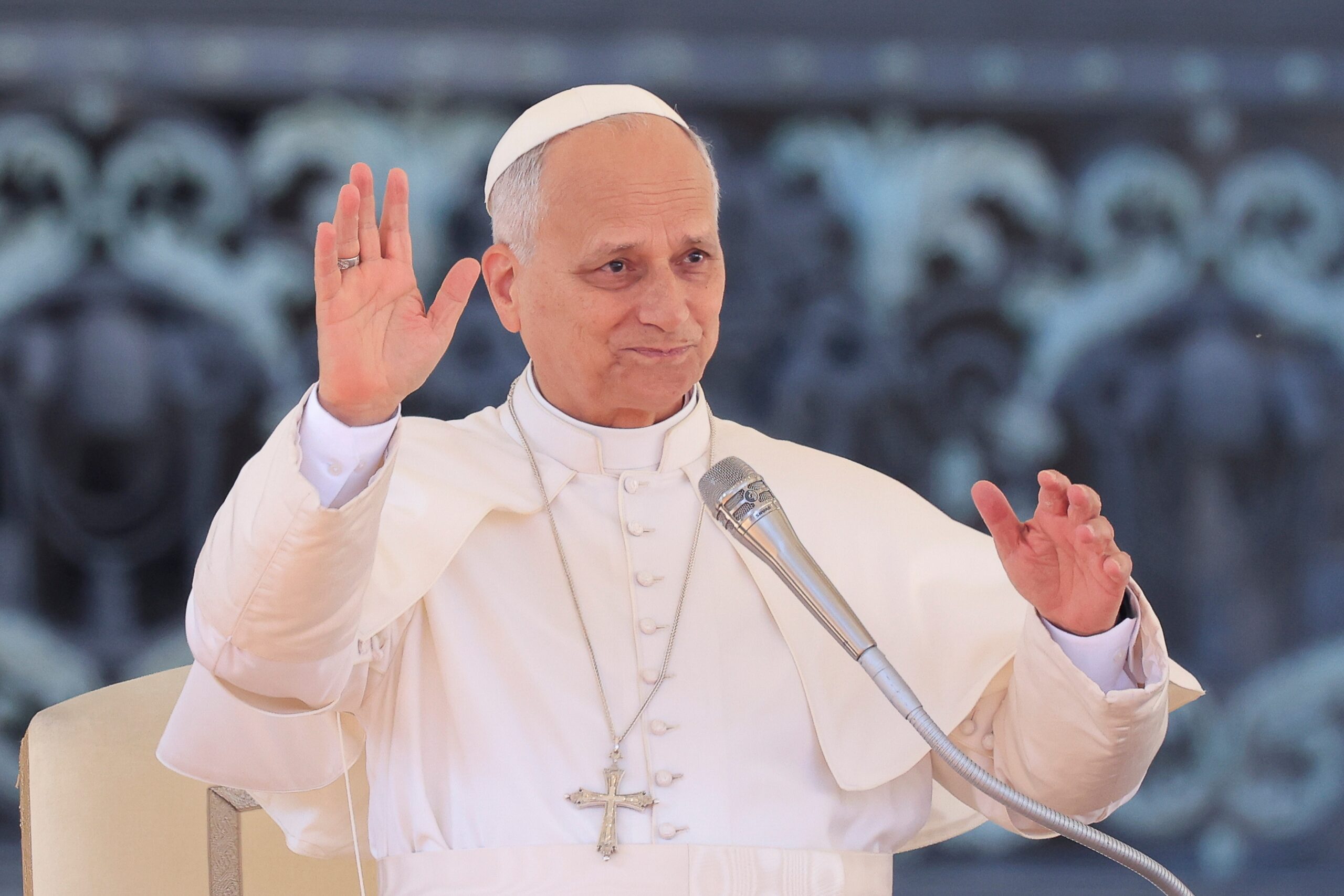
A 13-year-old girl who fled the war in Ukraine stood outside Rome’s Gemelli hospital on Saturday holding a felt doll made to look like the pope. Ten months earlier, Pope Leo XIV had embraced her in St. Peter’s Square as she awaited cancer surgery. This time, the pope was the cancer patient. Varvara told him their December hug had given her “the strength to overcome the illness that, fortunately, I have now beaten.”
The 71-year-old pontiff walked out of the hospital unaided, four days after surgeons removed a nodule that was determined to be pulmonary adenocarcinoma, the most common type of lung cancer. He is scheduled to lead the noon Angelus prayer on Sunday from the window of the Apostolic Palace, his first official duty since the operation.
An Announcement From the Window
Leo broke the news himself on October 11, telling pilgrims at his weekly Sunday prayer that doctors had found a small growth on his lung during a recent health check. “It was detected at a very early stage and is well contained,” he said, adding that “following their advice, I have decided to undergo surgery to remove it.”
The Vatican’s wording that day was careful. The Holy See did not disclose that the tumor was malignant until after the surgery, and later confirmed that the pope had undergone a biopsy before he was admitted to Gemelli.
The Surgery
Leo left the Vatican shortly before 1 p.m. on Tuesday, October 13, waving from the back of a black SUV as his convoy drove about 9 km north to the hospital. A medical bulletin from his lead surgeon, Professor Stefano Margaritora, and his personal physician, Dr. Luigi Carbone, said the lower lobe of the right lung was removed using a video-assisted technique, with the stated aim of making the procedure curative. Human lungs have five lobes, three in the right lung and two in the left.
The operation lasted about 90 minutes, after which Leo awoke normally and returned to his room on the hospital’s 10th floor.
Margaritora, Gemelli’s chief thoracic surgeon, later revealed that the cancer was found by accident. The nodule turned up during routine abdominal examinations, appearing as a small spot at the base of the lung near the diaphragm. Had it been higher up, the surgeon said, it would certainly not have been seen. The pope had no respiratory symptoms and felt perfectly well.
The surgeon acknowledged the weight of the moment, saying the operation stirred deep feelings because this was the first pope, at least in modern history, to undergo surgery for a malignant tumor.
What Doctors Still Don’t Know
The diagnosis is confirmed. The prognosis remains open. Experts said a full assessment requires knowing the size of the tumor and whether the cancer reached the lymph nodes, information the Vatican has not released.
“While we have the diagnosis, we do not yet have the stage,” said Dr. Stephen Liu, a lung cancer expert at Georgetown University. Liu told Reuters that a small cancer with no lymph node involvement would likely be cured by surgery alone, while wider spread would point to a poorer prognosis.
Histological testing of the tumor and related lymph nodes is underway. The results, along with the tumor’s molecular and genetic profile, will determine whether the pope needs chemotherapy, chemotherapy combined with immunotherapy, or targeted oral therapy.
A Pope in a Hurry
Leo recovered fast and went back to work from his hospital bed. He held a phone call with Russian President Vladimir Putin, met with top aides and celebrated Mass in a makeshift hospital chapel. Medical bulletins said he was carrying on “normal daily activities completely on his own.”
At that Mass, Leo presided alone, distributing Communion to medical staff and Vatican gendarmes. Vatican spokesman Matteo Bruni said the pope used his homily to thank the hospital staff for their daily care of the sick and for what they had done for him.
The Holy See Press Office announced Saturday morning that the pope would be released. His physicians said blood tests and a chest X-ray that morning confirmed his condition allowed him to go home. Leo celebrated Mass once more on the hospital’s 10th floor before returning that afternoon to the papal apartments, days ahead of the week-long stay the Vatican had first projected.
Asked how he felt as he was driven away, the pope answered, “I am much better, thank you.”
Margaritora gave his first extended account of the pope’s condition in an interview with Andrea Tornielli, editorial director of the Vatican’s Dicastery for Communication. The surgeon said the pope “truly put his heart” into his treatment and could be “fully recovered” in about ten days. He added that the recovery had required very little help from the medical team and praised the pope’s determination.
The Girl From Berdyansk
Varvara’s family fled the fighting in Ukraine and found refuge in Chernivtsi, where she was diagnosed with cancer in 2025. A humanitarian group evacuated her from Lviv to Italy for treatment in Turin. MRI and CT scans taken days before the pope’s discharge came back clear. She traveled by train with her parents, Dmytro and Iryna, from their new home in Castellamonte to greet him.
Her gifts were a framed photograph of their December embrace and the felt doll, modeled on a stuffed toy named Basik that she carried out of Berdyansk. When she first arrived in Turin, she described Basik as the only friend she had since the war began. She told Vatican News she wanted the pope’s doll to accompany him on his own road to recovery, the way Basik had accompanied her. The pope blessed her and thanked her, with a Ukrainian priest translating.
Latin America Trip On Track
Margaritora cleared the pope for his most demanding trip of the year. Leo is scheduled to visit Uruguay, Peru and Argentina from November 6 to 17, a journey with a dozen flights and two helicopter rides to high altitudes. The surgeon told Vatican News there are “no clinical reasons” why the trip should not take place. Oncology surgeons say protocols generally clear patients to fly after three weeks if recovery allows, and the Vatican has already published the list of journalists accredited to fly on the papal plane.
A Healthy Pope, A Family History
The diagnosis surprised many observers. Leo plays tennis and swims weekly, and he does not smoke. Cancer runs in his family: his mother, Mildred, died of cancer in 1990 at age 77.
His predecessor offered a sharp contrast. Pope Francis was hospitalized several times as he grew frail and died at 88 in April 2025.
The pope is the ultimate earthly authority for 1.4 billion Catholics and has no deputy who steps in when he is sick. When a pope is incapacitated, the Vatican bureaucracy carries on and holds off on any decisions requiring papal approval.
From Chicago to Peru to Rome
Leo was born Robert Prevost in Chicago in 1955 and served for decades as a missionary and bishop in Peru. A member of the Augustinian order, he became a naturalized Peruvian citizen and later headed the Vatican office that selects bishops worldwide. The cardinals elected him on May 8, 2025, making him the first American pope. Halfway through his first speech from the balcony of St. Peter’s, he switched from Italian to Spanish to greet his former diocese of Chiclayo, Peru.
This is his second brush with serious illness. In 1985, as a young priest, he contracted typhoid fever in Chulucanas, Peru, and was hospitalized. He later recalled that the pain was so severe he asked God to let him die, and he took his survival as a sign that he was still needed on earth.
The Pope and the Jews
Leo opened his papacy with a direct message to the Jewish world. In personal letters to Jewish leaders, including Rabbi Noam Marans, director of interreligious affairs at the American Jewish Committee, the new pope pledged to “continue and strengthen the church’s dialogue and cooperation with the Jewish people,” in the spirit of Nostra Aetate. That 1965 Vatican declaration rejected antisemitism and the charge of collective Jewish guilt for the death of Jesus, and affirmed the enduring covenant between God and the Jewish people.
Leo’s formation runs through Chicago, a city AJC describes as a virtual laboratory for Catholic-Jewish relations. As a newly ordained priest in 1982, Prevost studied under Rev. John Pawlikowski at Chicago’s Catholic Theological Union, where Pawlikowski co-founded the school’s Catholic-Jewish Studies Program and made the fight against antisemitism a core lesson of his course on Catholic social teaching. Pawlikowski remembered Prevost as a committed student of the Second Vatican Council’s reforms, including Nostra Aetate.
Jewish observers also watched his choice of papal name. AJC noted that his namesake Leo XII, who took power in 1823, stripped Jews of property rights and revived medieval persecution that drove Jews out of Italy. Leo XIV’s choice points instead to Leo XIII, author of the 1891 encyclical Rerum Novarum, which grounded the Church’s social teaching on human dignity.
Marans flagged the pressure point early. He said the strain in Catholic-Jewish relations caused by Pope Francis’ criticism of Israel meant Leo’s views on the war would be closely watched. AJC also pointed out that most of Leo’s ministry was spent in Peru and inside the Vatican, where he likely had little regular contact with Jews, and that his loyalty to the Global South ties him to a region where anti-Israel sentiment runs high.
The Pope and Israel
Leo’s record on Israel has answered that question. In July 2025, after an Israeli strike hit the Holy Family Church, Gaza’s only Catholic church, Leo spoke by phone with Prime Minister Benjamin Netanyahu and renewed his call for negotiations and a ceasefire. Netanyahu, who initiated the call, said Israel deeply regretted the strike and blamed a stray round. The following month, Leo demanded that Israel end “collective punishment” in Gaza, while also calling for the release of hostages held by Hamas.
In September 2025, Leo told visiting Israeli President Isaac Herzog that the two-state solution was the only way out of the conflict. That plan calls for the creation of an unprecedented Palestinian state inside Israel’s borders, militarized and ethnically cleansed of Jews, with its exclusively Muslim capital in Jerusalem, centered on Judaism’s holiest site, the Temple Mount.
He doubled down on the flight from Istanbul to Beirut that November. “We know that in this moment, Israel doesn’t accept this solution,” he told reporters. “We are also friends with Israel,” he added, casting the Vatican as a mediator.
The pope has kept pressing. In his January 9, 2026 address to the Vatican’s diplomatic corps, Leo described two states as the framework for meeting the aspirations of both peoples. At the Angelus in Castel Gandolfo on August 16, after condemning violence against Arabs in Judea and Samaria, he went further: “I urgently call on the international community to work toward advancing the two-state solution.”
Leo is carrying forward a policy his predecessors built over decades. Pius XII called in 1949 for Jerusalem and its holy sites to be placed under an internationally guaranteed legal status. Paul VI appealed to the United Nations on the eve of the 1967 Six-Day War to declare Jerusalem an open city. John Paul II, in his 1984 apostolic letter Redemptionis Anno, paired a call for security for the Jewish people in Israel with a demand for a Palestinian homeland. Benedict XVI endorsed a sovereign Palestinian state during his 2009 visit, and Francis hosted Shimon Peres and Mahmoud Abbas for a prayer for peace in the Vatican Gardens in 2014, a year before the Holy See signed an agreement formally recognizing a “State of Palestine.” Vatican News presents the record as nearly 80 years of unbroken papal policy that has endured despite the Israeli government’s firm rejection.
Netanyahu has said Israel’s opposition to a Palestinian state has “not changed one bit.”
For now, the pope who wants to mediate the Middle East is waiting on a lab report. The pathology on his lymph nodes will determine whether last Tuesday’s surgery ended the fight or only opened the first round.
Runs about 1,900 words. If the Angelus goes ahead this afternoon and he says anything about his health, send it over and I’ll update the lead.
Sources:
Jerusalem Post · Times of Israel · Vatican News (discharge) · Vatican News (Varvara) · Vatican News (two states) · AJC · AP via ABC30 · CNN · NPR · Reuters via The Star · Vatican News (Netanyahu call) · AP via WALB · Jewish News