




A wave of non-Jews publicly declaring themselves Zionists has swept across X in the past two weeks, with Christians and Catholics prominent among those posting. A Jerusalem Post data analysis counted 613 posts from 549 separate accounts between October 4 and October 11, each following the same three-part formula: a denial of Jewish identity, a statement of nationality or faith, and a declaration of Zionism. Dutch writer Bart Schut summed up the format on October 11: “I’m not Jewish. I’m a Dutch atheist. And I am a Zionist.”
The trend built slowly before erupting. The Post counted three matching posts on October 4, 13 on October 5, 10 on October 6, 22 on October 7, and 26 on October 8. On October 9, two days after the third anniversary of the Hamas massacre, the number jumped to 131. Another 270 appeared on October 10, followed by 138 on October 11 before data collection ended. Roughly 88% of the posts appeared from October 9 onward.
Posters identified as American, Canadian, German, Finnish, Irish, Italian, New Zealander, English, Polish, Australian, British, Dutch, Czech, Japanese, Portuguese, and Nigerian. Many added a religious identity, with Christians and Catholics appearing alongside atheists, agnostics, Hindus, and Muslims. Most accounts posted only once, and the Post found no sign of a centrally organized campaign. Israeli X user Oren Barsky wrote on October 9 that the trend ranked among the most moving things he had seen on the platform, and two days later he reported it had taken over his feed.
“Some People Are Zionist! Get Over It!”
The first posts appeared on October 4, the same day Britain’s Green Party conference voted 1,022 to 813 to pass a motion declaring “Zionism is racism.”
On October 10, the British activist group Our Fight, made up mainly of non-Jews, answered with a campaign beside the Winston Churchill statue in Parliament Square. Activists wore T-shirts reading “Some people are Zionist! Get over it!” and held signs reading “PROUD ZIO,” reclaiming a term used as a slur against Zionists. Our Fight founder Mark Birbeck told GB News that the definition is simple: “that’s all Zionism is: the right of Jews to have a homeland.” According to the group, Birbeck was escorted out of the Green Party conference hall and stripped of his pass after standing at the front of the room in a campaign T-shirt.
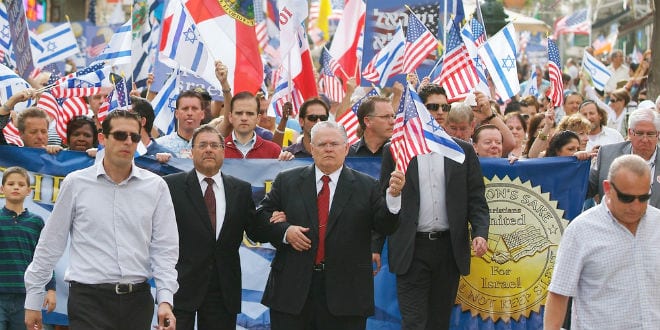
The X declarations follow a major show of Christian support in Jerusalem. On October 7, Christian leaders from 122 countries gathered in the capital to mark the anniversary of the massacre. Mike Evans, founder of the Friends of Zion Heritage Center, told Fox News Digital that “the vast majority of Zionists in the world are not Jewish,” adding that they are Bible-believing Christians. George Deek, Israel’s Special Envoy to the Christian World, told the outlet that the presence of Christian leaders sends a message that Israel does not stand alone.
From Guilty Secret to Public Declaration
For many young Christians, the public declarations mark a shift from quiet sympathy to open advocacy. In a 2021 essay for Jewish News, Rachel Carey, then a second-year politics student in Britain and an Emerson Fellow with StandWithUs UK, described Jewish friends asking her why a gentile would take up Israel advocacy on campus. She wrote that she cares about Israel as a Christian, a politics student, and a human being opposed to anti-Jewish hatred, and that her university friends who sympathized with Zionism admitted it timidly. Support for Israel, she wrote, “should not be treated like a guilty secret.”
Carey was raised by Christian Zionist parents. When she was nine, her parents discovered the history of Christian antisemitism and the theology that had justified centuries of violence against Jews, and were appalled that no one had ever taught it to them. The family began studying the Jewish roots of Christianity and Israel’s rebirth as a nation, and came to admire Jewish practices including the weekly rest of Shabbat, the Sabbath, an atmosphere of blessing, and the centrality of family. She called on non-Jewish students to stand shoulder to shoulder with their Jewish friends, without speaking over them, even when it is unpopular.
Five years later, hundreds of non-Jews posted the secret openly under their own names.
A War Inside the Church
The online declarations come amid a bitter fight within Christianity over whether a believer may embrace Zionism at all.
On January 17, the Patriarchs and Heads of the Churches in Jerusalem, including the Greek Orthodox Patriarchate and the Latin Patriarch, Cardinal Pierbattista Pizzaballa, issued a statement condemning “damaging ideologies, such as Christian Zionism,” and accusing outside actors of interfering in the internal life of the churches.
US Ambassador to Israel Mike Huckabee responded on X three days later, defining a Zionist as someone who accepts the Jewish people’s right to live in their “ancient, indigenous, and Biblical homeland.” A September analysis in the Middle East Quarterly argued that the patriarchs’ position reflects Middle Eastern church politics more than authoritative Christian doctrine, and traced Arab Christian opposition to Zionism back to the Ottoman era.
The attacks have come from within American Christianity as well. In August, the Presbyterian Church (USA) hosted a conference titled “Christianity Without Christian Zionism,” building on a 2024 General Assembly resolution calling on the denomination to reject Christian Zionism in all its forms. On the right, Tucker Carlson has branded Christian Zionism a “dangerous heresy,” a charge Evans rebutted in an open letter defending it as biblical belief in the Jewish people’s right to their homeland and inviting Carlson to debate.
Against that backdrop, ordinary Christians posting their nationality, their faith, and their Zionism on X amounts to a grassroots answer to their own church leaders.
Ten Men From Every Language
The prophet Zechariah prophesied around 520 BCE, when a small band of Jews had returned from Babylon to a ruined Jerusalem. He described a future in which the nations would come looking for the Jewish people:
“Thus saith the LORD of hosts: In those days it shall come to pass, that ten men shall take hold, out of all the languages of the nations, shall even take hold of the skirt of him that is a Jew, saying: We will go with you, for we have heard that God is with you” (Zechariah 8:23).
The Hebrew is precise. The ten men come mikol leshonot hagoyim, from all the languages of the nations, and each identifies where he comes from before he speaks. They grab the kanaf, the corner of the garment, where a Jew ties his tzitzit, the ritual fringes commanded in the Bible. The Sages in the Talmud (Shabbat 32b) did the arithmetic: ten men from each of the seventy nations, at each of the four corners of the garment, means 2,800 people attaching themselves to every single Jew.
The men in Zechariah’s vision keep their nations and their languages. They declare where they come from, and then they declare where they stand. Their words are nelcha imachem, “we will go with you,” and their reason is theological: they have heard that God is with the Jewish people.
That reason sits at the core of Christian Zionism. Its adherents ground their support for Israel in God’s first promise to Abraham:
“And I will bless them that bless thee, and him that curseth thee will I curse; and in thee shall all the families of the earth be blessed” (Genesis 12:3).
The Bible frames the relationship between Israel and the nations as a blessing that runs in both directions. The families of the earth receive blessing through Abraham’s descendants, and those who bless Abraham’s descendants are blessed in return. A Christian who calls himself a Zionist is placing himself inside that verse.
The patriarchs in Jerusalem call Christian Zionism a damaging ideology. A Presbyterian conference calls for Christianity without it. Tucker Carlson calls it heresy. Hundreds of Christians, Catholics, and others answered from their own countries, in their own languages, each one reaching for the corner of the garment. Zechariah described them 2,500 years ago.

