



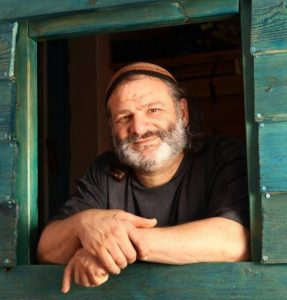
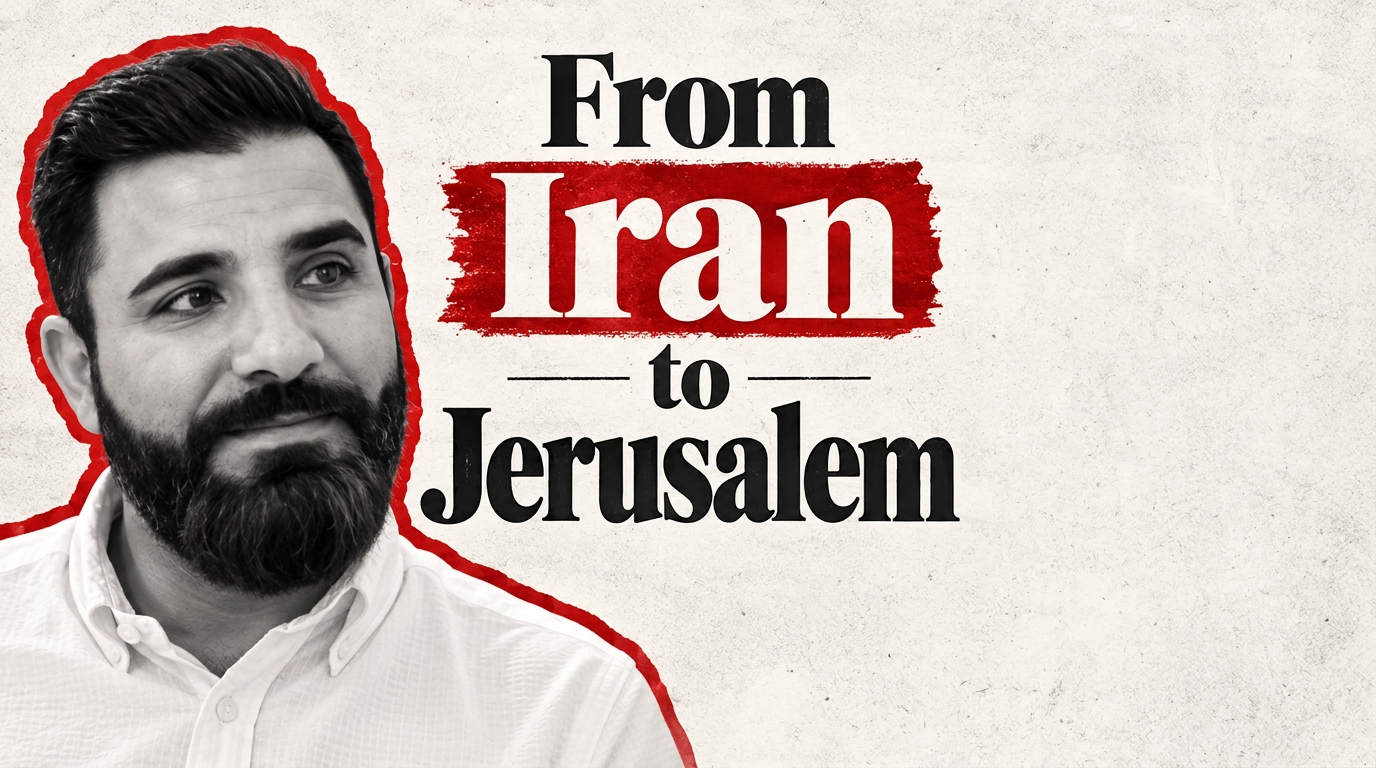
Ramin Parsa, an Iranian-born Christian who fled the Islamic Republic after surviving torture and a stabbing, has been granted temporary residency in Israel after a three-and-a-half-year battle with the Interior Ministry. Parsa, who lives in Jerusalem with his Israeli wife and young son and is expecting a second child, told Israel365 News that he was raised in Shiraz, an hour from the tomb of Cyrus the Great, without ever learning what the Persian king had done for the Jewish people. “Day in, day out, in the school, on TV, the regime’s state media, radio, newspapers, everything was about Islam and Muhammad and Hussein and how we should fight the Jews and Christians and the infidels and the imperialist America and the Zionist Israel,” he said.
Today the Persian king’s name lives on in Parsa’s Jerusalem home. “My son, his middle name is Kuresh, which is Cyrus,” he said.
The permit, issued last month for one year, followed years of rejections. Parsa, who moved to Israel in early 2023, first applied for status in 2024. The ministry rejected him a year and a half later on the grounds that he was born in an enemy state. A court ordered the ministry to reconsider, and on July 13 the reassessment came back with the same answer: leave Israel, or take his wife and son with him. Throughout those years, Parsa was barred from working or traveling abroad. After October 7, he cooked thousands of meals for Israelis displaced from the Gaza border and the north.

The breakthrough came when US Ambassador Mike Huckabee brought the file to Prime Minister Benjamin Netanyahu’s office, which reopened it. Parsa told The Jerusalem Post it was “a miracle, actually, a miracle of God.” The permit was issued under a discretionary provision for people deemed a benefit to the state, and Parsa has since booked speaking trips to South Africa, Germany, and the United States.
Parsa said his story belongs to millions of Iranians. “This will shock the Muslim world,” he said. “I believe that Iran will go from an Islamic country to a Christian country. Already Iran is not an Islamic country. Already millions of Iranians have left Islam.”
The question for readers of the Bible is a pointed one. What did the Hebrew prophets see in a Persian king that led Isaiah to call him God’s anointed, and what does it mean when Persians raised to chant for Israel’s death begin naming their children after him?
“Death to Israel Was Literally Our Prayers”
Parsa described a childhood saturated with hatred of Jews.
“When I was growing up, every morning in the school they told us to shout, ‘Death to America, death to Israel.’ That was literally our prayers every morning,” he said. “They would read the Quran, and it’s cold winter, and we are in the yard of the school, hundreds of students, and they ask us to shout ‘Death to America, death to Israel.’ Flag-burning ceremonies. Quds Day, which is supposed to be Jerusalem Day, they bring the students out, they curse Israel, they burn the flag.”
State television went further. “We had TV shows in Iran that showed Jews chasing a Muslim boy to capture him, to kill him, to use his blood to make matzah,” he said. “The Jews are the only people who are not supposed to drink blood. It’s a command in the Bible.”
His schoolbooks carried the same message. “In our textbook we have pictures of an Israeli soldier pointing a rifle at a Palestinian boy, and the boy is crying, looking so oppressed, and the Israeli soldier looks so mean and ugly. Of course it was a caricature. But they tried to make us hate the Jews and Israel. And at the same time, everything they say Israel is doing to Palestinians, they were doing it to us.”
He saw his first execution as a small boy. “When I was eight, nine, the first time I saw public executions,” he said. “They accuse them of working for Israel or for the CIA or for the Mossad. They arrest innocent people and they execute them by false accusations.”
The regime enforced its rules on the street. “I saw women being beaten on the streets, harassed, beaten, arrested because a little bit of the hair was visible,” he said. “People being beaten for drinking alcohol. They put the Quran under their arms and they start whipping them with a big thick cable in the neighborhood, publicly, to intimidate the people.” Once, he said, he watched morality police tear a T-shirt printed with an American flag off a young man’s body. “The poor guy had to walk home with no shirt.”
His brother was arrested for eating in public during Ramadan. “They wanted to give him forty lashes,” Parsa said.
The Checkpoint
Parsa’s own break came at 16. He was riding to a family wedding with relatives who had alcohol in the car when the Basij, the regime’s morality militia, closed the street.
“These checkpoints, unlike the ones in Jerusalem and in Israel, are not to protect civilians,” he said. “They check the cars to see if somebody’s breaking the Sharia law. If you’re with a woman, they ask you, ‘Who is this woman?’ It has to be your mom, your sister, or your wife. If it’s anybody else, both will be arrested, interrogated, taken to jail, humiliated, tortured.”
The militiamen smelled alcohol and loaded everyone onto a bus. “They blindfolded us on the way,” he said. “They took all our clothes off, bare naked, and they poured cold water on us, and they began to whip us with these big, thick electric cables. They said, ‘We want to make you sober.’ We are screaming, and they’re beating all of us. All of us were 16, 17, 18, 19, teenagers.”
The beatings continued. “They had us naked, face the wall, sit up, sit down, eighty, ninety times. If you couldn’t do it, they would whip you again,” he said. “They throw us into a small room with fifty people. One bottle for everyone to drink from, one boiled egg in the morning, one boiled egg at night. Sixty seconds in the morning, sixty seconds at night to go to the restroom. And they were doing it with glee. They were laughing. They were enjoying torturing us. That’s when I saw the cruelty. That’s when my eyes got opened.”
His family bribed an official, and he was released after paying a fine. His mother insisted the regime had corrupted a good religion, so Parsa read the Quran and the Hadith in Persian translation to find out.
“I saw so much evil in both the Hadith and the Quran,” he said. “Everything the regime in Iran, everything Hamas, Hezbollah, Houthis, everything they do is exactly according to the commandments of Muhammad. So I said, if there’s a God, this could not be from him.”
“Come Into My Life”
For three years, Parsa searched. “I was crying out to God, from sixteen to nineteen,” he said. “I knew there’s a God because of the creation. Who made this beautiful nature, the birds, the animals, the stars, the moon?”
At 19, after his father’s death and a period of depression, he heard a Christian testimony on a radio broadcast from outside Iran, then on illegal satellite television. “Everybody has one,” he said. “People camouflage the dishes on the roof so when the helicopter comes, they can’t see it.”
He rejected the message twice. The third time, he prayed. “I said, ‘Okay, Jesus, if it’s true, then that means you’re alive. If you’re alive, then you hear me. So come into my life,'” he recalled. “The moment I said that, the heat went through my hand. It went through all my body. I began to shake, I began to cry. It’s like somebody lifted 500 pounds of weight off my shoulders. It’s like somebody put his hand into my heart and took out all the hatred, anger, bitterness, depression.”
He went looking for the Bible, which is banned in Iran. “I came on the internet, they blocked it, I used a VPN, broke the blockage, found all the books of the Bible. I had no idea what was Exodus, Numbers, Deuteronomy,” he said. “I read the four gospels and I was just crying. I saw that this Jesus that just changed my life was Jewish, from Israel. The Bible was written by the Jews, all the prophets were the Jews, and I said, ‘Why is this book illegal?'”
He began burning the gospels onto CDs and handing them out. “They were so hungry. They were begging, ‘Please give me one too,'” he said. “After eight months, somebody stabbed me on the street. I was in a phone booth. This guy walked up to me and stabbed me and ran away.”
Parsa fled to Turkey with no passport and no money, spent two years there as a UN-recognized refugee, and resettled in the United States, where he became a citizen and met his Israeli wife.
A Regime at Three Percent
Parsa described a country looted to fund terror. “Iran is a rich country. We have the number three oil in the world, number two gas in the world,” he said. “But all the money has been given to Hezbollah, Hamas, Houthis, and the top leaders in Iran live a lavish life. Their children live in Europe, private jets, and yet the people are suffering. People can’t eat meat for a year.”
The currency tells the story. “When the Islamic revolution happened, a dollar was seven toman,” he said. “By the time I escaped Iran in 2006, a dollar was about 700 toman. Today a dollar is about 270,000 toman.”
“The average income in Iran is about $100, $120, $150 per month, sunrise to sunset,” Parsa said. A Hezbollah terrorist, he said, receives “two thousand dollars” a month, and that money comes “from Iran.” He added, “My family members in Iran have to work hard to make $150, and yet the Hezbollah terrorist gets $2,000 just for hating Israel and for being willing to fire rockets at Israel.”
He pointed to the special election held after President Ebrahim Raisi died in a 2024 helicopter crash. “The regime did huge propaganda, advertisement, even trying to bribe them: ‘We give you a bag of rice if you come to vote,'” he said. “Three percent participated. Despite all the advertisement, all the bribing, three percent.”
He said the regime killed 86,000 protesters on the nights of January 8 and 9 of this year. “They went to hospitals, they shot wounded people, and they shot the doctors and nurses that treated them,” he said. “They executed a man for opening his house, allowing protesters to hide. And yet the world said nothing about it. Nobody talks about Iran except Prime Minister Netanyahu and President Trump.”
Iranians noticed. “Many of them say it on social media: ‘We feel that Prime Minister Netanyahu was our president, and the president of the Islamic regime was the president of Gaza,'” Parsa said. “They’re calling him Bibi Jun,” a Persian term of endearment. “They feel that God’s judgment and justice came against the regime.”
The regime’s propaganda has turned on itself, he said. “Everything the regime said about Israel, people believe the opposite now. The people are saying, ‘Our enemy is not America, our enemy is not Israel. Our enemy is right here, this Islamic regime.'”
Even names are changing. “In our neighborhood we had ten Muhammads, fifteen Alis, eight Husseins, six Hassans,” Parsa said. “We had to put nicknames on them, Muhammad with the big nose, Ali with the big ears. Today people are changing their names from Islamic Arabic names to Persian names and naming themselves Cyrus.”
The Anointed King
Parsa first read about Cyrus in the Hebrew Bible. “I saw, wow, King Cyrus, Isaiah 45, Isaiah 44, Ezra chapter 1, Second Chronicles,” he said. “The last verse of the Jewish Bible is the command of King Cyrus to the Jews to make aliyah, to go to Jerusalem to rebuild the Temple. My kings, Cyrus, delivered the Jews from captivity in Babylon, and he said the Lord God of Israel is the only true God. How could this be hidden from us? That’s why the Bible was illegal.”
Isaiah prophesied Cyrus by name some 150 years before his birth and gave him a title the Bible reserves for kings and priests of Israel:
“Thus saith the LORD to His anointed, to Cyrus, whose right hand I have holden, to subdue nations before him, and to loose the loins of kings; to open the doors before him, and that the gates may not be shut” (Isaiah 45:1).
The Hebrew word is Mashiach, anointed, the same word that gives us “Messiah.” Cyrus fulfilled the prophecy in 538 BCE when he conquered Babylon and issued his decree allowing the Jews to return to Jerusalem and rebuild the Temple. The Tanakh, the Hebrew Bible, closes with that decree, and its final word is v’ya’al, “and let him go up,” the root of aliyah, the term Jews use for immigration to the Land of Israel.
The Sages read Cyrus’s story with a sharp eye. The Talmud (Megillah 12a) records that Rav Nachman bar Rav Chisda taught that Isaiah’s verse contains a complaint. God says to the true Messiah, “I have a grievance against Cyrus. I said he would build My house and gather My exiles, and he only said, ‘Whoever is among you, let him go up.'” Cyrus opened the gate and stepped aside. Most of the Jews of Babylon stayed in Persia, and the redemption he started remained unfinished.
Parsa traced the line of Persian kings who protected the Jews. “Darius fasted overnight for Daniel, and when Daniel survived the lions, he made the proclamation that everybody in my domain must fear the God of Daniel,” he said. “Then you see Xerxes, Esther’s husband. Esther was a Jewish girl, and he helped save the Jews from annihilation by reversing what Haman the Agagite, the Amalekite, had plotted against the Jewish people. Then Artaxerxes gave permission to Nehemiah to rebuild the walls of Jerusalem, and he gave Ezra commission to teach the law of the Lord to those who had come back from captivity.”
The Persians who revere Cyrus are now blocked from honoring him. “We used to go to mosques to celebrate Persian New Year,” Parsa said. “Today Iranian people go to the tomb of Cyrus to celebrate, and the regime closed the road so they would not be able to go. They tell people, go to Karbala, go to Mecca, do the Hajj. Why do we have to go and bow before a black stone in Mecca while we have such a civilization? We are the children of Cyrus and not Muhammad.”
The Cyrus Accord
Parsa said the bond between Iranians and Israelis runs deeper than any signed agreement. “I can take you right now and drop you into Isfahan or Shiraz or Tehran, and you tell the people you just came from Israel. I guarantee it, people will take pictures with you, they take you home, they make tea for you, they make lunch for you, they will love you,” he said. “If I take you to Jordan or Egypt or Lebanon and you say you’re from Israel, you probably will not make it back.”
“Peace is more than a piece of paper saying, ‘Hey, we have an agreement,'” he continued. “It’s the people of a nation being in bond and in love with the people of the other nation. That’s why I believe in the Cyrus Accord.”
He sees Iran’s liberation as Israel’s security. “To pray for Iran to be free is the most pro-Israel prayer,” Parsa said. “Once that regime is gone, all these proxies will be gone, out of business.”
He pointed to Isaiah 19, which describes a highway from Egypt to Assyria with both nations worshipping the God of Israel. “Iran has oil and gas which can help Israel. Israel has technology, AI, startups, water technology, agricultural technology that can benefit the Iranian people,” he said. “That’s my prayer every day, that that regime would fall and the people will be free.”
He looks forward to the day Israelis can visit Persia’s Jewish sites. “One day you and I and a bunch of Israelis can travel to Iran to visit the tomb of Mordecai and Esther. Daniel the prophet is buried there. We can go to the palace of Xerxes,” he said.
For now, the price is personal. “I’ve not seen some of my siblings for twenty years,” Parsa said. “My mother has not seen my baby, because of an evil regime that has chosen hate and death and destruction. But the handwriting is on the wall, and the God of Israel is going to bring that regime down.”
Two and a half thousand years ago, a Persian king told the Jews of his empire to go up to Jerusalem, and most of them stayed behind. Today a Persian from Shiraz has gone up himself, married into the people Cyrus freed, and given his son the king’s name. The Sages said Cyrus left the job half-done. Ramin Parsa intends to see the Persians finish it.
