

Scientists at Israel’s Weizmann Institute of Science have developed an artificial intelligence system that reconstructs the images a person is viewing from scans of their brain activity, matching the originals in content, color, and composition more accurately than any earlier method. The research, which drew international attention after MIT Technology Review reported on it on October 1, could one day help paralyzed patients communicate.
Within days of the announcement, the research was being cast online in far darker terms, reviving one of the oldest accusations against the Jewish people: that they hold secret power over the human mind.
How Brain-IT Works
The system, called Brain-IT, was developed by a team led by Professor Michal Irani, dean of the Faculty of Mathematics and Computer Science at the Weizmann Institute in Rehovot. Irani is a computer scientist who has spent years working on computer vision and on decoding information from brain activity. The research was presented at two scientific conferences and gained wide attention after MIT Technology Review reported on it on October 1.
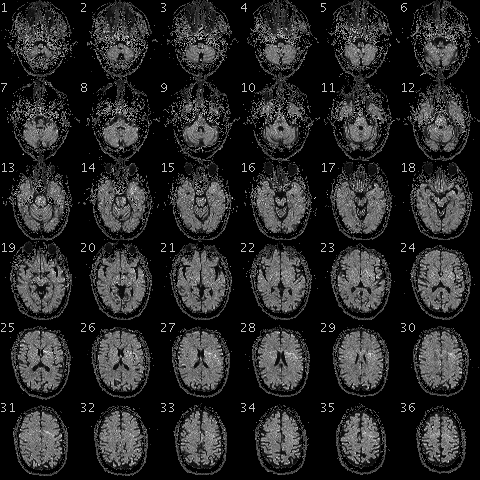
The raw material came from functional magnetic resonance imaging (fMRI), which tracks the flow of oxygenated blood through the brain to show which regions are active at any given moment. Irani’s team trained its AI on publicly available data from eight volunteers, each of whom had viewed about 9,000 images while lying in a high-resolution scanner.
The decoder works on two tracks at once. One branch predicts the image’s structure, such as where the colors are and how objects are arranged. The other predicts the content, such as a bunch of bananas on a plate. A diffusion model, the same type of AI used by popular image generators, combines the two predictions into a picture.
The team’s key innovation solved a data shortage. Brain scans are expensive and scarce, so the researchers built a second tool that works in reverse: an encoder that predicts what a person’s brain activity would look like when viewing any given image. Using the encoder and decoder together, the team could train its system on images no volunteer had ever seen. About 70 percent of the training data came from such images.
The result is a “universal” system that adapts to a new person quickly. Earlier tools needed about 40 hours of brain scans from each new subject. Brain-IT needs one. “What’s more, while every other model requires dozens of hours of brain scans to learn to ‘read’ a new person, our model needs only one hour,” Irani told the Daily Mail.
What It Cannot Do
The system has clear limits, and Irani is open about them. It reconstructs images of a person actively looking at them, and it requires a willing volunteer to lie still inside an MRI machine, which typically costs $600 to $1,000 an hour to operate. It still makes mistakes. Irani showed MIT Technology Review a cake that her system reconstructed as a pile of three sandwiches, and a dog in a bathtub that came out as a similarly colored goat in a bathtub. She called the popular “mind reading” label a cute, jazzy name for what the system does.
Reconstructing thoughts, memories, or dreams remains out of reach. Irani hopes to move next to video and audio, and eventually to imagined scenes and dreams. She acknowledged that the system cannot do that yet.
The potential uses are medical. Irani hopes the technology will one day allow patients who are “locked in,” fully paralyzed but conscious, to communicate through their brain activity alone. It could also help researchers understand conditions such as PTSD by showing what a flashback looks like.
Excitement and Unease
Outside experts greeted the work with admiration and caution. Judy Illes, a neuroethicist at the University of British Columbia, called it “magnificent.” Tommy Sprague, a neuroscientist at the University of California, Santa Barbara, praised the results and warned that a way to extract a person’s thoughts without consent would make decades of science fiction come true. Marcello Ienca, a neuroscientist and philosopher at the Technical University of Munich, said the real turning point will come if similar decoding moves from MRI scanners to EEG, the caps of electrodes that read the brain’s electrical signals. Once an EEG device is calibrated to one person, he warned, companies could extract more information from that person’s brain without consent, and courts might one day accept reconstructed mental images as evidence.
Irani acknowledged that the technology could be misused if it moves to EEG. She told MIT Technology Review that, for now, she tries to think only of the good it can do.
A Nation of Brain Science
Brain-IT is one breakthrough in brain science, a field where Israel has become a world leader across research labs, startups, and the Defense Ministry.
In August, the Times of Israel reported on Hemispheric, an Israeli startup co-founded by Gidi Littwin, a co-inventor of Apple’s Face ID, and computational neuroscientist Hagai Lalazar. The company built an AI model called Descartes and trained it on more than 250,000 hours of brain recordings from 100,000 paid volunteers in Asia, Israel, and Boston. Patients wear a dry EEG headset, shaped like a bicycle helmet, for 15 minutes while playing game-like tasks on a tablet. The goal is diagnosis: measuring brain health objectively to help doctors treat PTSD, depression, Parkinson’s, and Alzheimer’s. Hemispheric recently raised $52 million and plans to seek FDA approval for its PTSD application early next year. Dr. Nirit Lev, head of neurology at Meir Medical Center in Kfar Saba, cautioned that the technology is still unproven. “EEG captures only the scalp, and only some parts of the brain,” she told the Times of Israel.
Israel’s defense establishment is working in the same field. In February, Dr. Alona Barnea, director of the Neurotechnology Division at the Defense Ministry’s research and development directorate, told a Tel Aviv tech conference that Israel is developing brain-computer interfaces to enable a soldier to operate unmanned systems via neural signals. “We are working on using the brain to communicate with drones,” she said, as reported by Calcalist. Her team is also researching AI “digital twins” modeled on individual commanders’ brain activity and decision-making.
Israeli startups are pursuing the same goal for both military and medical uses. National Defense Magazine reported in March 2025 on Israeli companies presenting non-surgical alternatives to Elon Musk’s Neuralink brain implant at a defense forum in Tel Aviv. Developers call the technology “silent speech,” a way for a person wearing sensors to operate a device by intention alone. One of the companies, GrayMatters Health, received FDA clearance in 2023 for a brain-training treatment for PTSD.
Israel’s leadership in brain science is real, and it grows out of the same concentration of engineering talent that produced its leadership in cybersecurity, medical devices, and artificial intelligence. Every one of these projects depends on a willing user: a volunteer in a scanner, a patient in a headset, a soldier steering his own drone with his own brain signals. Reading the mind of an unwilling stranger is something none of them can do.
That distinction disappeared almost as soon as the Weizmann research hit the news.
“The Israeli Connection”
On October 12, Leo Hohmann, a veteran conservative journalist and longtime WND writer known for his pro-Israel reporting, published a piece on his Substack newsletter titled “The disturbing advancement of AI ‘mind-reading’ technology and the Israeli connection everyone is afraid to talk about.”
Hohmann described the research accurately at first, then went much further. “In one hour, this technology can size up your brain patterns and reconstruct your thoughts,” he wrote. The system reconstructs pictures a volunteer is looking at inside an MRI scanner. It does not reconstruct thoughts, and its own developer says that remains out of reach.
Hohmann’s “Israeli connection” was the Weizmann Institute’s ties to Israel’s defense industry, which he wrote that other outlets had failed to mention. He warned that governments could use such technology to build a “department of pre-crime” and arrest people for their thoughts, or to interrogate prisoners of war. He then turned to the institute’s genomics and bioinformatics research and suggested it was the kind of work militaries pursue for genetic biowarfare.
Hohmann recounted Iran’s June 2025 ballistic missile strike on the Weizmann campus, which heavily damaged the campus and destroyed laboratories but killed no one. He asked why Iran had targeted the institute, and answered that some of its research “was being militarized.” He closed by warning that Weizmann’s work to read human thoughts could make Orwell’s 1984 “look like child’s play.”
The readers’ comments took it further still. One commenter tied the research to end-times prophecy, and another wondered whether it could affect people “wired with nanotech from the jabs.”
Hohmann raised a question serious scientists also ask. Neuroethicists quoted by MIT Technology Review warned about mental privacy and the risk of misuse, and they raised those concerns about the technology itself, wherever it is built. Hohmann’s piece pointed the danger specifically at Israel, a framing his own headline signaled. Similar brain-decoding research is underway at the University of Texas and other American institutions, and Elon Musk’s Neuralink is implanting brain chips in American patients.
Hohmann did not respond to a request for comment by publication time.
Sorcerers, Svengali, and Jinn
The libel attacking Israeli brain research is far older than the State of Israel. Jewish tradition credits King Solomon with dominion over spirits. The Talmud (Gittin 68a) tells how he captured Ashmedai, king of the demons, to help build the Temple. Islamic tradition expanded the idea. The Quran describes jinn laboring for Solomon, and Muslim commentators have read one verse (2:102), which speaks of sorcery taught “in the reign of Solomon,” as an accusation against the Jews. A legend about a righteous king became, in the hands of Israel’s enemies, a permanent Jewish skill in the occult.
Medieval Christian Europe built that legend into a full libel. In his 1943 study The Devil and the Jews, the American rabbi and historian Joshua Trachtenberg documented how Christians came to see Jews as agents of Satan who poisoned wells, desecrated the communion wafer, murdered Christian children for their blood, and practiced black magic. Kabbalah, the Jewish mystical tradition, was recast as witchcraft. Jewish physicians were suspected of using secret knowledge to harm their Christian patients.
In the 19th century, the charge moved from magic to psychology. George du Maurier’s bestselling 1894 novel Trilby introduced Svengali, a sinister Jewish musician who hypnotizes an innocent young woman and completely controls her. His name entered English as a term for a manipulator. Less than a decade later, the Protocols of the Elders of Zion, a forgery produced in Tsarist Russia, described a Jewish plan to rule the world by controlling the press and public opinion. The Nazis condemned psychoanalysis as “Jewish science” because Sigmund Freud and many of his followers were Jews. Conspiracy theorists still point to Freud’s nephew Edward Bernays, the father of modern public relations, whose 1928 book was titled Propaganda.
The Islamic Republic of Iran has revived the oldest form of the charge. In a 2014 broadcast on Iranian state television, cleric Valiollah Naghipourfar was asked whether Israel used jinn, the spirits of Islamic tradition, to gather military intelligence. He said yes, adding, “The Jew is very practiced in sorcery.” In a March 2020 televised address, Supreme Leader Ali Khamenei claimed that “the Jews are experts at sorcery” and that Israeli and Western intelligence services use the occult and jinn for espionage. Ali Akbar Raefipour, director of Iran’s Masaf Institute, has claimed that the Mossad maintains “supernatural units” that wage psychic warfare and read minds. After Israel killed Hezbollah leader Hassan Nasrallah in September 2024, Iranian cleric Mostafa Karami said on television that the IDF had harnessed jinn, which he claimed the Jews have used since the days of David and Solomon.
In July 2025, after the Twelve-Day War, Abdollah Ganji, a former editor of the IRGC-linked newspaper Javan and an adviser to Tehran’s mayor, told his 150,000 followers on X that sheets of paper bearing “talismans with Jewish symbols” had been found on the streets of Tehran. Some Iranians pushed back. Former government spokesman Abdollah Ramezanzadeh said that talk of Jewish talismans and jinn was an attempt to downplay the role of infiltrators and the enemy’s real tactics. The Mossad’s Persian-language account on X, as described by the Jerusalem Post, answered Ganji with one line: “Using drugs and talking to the jinn are not desirable traits for someone leading a country.”
Ramezanzadeh identified the function of the myth. Israel penetrated Iran’s military, nuclear program, and leadership through intelligence work, and the sorcery story explains away that failure. The Jewish state’s real achievements become proof of supernatural power.
The West has its own chapter in the story, and it belongs to the United States. For more than 20 years, the US military ran a secret program at Fort Meade, Maryland, training “remote viewers” to spy psychically on Soviet sites. The program grew out of CIA-funded experiments at the Stanford Research Institute in the early 1970s, and one of the first subjects tested was a young Israeli performer named Uri Geller. The program was shut down in 1995. Geller has spent five decades hinting at secret psychic missions for the Mossad and others, none of them documented, and in 2025 he told the Jerusalem Post that the Iranian official who accused Israel of using occult forces was “basically right.” The only government proven to have spent years and millions of dollars on psychic espionage was the American one.
The Bible reserves the power to see inside the human mind for God alone:
“I the LORD search the heart, I try the reins, even to give every man according to his ways, according to the fruit of his doings.” (Jeremiah 17:10)
The Hebrew word for “reins,” kelayot, literally means “kidneys,” which, in biblical idiom, stand for a person’s innermost thoughts and motives. The people accused for two thousand years of sorcery and mind control are the people whose Bible first outlawed sorcery and declared that only the Creator can read a human heart.
“The Laboratory”
In Western activist and academic circles, the same accusation now arrives in the language of technology and human rights.
In March 2025, +972 Magazine, Local Call, and The Guardian reported, citing anonymous Israeli security sources, that Unit 8200, the IDF’s elite signals intelligence unit, was building a ChatGPT-style language model trained on intercepted Arabic conversations. The IDF declined to address the specifics, saying only that any use of technological tools goes through a rigorous professional process. Quoted in the report, Nadim Nashif, founder of the Palestinian digital rights group 7amleh, said Palestinians “have become subjects in Israel’s laboratory” for weaponizing AI. The image of Israel as a “laboratory” for technologies of control has become a genre of its own, with books and conferences built around it. The same report acknowledged, in passing, that the CIA and British intelligence agencies are building similar AI tools.
In May 2024, the European Institute of the Mediterranean (IEMed), a Barcelona think tank whose governing consortium includes the Spanish Foreign Ministry, the Catalan government, and Barcelona’s city council, published “Israel’s Technology of Oppression” by anti-Zionist activist Shir Hever. The paper built on real investigations into Israeli spyware and private disinformation firms, then made a sweeping leap: when private companies sell surveillance-driven disinformation, Hever wrote, “it almost exclusively involves Israeli companies.” He also asserted that Israel spends as much on disinformation as on explosives. Commercial spyware is a global industry, and firms from Italy, Germany, and Britain sold intrusion tools to governments for years. The same paper presented as fact the claim that Israel bombed Gaza’s Al-Ahli hospital in October 2023, a claim that US, British and French intelligence assessments, along with Human Rights Watch, attributed to a misfired Palestinian rocket.
Eran Toch, a Tel Aviv University researcher who studies privacy and technology, has warned about exactly this pattern. Portraying Israel as the epicenter of inhuman AI, he said, “repeats centuries-old anti-semitic tropes that connect Jews, technology, and oppression.”
Israel’s own media and supporters sometimes supply the raw material. A 2014 Haaretz science story about Ben-Gurion University research on how the jewel wasp turns cockroaches into “zombies” ran under the headline “Israeli Scientists Unlock Secret of Mind Control,” with “in Zombie Cockroaches” tucked at the end. A February 2026 Jerusalem Post opinion piece celebrated Israeli “neuro-warriors” and “cognitive dominance.” Each phrase is harmless in context and ready-made for anyone who wants to crop it.
The Mind Belongs to Its Owner
The Weizmann Institute’s breakthrough is a computer program that, with a willing volunteer lying in a scanner, can sketch a reasonable copy of the photograph that volunteer is viewing. Its developer hopes it will one day let paralyzed patients speak and help doctors see what a PTSD flashback looks like. Asked about misuse, Michal Irani told MIT Technology Review that she tries to think only of the good the technology can do.
The accusation that Jews secretly control minds was invented long before anyone could scan a brain. It has been told about Solomon’s demons, about medieval Jewish doctors, about a fictional hypnotist named Svengali, about Hollywood and the press, about jinn in Tehran, and about spyware in Barcelona think-tank papers. Each generation hands it a new tool. This month, Israel’s enemies were handed a real one, a brain scanner built in Rehovot, and some of Israel’s friends helped load it.
The questions about mental privacy are legitimate, and they apply to every laboratory and every government on earth. The Jewish people answered the question of who may look inside a human heart more than 2,500 years ago. The answer was written in Jeremiah: the Creator alone.